A Call To The Remnant

Scottish Warriors for Christ- http://www.facebook.com/acalltotheremnant

Posts Tagged ‘beauty from the ashes’

Testing and Faithfulness

Posted by appolus on May 21, 2026

There is an unfathomable mercy in the way God deals with men. We enter our lives in Christ with our plans, our expectations, our presumptions about ourselves, our strengths, our usefulness, even our spirituality. Yet sooner or later the hand of God permits the furnace, the trials and the tribulations and all the confidence of the flesh, often masquerading as spirit, begins to collapse beneath the weight of an often crushing reality.

Scripture declares, “The Lord tested Abraham” not to destroy him, but to reveal what could only be wrought through trial. The great saints were not men preserved from breaking; but, through brokenness, they were led into a deep fellowship. Much is spoken about victory, but very little about the wildernesses through which God forms a man.

Moses is not merely led into the wilderness, he is led to “the back of the desert.” There, stripped of ambition, hidden from the eyes of men, he encounters God in the fire. Typically, its in the fire, that the Lord can truly reach us. And there the Lord speaks the only promise that ultimately matters: “Certainly I will be with thee…….and this to you will be a sign.” (Exodus 3:12 NKJV).

The tragedy of modern Christianity is that many seek the promises of God without desiring the awful (full of awe) presence of God. Yet the true servant of God reaches the place where even the promised land itself means nothing apart from Him.

Moses stood before the Lord after Israel had fallen into corruption and idolatry after only 40 days, and when God declared that He would send an angel before them, Moses answered with holy boldness: “If Your Presence does not go with us, do not bring us up from here” (Exodus 33:15 NKJV).

That is the language of a man who has gone beyond religion, beyond ministry, beyond ambition, and has discovered that God Himself is the inheritance. Moses himself would not enter into the promise. In the end, for Moses, it was not about the promise, rather, it was about the presence. Can we say that? Or to one degree or another is our relationship with God still transactional?

Moses and David stand before us as two broken men stripped of every confidence except the mercy of God. Moses stands amidst the ashes of Israel’s idolatry, with judgment hanging over the camp, and does not presume upon previous promises, but ratger cries out and appeals to the mercy of God “If I have found grace in Thy sight, show me now Thy way.” He does not demand the presence of God because Israel had been chosen, nor because he is their appointed leader. He pleads as a man conscious that unless God Himself goes with them, then none of the journey has any true meaning.

David also understandsthis. Before the throne, before the crown, before the full appearing of the promise, there was the long years in the wilderness. The rejection. The persecution….the testing….and then…. Ziklag, that dreadful place where everything had turned to ashes.

Scripture says, “David and the people who were with him lifted up their voices and wept, until they had no more power to weep” (1 Samuel 30:4 NKJV). He cried until there were no tears left to cry. And even his own men, those broken rebels and rejects, who had followed him, spoke of stoning him. Yet there, in that crushing hour, “David strengthened himself in the Lord his God” (1 Samuel 30:6 NKJV).

Later, in the hour of Absalom’s rebellion, David flees Jerusalem barefoot and weeping beneath the shadow of his own failure and the rebellion of his son. Yet when the priests bring the ark to follow him into exile, he refuses to cling even to that sacred symbol. “Carry the ark of God back into the city. If I find favor in the eyes of the Lord, He will bring me back” (2 Samuel 15:25 NKJV). There is something profoundly beautiful in that surrender. There is in both men the same holy trembling before God, the same refusal to presume upon divine mercy.

Neither man attempts to compel heaven by office, anointing, history, or sacred things. Moses cries for the presence of God; David leaves the ark behind. Both understand that the outward symbol is empty if the Lord Himself withdraws. This is the profound difference between true faith and religious presumption. Presumption demands that God stand with man because of position, ministry, inheritance, doctrine, or past experience.

But the man who has truly seen God no longer bargains with Him. He casts himself wholly upon mercy. Moses pleads, “Show me Thy way.” David says, “Let Him do to me as seemeth good unto Him.” Here is the deep work of the cross in the soul, a man emptied of self-defense, stripped of spiritual pride, no longer seeking to use God, but surrendering himself utterly to Him.

And this is where grace is truly discovered. Not in the triumph of self-confidence, but in the collapse of it. Not in demanding that God vindicate us, but in yielding ourselves to His sovereign will. David does not defend himself before God, Moses does not presume upon Israel’s standing.

Both stand upon mercy alone. Such men discover that grace is not merely God giving blessings , it is God giving Himself. For when every outward support is shaken, when religious certainty, symbols, strength, and reputation are stripped away, the soul discovers that its only hope has always been the presence of God Himself.

And this is the mystery few understand until they walk through suffering themselves: there are revelations of grace that cannot be discovered in ease. The Apostle Paul speaks of “the power of Christ” resting upon him in weakness (2 Corinthians 12:9 NKJV). Not merely visiting him, not giving him fleeting moments of blessing, but resting upon him.

The Greek word carries the idea of Christ’s power tabernacling over a man , spreading itself over him like the holy covering of God. It is the presence of God coming down and abiding, like the cloud over the tabernacle, like the fire in the wilderness. There is a communion found only in the fire, where the clouds descend low upon the soul and the presence of God becomes more real than earthly comfort, reputation, or success.

I know something of this myself. In the midst of stage four cancer, with my body ravaged by disease and chemotherapy, the power of God came down and rested upon me. I was not merely touched by a passing sense of His nearness; I walked in the cloud of His presence by day. I walked in the fire of His glory in the night watches. I discovered grace not as a doctrine, but as a living, sustaining, overshadowing reality. It was a masterclass in grace, and I would not trade that holy nearness for anything this world could offer.

The three Hebrews discovered this in Babylon, for it was only in the furnace that they found “One like the Son of God” walking in the midst of the flames (Daniel 3:25 NKJV). And so the saint learns at last that the ultimate gift of God is not escape from the trial, but Himself in the midst of it. “When thou passest through the waters, I will be with thee… when thou walkest through the fire, thou shalt not be burned” (Isaiah 43:2 KJV). That is the inheritance of the tested man: not the absence of suffering, but the abiding presence of God in the midst of it.

Scriptures: Exodus 3:12; Exodus 33:12–17; Exodus 34:8–9; 1 Samuel 30:4–6; 2 Samuel 15:24–26; Psalm 51:16–17; 2 Corinthians 12:9; Daniel 3:25; Isaiah 43:2.

Posted in Christian, christian blog, christian living, Christianity, Daily devotional, Devotions, Frank McEleny, inspirational, intimacy, Jesus, revival, testimony, the crucified life, the deeper life, the gospel, the remnant, The State of the Chuch and Manifest presence | Tagged: , , , , , , , , | 4 Comments »

SPIRITUAL INDIGESTION

Posted by appolus on May 16, 2026

There are foods I used to eat in my youth growing up in Scotland that seemed to carry very little consequence. Rich foods. Greasy foods. Things deep fried in oil and soaked with heart clogging grease. They tasted very good going down, and for many many years I was “strong,” enough to bear the effects.

As I got older I compensated. I kept medicines nearby. Tums, Pepto Bismal and so on. I would take something before the meal and then something afterward to manage the indigestion which was getting worse. I learned to manage the consequences while still indulging the appetite.

But time has a way of exposing reality.

Eventually my body no longer tolerated what once seemed harmless. The medications lost their power to shield my system from the effects. I had my Gall Bladder taken out. What once brought pleasure began to bring immediate distress. I came at last to a simple conclusion: “I cannot eat this food anymore.” Not because the food ceased to taste good, but because the cost became too great and was often immediate.

So it is with the flesh.

There are indulgences of the old nature that I may have tolerated in earlier years of spiritual life. Words spoken in pride. Reactions born of self. Ambition clothed in spirituality. Vanity. Bitterness. The subtle and oftentimes less than subtle exaltation of self. For many seasons these things may have appeared manageable. The conscience was disturbed, yet not deeply enough to produce true abandonment. I continued indulging the flesh to one degree or another while attempting to quiet the inward consequences through religious activity, self delusion, explanations, emotion, or outward devotion.

But the Holy Spirit is faithful.

As Christ gained ground within me, the inward man become increasingly sensitive. What once scarcely registered now grieved my soul almost immediately. A wrong spirit leaves an inward bitterness. A spiritual indegestion. A careless word clouds fellowship with God. A movement of pride becomes unbearable to the heart that longs for Christ alone.

This is one of the marks of true spiritual growth.

The worldly man sins freely because he feels little. The immature believer can still indulge the flesh while imagining recovery will come easily. But the man who walks with God discovers something terrible and wonderful at once: the flesh and the spirit can never dwell together in peace. Quenching the Holy Spirit has real consequences in our lives.

The deeper life…. is not learning how to better manage the flesh. It is coming to the Cross concerning it.

There comes a point where I no longer ask, “How far may I go and still recover?” but rather, “How may Christ be fully formed within me?” And to be honest, I never once thought “how far may I go,” but in practice it amounted to the same thing.

For the Spirit of God does not merely oppose the outward acts of the flesh; He wars against its very principle. Self-life in all its forms must eventually come under the sentence of the Cross.

And thus I have learned, often painfully, that some things simply cannot continue. Not because they are no longer pleasurable to the natural man, but because they now wound the inward fellowship with Christ too deeply to be tolerated. The pleasure one gets out of indulging the flesh, has ever diminishing rates of return for the man or woman who is determined to walk in the depths with the Lord.

“For the flesh lusteth against the Spirit, and the Spirit against the flesh: and these are contrary the one to the other.”
— Galatians 5:17

Posted in Christian, christian blog, christian living, Christianity, Daily devotional, Jesus, remnant church, spiritual growth, testimony, the crucified life, the deeper life, the gospel, the persectuted church, the remnant | Tagged: , , , , , , | 2 Comments »

SOUL FOOD-TAKING THOUGHTS CAPTIVE

Posted by appolus on April 20, 2026

Our small house church is reading a book by George Watson entitled “Soul Food.” I highly recommend it. It is really about the battle against self, and taking up the cross. I actually wrote this a number of years ago, but the issues of the heart never really change.

2Co 10:5 Casting down imaginations, and every high thing that exalteth itself against the knowledge of God, and bringing into captivity every thought to the obedience of Christ;

It’s a terrible thing to be held captive by our own thoughts. How exhausting it can be when we allow them to consume and overwhelm us? Its the voice of self. Self always has a victim, typically itself, and a perpetrator. It lifts itself up, and tears others down while burning every bridge.

The thoughts of self begin to eat away at us. They rob us of sleep and leave us tired and weary and walking the floor at night. Self, our own self, is our deadliest enemy, and typically it morphs into self-righteousness. Look at me Lord, I am not as wicked as these others. They should be more like me. There is no justification in this.

I thank the Lord that He freed us and gave us the ability to take every thought into captivity and focus on Him. You can always tell when a saint is focused on the Lord, they elevate Jesus, they lift up, they do not tear down.

If a specific situation or trial has taken hold of your mind today, know that there is a way of escape. You are no longer slaves to the flesh, no longer slaves to your own thoughts. Our own thoughts and “imaginations,” elevate us and sit us on the throne of our own hearts.

If you have been set free by the Lord then you are free indeed. You now have the power to take those thoughts captive; they must bow to the Spirit of God in you. You will know this man because he is humbled in his own sight and his cry will be “be merciful to me.” The other man will loudly tell you what he has and is doing.

“Come to Me all you who labor and are heavy laden, and I will give you rest. Take My yoke on you and learn of Me, for I am meek and lowly in heart, and you shall find rest to your souls. For My yoke is easy, and My burden is light.” (Matt. 11:28-30)

Posted in christian blog, christian living, Christianity, Daily devotional, Devotions, Frank McEleny, Jesus, remnant church, revival, the crucified life, the deeper life, the gospel, the persectuted church, The presence of God, the remnant, The State of the Chuch and Manifest presence, the state of the church | Tagged: , , , , , , , , , | 1 Comment »

Hireling versus Shepherd

Posted by appolus on February 6, 2026

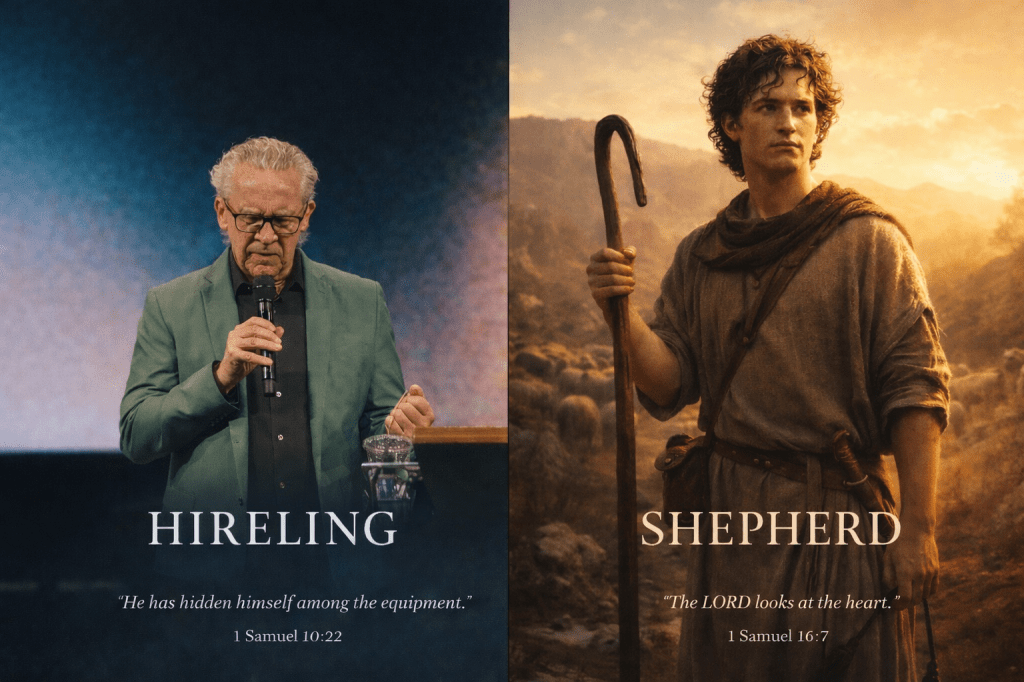
There is a profound contrast in Scripture between Saul and David, and it is not merely the difference between two kings, but between two kinds of men, two kinds of callings, and two kinds of authority.
Saul is chosen by men. He fits the visible criteria. He is tall, impressive, outwardly commanding. He looks like a king. Yet when the moment comes for him to step into what God has spoken, he is found hiding among the equipment. The one selected to lead is crouched among baggage.

He has already spoken of his small tribe, his insignificant family, and while those words sound humble, they reveal a man measuring himself by human categories and shrinking beneath the weight of them. His humility is not rooted in trust, but in fear. When pressure comes, he preserves himself.

David is altogether different.

David’s story does not begin on a battlefield or in a palace, but in obscurity. He is the youngest. He is forgotten by his own father when Samuel comes to anoint a king. Yet long before any man sees him, the eye of the Lord is already upon him.

Scripture reminds us that God knows His own before they ever draw breath, that He forms them and calls them while they are yet in the womb. David is such a man. The hand of God, the presence of God, and the purpose of God are upon him from the beginning.

This is no man hiding among the equipment.
While Saul hides, David fights. While Saul shrinks from visibility, David embraces responsibility. Alone in the fields, with no audience and no reward, David lays his life on the line for the sheep.

When the lion comes, when the bear comes, David does not calculate his odds. He does not preserve himself. He runs toward danger, because something in him already understands what it means to be a shepherd. The sheep matter more than his own safety.

This is the true shepherd, contrasted with the king men choose.

Men look for height, strength, charisma, and persuasive speech. God looks for the heart. Men crown what impresses them outwardly. God entrusts authority to those who are faithful inwardly. Saul is anointed first, but David is formed first.

David’s courage does not begin after anointing, it precedes it. His confidence is not in himself, but in the Lord who has already delivered him before anyone was watching.

This distinction is not confined to ancient Israel. It is painfully relevant today.

In every generation, men continue to choose leaders who are tall, handsome, articulate, and compelling. They gather crowds, build platforms, and command loyalty. Yet many have never been touched or shaped by the Spirit of God in secret. They are appointed by men, affirmed by numbers, and sustained by applause.

When the crux of the matter comes, when the cost is high and the wolves are near, they preserve themselves. They protect the institution, the reputation, the platform, rather than laying down their lives for the sheep.

David stands as God’s rebuke to this pattern.
God is not impressed by appearance. He is not moved by charisma. He does not entrust His flock to those who hide when the cost becomes personal. He looks for shepherds who have already proven, in hidden places, that they will bleed for what is His. He looks for hearts that run toward danger when others retreat, for men who fear God more than visibility, and obedience more than survival.

The tragedy of Saul is not that he was small.
The glory of David is not that he was strong.
The difference is this: Saul belonged to himself.David belonged to God.

And that difference still determines everything.

Posted in Babylon, Christian, christian blog, christian living, Christianity, consequences of sin, Daily devotional, Devotions, end times, End Times Eschatology, False Prophet, False Prophets, False Prophets and Teachers, false teachers, Greedy Shepherds, heresy, Jesus, Kansas City Prophets, Modern church critique, New Apostolic Reformation, Patricia King, Paul & Jan Crouch, prostitutes, Spiritual warfare, testimony, the crucified life, the deeper life, the gospel, the persectuted church, the remnant, The State of the Chuch and Manifest presence, the state of the church, watchmen | Tagged: , , , , , , , , , , , , , , | 2 Comments »

The ground upon which the Lord works, is Holy Ground.

Posted by appolus on February 4, 2026

I was speaking with a brother the other day, a man seasoned by many years. He has been a pastor for more than three decades and also served for many years as a police officer. Before all of that, he once drove a concrete truck.

He told me about a day in Texas when the truck broke down while carrying ten yards of concrete. The drum stopped turning. Time passed, and before the load could be poured, the concrete had set solid inside the bowl. It took him nearly a week with a jackhammer to break it free. Concrete must keep moving until it is ready to be laid, otherwise it hardens without mercy and becomes unusable.

So it is with our hearts. When the Spirit’s work is resisted, delayed, or neglected, what was meant to be formed and poured out becomes hardened instead. What should have been usable for God’s purpose becomes difficult to break and costly to restore.

He spoke about the slump. Concrete must meet a precise measure. If it does not rise to the required standard, the entire load is rejected and discarded. There is no partial acceptance. If it does not meet the specification, it cannot be used.

So it is with the work God is doing in us. God does not measure by appearance or intention, but by what meets His standard. What does not rise to the measure of obedience and faith cannot be blended in or excused, it must be dealt with before the work can continue.

I shared with him what I had learned in construction. Samples are taken from the pour, allowed to harden, and weeks later crushed beneath great pressure. Only then is its strength revealed. Only then is it known whether it can bear the load for which it was made.

So it is with our faith. What God has formed in us is not proven in comfort, but under pressure. The crushing does not create the strength, it reveals whether the strength is truly there to bear the weight God has assigned.

There is also the matter of composition. Water, sand, aggregate, and cement must all be present, and each must be measured carefully. Too much or too little of any one part weakens the whole. The mixture determines the endurance.

So it is with the life God forms in us. Truth, obedience, suffering, grace, and patience each have their place, and none can be removed without consequence. When we favor one at the expense of the others, the strength of the whole is compromised, and what remains cannot endure the load it was meant to bear.

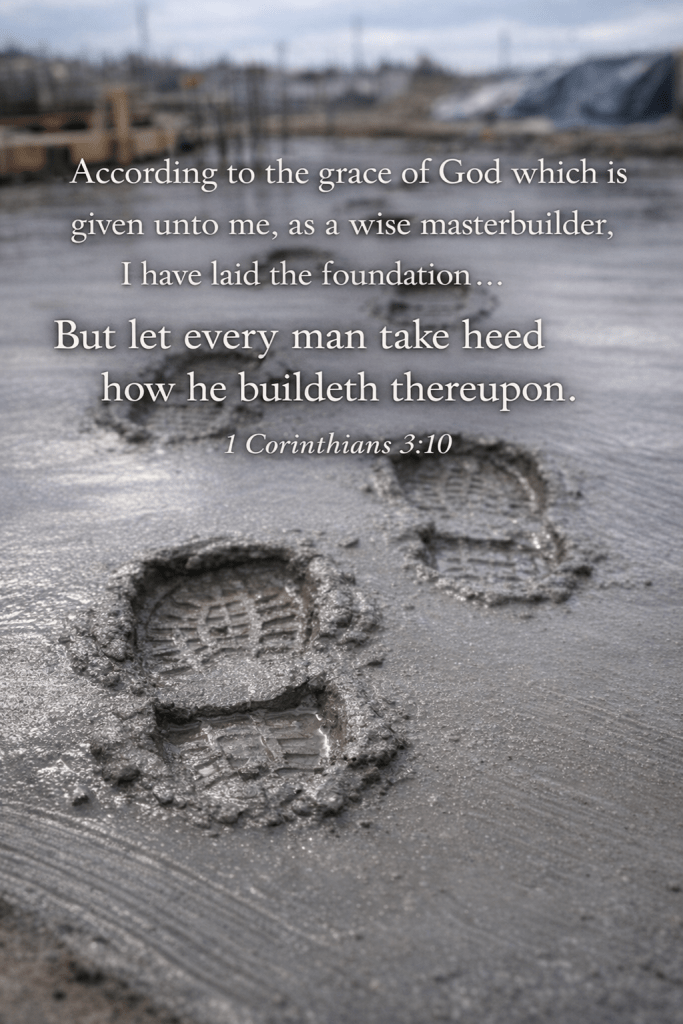
He then spoke of the freshly poured surface, smooth and carefully troweled. Sometimes someone comes walking toward it. You can see it happening and men shout warnings, but at times the person keeps going and walks straight through the concrete.

When that happens, the work is ruined. Either it must be torn up and done again, or the footprints remain forever, a permanent mark where none was meant to be.

Here the lesson becomes clear. When the Lord is doing a work, it is holy ground. When He is forming, shaping, and strengthening something, it is not to be trampled by careless feet.

God determines the mixture of our lives. He measures joy and sorrow, strength and weakness. He allows the testing and the crushing, not to destroy us, but to reveal whether we can bear the load appointed to us.

The strength that grows in us is not accidental, and the endurance is not self-made. It is the result of a careful and deliberate work of God. And even then, He does not leave us to carry the load alone. He bears it with us.

Posted in Christian, christian blog, christian living, Christianity, Daily devotional, Devotions, Jesus, remnant church, revival, testimony, the crucified life, the deeper life, the gospel, the remnant, The State of the Chuch and Manifest presence | Tagged: , , , , , , , , | 1 Comment »

Philip Yancey- Cautionary Tale

Posted by appolus on January 10, 2026

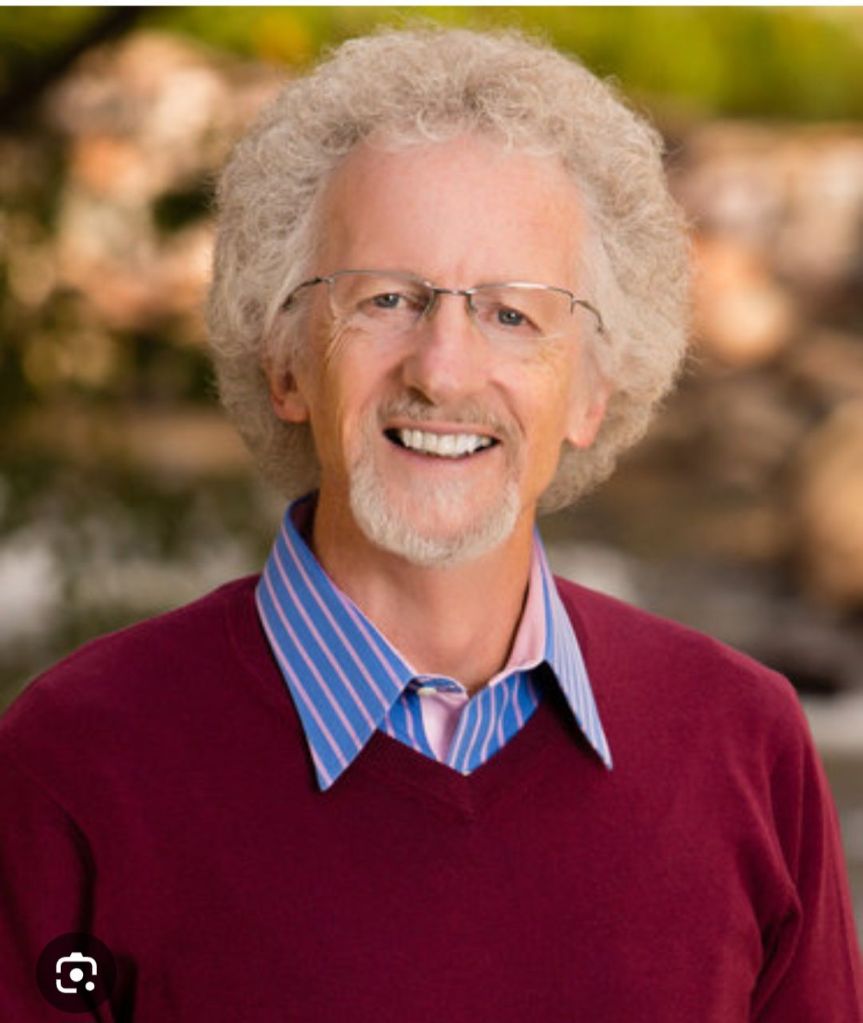
Phillip Yancey ……..

I am less interested in his fall than I am in the response. Many who have read anything I have written over the years will note, much of it has been on grace, and of course, Phillip had much to write on that subject. This is my response to much of what I hear, and much of what I hear plays into “cheap grace,” and it’s multiple shades.

Grace That Saves vs. Grace That Reigns: A Cautionary Reflection

The issue before us is not whether sin is real, nor whether grace is necessary. Scripture is clear on both. The question is what kind of grace we are talking about, and what kind of Christianity it ultimately produces.

In recent years, public moral failures among respected Christian figures have often been framed almost exclusively as inevitable expressions of “shared human brokenness.” While this language sounds humble, it subtly shifts sin from a moral failing into some kind of inevitable human failing. In doing so, it does not merely acknowledge weakness, it lowers the expectation of transformation for the redeemed.

Scripture never denies that believers can sin. But it emphatically denies that sin remains our identity, our default, or our governing power.
“How shall we who died to sin still live in it?” (Romans 6:2)

When Christian theology repeatedly insists that believers are always on the brink of collapse, always fundamentally the same as before conversion, it may sound realistic, but it is not apostolic. It is Romans 7 isolated from Romans 6, and Romans 7 elevated over Romans 8. It treats ongoing struggle as the final word, rather than the cross, the resurrection, and the indwelling Spirit.

The familiar phrase “we are just sinners saved by grace” is often offered as a summary of humility, yet it is theologically inncorrect. Scripture does not primarily identify believers as sinners with an added provision. It calls them saints, new creations, those freed from sin, those led by the Spirit, those no longer under condemnation.

Grace in the New Testament is not merely pardon after failure. It is power for obedience. It is the power to overcome.
“For the grace of God has appeared… training us to renounce ungodliness and worldly passions.” (Titus 2:11–12)

When long-term, concealed patterns of sin emerge in the lives of Christian leaders, the appropriate response is not surprise, but neither is resignation. Scripture does not reduce such failures into “this is simply what humans do.” It speaks instead of accountability, sobriety, discipline, and, in some cases, disqualification.
“Be not many teachers, for you will incur a stricter judgment.” (James 3:1)

An extended pattern of deception is not merely a momentary lapse. It reflects a sustained resistance to conscience and to the sanctifying work of the Spirit. To explain such outcomes primarily in terms of “low anthropology” is to misdiagnose the problem. The issue is not that we expected too much of human nature, but that we expected too little of regeneration.

Grace does not erase distinctions between light and darkness, faithfulness and betrayal, maturity and self-indulgence. Nor does it dissolve moral responsibility under the banner of shared frailty.

The New Testament does not warn believers against being shocked so much as it warns them to be sober. It is not unspiritual to be sobered by contradiction between confession and conduct. It is a recognition that truth was professed while obedience was withheld.

Grace does not merely arrive after the wreckage. Grace, when obeyed, prevents the wreckage.
“The law of the Spirit of life in Christ Jesus has set you free from the law of sin and death.” (Romans 8:2)

To insist on this is not moralism, nor denial of weakness. It is fidelity to the gospel’s claim that sin no longer reigns, that believers are not trapped in inevitability, and that holiness is not exceptional but normative Christian life.

Grace that only forgives after the fall but never empowers before it is not amazing grace.
It is cheap grace.

And cheap grace inevitably reframes defeat as realism and victory as naïveté.

Posted in Christian, christian blog, christian living, Christianity, Daily devotional, Devotions, Jesus, revival, testimony, the crucified life, the deeper life, the gospel, the persectuted church, The presence of God, the remnant, The State of the Chuch and Manifest presence | Tagged: , , , , , , , | 7 Comments »

Is your mind redeemed?

Posted by appolus on October 14, 2025

“Let this mind be in you which was also in Christ Jesus.” (Philippians 2:5)

“For the weapons of our warfare are not carnal but mighty in God for pulling down strongholds, bringing every thought into captivity to the obedience of Christ.” (2 Corinthians 10:4–5)

In nature, when water flows over sandstone, it slowly carves a channel. At first it is shallow, but as the water continues, the groove deepens, until it becomes a permanent path. When the rain returns, it always follows the same course.

The human mind works much the same way. When we experience pain in the body, for example an injury to the elbow, the signal travels from the point of pain along a neural pathway to the brain. The more often that signal fires, the more established that pathway becomes.

In the same way, when someone wounds us through word or deed, a kind of spiritual signal travels from the point of the injury to the soul. Over time, that pain forms an inner pathway, a reflex of hurt, fear, or anger that becomes easier to travel each time it is triggered.

And so, just as the sandstone is shaped by the flow of water, the soul becomes shaped by pain. It cuts deep grooves into the inner life, and our thoughts begin to flow along those old tracks without effort. We do not even choose it, it becomes instinct.

Yet there is a remarkable truth found even in the world of medicine.Surgeons sometimes use a method called mirroring, where a patient focuses their attention on the healthy limb instead of the injured one. The brain begins to believe that healing is occurring in the damaged area, and the pathways of pain are slowly rewritten.

In the same way, Jesus is our healthy limb. When we take our eyes off our wounds and fix them on Him, we begin to heal. As we behold Him, His forgiveness, His grace, His mercy, we begin to mirror Him. We start to think as He thinks, to love as He loves, and to forgive as He forgave.

And this healing does not simply restore us to our original condition. It lifts us higher, it transforms us. For we are not merely conquerors over pain and sin, we are, as Scripture says, “more than conquerors through Christ Jesus.” (Romans 8:37)

Paul writes, “Let this mind be in you which was also in Christ Jesus.” (Philippians 2:5) This is an invitation to transformation, to a spiritual rewiring of our inner life. The Holy Spirit begins to pour living water through us, and slowly, the current changes course.

Where fear once ruled, trust begins to flow. Where bitterness dug deep, forgiveness takes root. Where sorrow carved its mark, peace begins to move like a river.

Paul also says, “Bring every thought into captivity to the obedience of Christ.” (2 Corinthians 10:5) Each time we catch a thought before it slides into the old groove, we redirect the flow toward Him. This is the renewal of the mind, the Spirit reshaping what pain once defined.

Each surrendered thought deepens a new channel of grace. Each moment of obedience erodes the old pathways of pain. Soon the soul begins to flow naturally toward Christ. The old grooves may still be visible, but they no longer control the current.

Ask yourself:
What grooves in my mind were carved by pain or fear?

Do I still let my thoughts run down those channels?

Or am I letting the Spirit redirect the flow toward peace, mercy, and faith?

Posted in christian living, Christianity, Daily devotional, intimacy, Jesus, revival, testimony, the crucified life, the deeper life, the gospel, the persectuted church, The presence of God, the remnant, The State of the Chuch and Manifest presence, the state of the church | Tagged: , , , , , , , , , | 5 Comments »

In the eye of the Storm

Posted by appolus on July 12, 2025

In the fierce heart of every storm, there lies a sacred stillness , a place untouched by the chaos that rages all around. That stillness is Christ. He is not on the edge, not watching from afar , He is at the very center, the calm within the tempest, the anchor of our souls.

When we run to Him, we do not escape reality , we enter into a deeper one. We step into perfect peace, not because the storm ceases, but because the Prince of Peace reigns within it. But if we flee, if we try to outrun the storm in our own strength, we hurl ourselves into its fiercest winds. The resistance grows, the fear swells, and we are battered by every gust.

Brothers and sisters, run to the center. Run to Jesus. For in Him, the storm loses its power, and the winds fall silent in the shadow of His presence. He prepares a table for us in the heart of every storm. He causes us to lie down in green pastures , beside still waters. He anoints us with oil and restores us. This goodness and mercy shall follow us all the days of our lives.

Posted in Uncategorized | Tagged: , , , , , , | 2 Comments »

Victory in Christ

Posted by appolus on April 12, 2025

Who, I ask you, who can separate us from the love of Christ?
Shall trial? Shall agony? Shall persecution or hunger or nakedness or danger or the edge of the sword?
It is written—For Your sake we are killed all the day long. We are accounted as sheep for the slaughter.

And yet—yet! In all these things, not outside of them, not after them, but in the very midst of them, we are more than conquerors through Him who loved us.

I am fully persuaded—utterly convinced—anchored with a faith that will not be shaken,
That neither death, nor life,
Nor angels nor demons,
Nor rulers nor tyrants,
Nor the present agony nor the looming shadow of the future,
Nor the height of ecstasy nor the depths of despair,
Nor anything that has ever been created in heaven or on earth or beneath the earth
—none of it, nothing—
shall be able to sever us, to tear us, to pry us loose from the love of God which is ours in Christ Jesus our Lord.

Oh, do you see it, saints?
We are more than conquerors—not just survivors, not merely enduring, but victorious with eternal weight—in every circumstance.

Whether clothed in splendor or stripped bare in affliction,
Whether seated in honor or cast into the pit of shame,
Whether celebrated or scorned,
Whether fed at a banquet or starved in a wasteland,
Whether on the mountaintop or in the furnace—we overcome.

And we do not boast in our own strength. No! We walk humbly before men when they praise us. And we fall humbly before God when they revile us. For in the kingdom of God, victory and defeat are not what the world claims they are.

The cross proves this.

For at the hour when Jesus hung stripped, beaten, nailed to a tree—when the world saw only ruin,
He was in fact winning the greatest victory ever known in heaven or on earth.
He triumphed over sin. He broke the power of death.
He shamed the powers of darkness and bore the full weight of the wrath of God.
And He did it not by avoiding the humiliation—but by embracing it, enduring it for the joy set before Him.

And now, because He conquered, we too conquer.

Because He stood, we stand.

Because He rose, we rise.

So let the sword come. Let famine rage. Let persecution howl. Let all hell be loosed against us.
We will not be moved.
For we are more than conquerors—not in ourselves, but in Christ Jesus, by the power of the Holy Spirit.

And nothing—nothing—shall separate us from His love.

Posted in Jesus, the crucified life, the deeper life, the persectuted church, the remnant, The State of the Chuch and Manifest presence | Tagged: , , , , , , , , , , , , , , | 3 Comments »

Beauty from the Ashes

Posted by appolus on September 3, 2014

What I love about the Lord our God is that He makes beauty from the ashes. Now, certainly it takes eyes to see what the Lord can and does do. When our eyes are on the Lord then darkness flees in the light of His beauty and whatever His beauty shines on becomes beautiful. When we look through the eyes of the flesh oftentimes all things are perceived darkly and in this there is no beauty. To praise God in the depths of the dungeon is a glorious thing, more glorious that praising Him on the mountaintops. See the power of God fall upon Paul as He praises God in the midnight hour in the depths of his afflictions.

There is a deep spiritual lesson here as we witness Paul praising God and being full of joy where there should be no joy. See the saints down through the centuries praise God in the depths of their situations, even as flames licked around their mortal bodies. Even when we walk through the valley of the shadow of death, God makes us to lie down in green pastures. He prepares a table before us in the presence of our enemies, in their presence mind you, and goodness and mercy and love and joy follow those saints all the days of their lives.

What a witness it is to the world to rejoice in God when nothing is going our way and we seem to have all the troubles and the burdens of the world on our shoulders, but of course, if we shall, we lay it upon His shoulders and we cast our cares upon Him and our burdens become light in the beauty and grace of His presence and there is rest for our souls. Paul would rather talk about his infirmities that God be glorified. May God be glorified in our own conversations with each other and the world.

Posted in Christian, christian living, Christianity, church of scotland, Daily devotional, Devotions, end times, Jesus, pentecostal, revival, the remnant, the state of the church, theology | Tagged: | Leave a Comment »