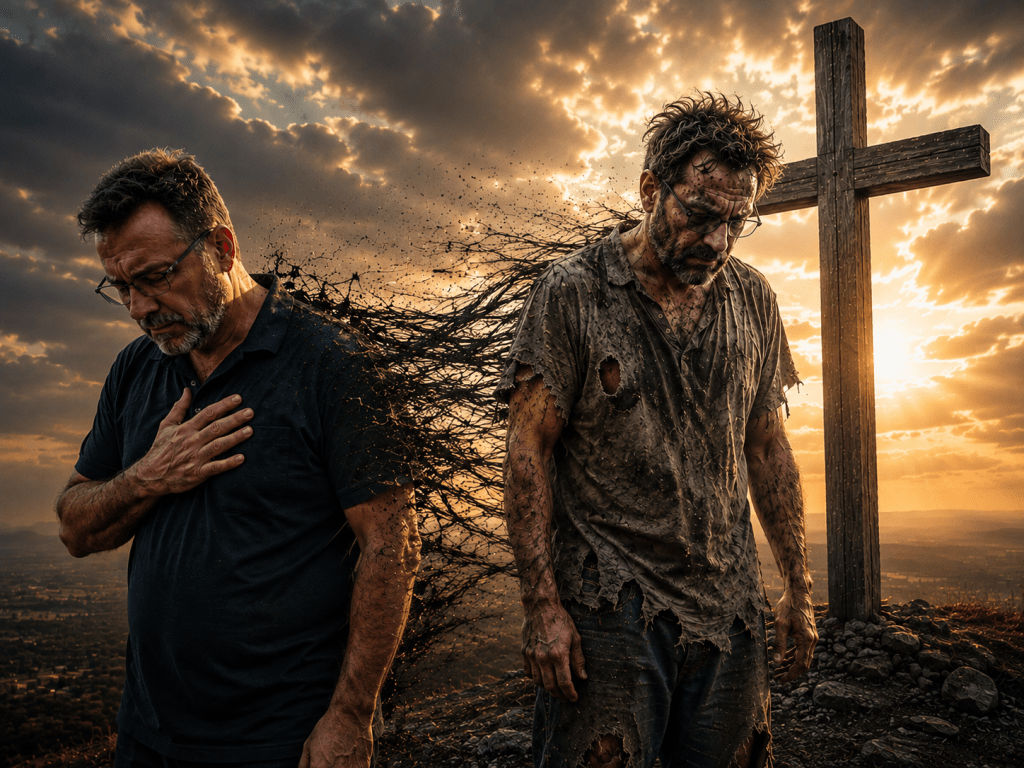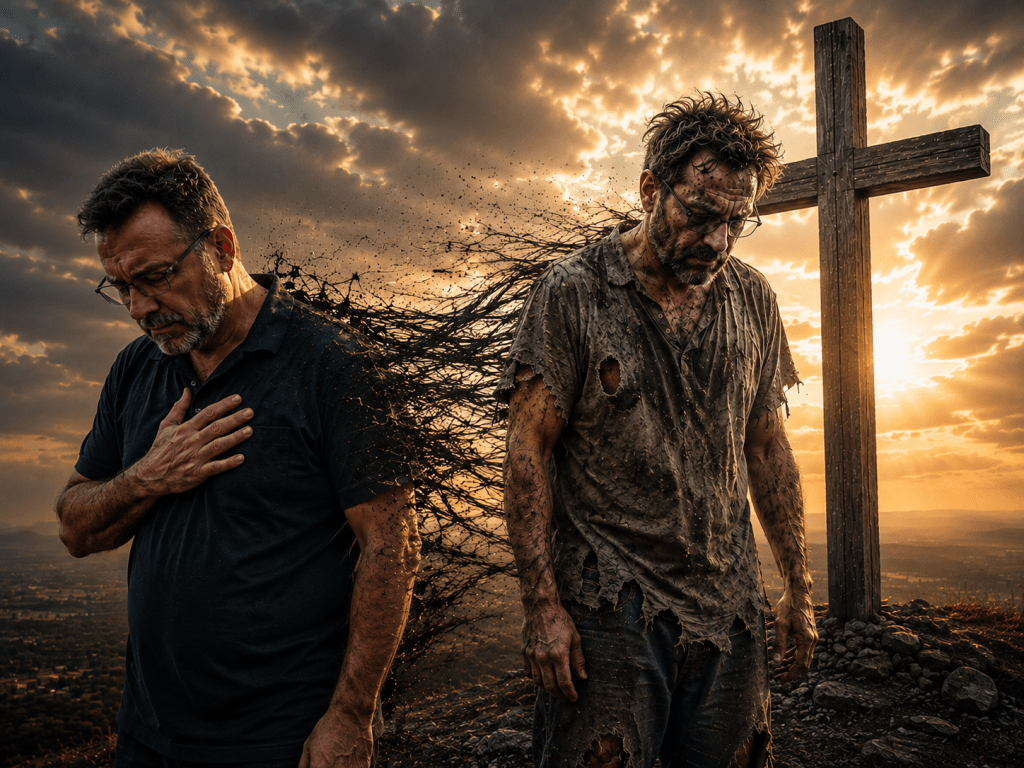
We often confuse the old man with the flesh, and they are the same thing. In teaching, this causes much confusion.
When I was born again at the age of 26, I went through a metamorphosis. I don’t mean theoretically or theologically. I mean in actuality. Before I surrendered to God, I knew exactly what that surrender would cost me. I knew that my life would no longer be mine. The man who was captain of his own soul would have to die. His captaincy, his authority over himself, his autonomy, his right to determine the direction of his own life, all of that had to be surrendered. That is precisely why I held back for so long. I had counted the cost. Then I surrendered, and that old man died. “Knowing this, that our old man was crucified with Him…” Romans 6:6.
Old Frank was gone. Crucified. Never to return. But Frank was still very much alive. My flesh didn’t disappear. My soul didn’t disappear. My memories didn’t disappear. My weaknesses, habits, appetites, emotions and all the consequences of 26 years of living under my own authority didn’t magically disappear either. What changed was who was Lord. Old Frank had been captain of his own soul. New Frank belonged to Christ.
And now new Frank had to deal with all of old Frank’s problems, but under an entirely different government: contained and directed by the Word of God, under the authority of God and by the direction and power of the Holy Spirit. That is sanctification.
This is why I see absolutely no contradiction between Romans 6, Romans 7 and Romans 8. The old man was crucified in Romans 6. The flesh and its inability are exposed in Romans 7. And Romans 8 reveals how the regenerated man now overcomes: through the power of the Holy Spirit.
Paul does not tell Christians that because the old man is dead there is therefore nothing remaining to overcome. Quite the opposite: “But if by the Spirit you put to death the deeds of the body, you will live.” Romans 8:13. And again: “For the flesh lusts against the Spirit, and the Spirit against the flesh; and these are contrary to one another…” Galatians 5:17. And therefore: “Walk in the Spirit, and you shall not fulfill the lust of the flesh.” Galatians 5:16.
Notice that Paul does not tell us the flesh no longer exists. He tells us not to fulfill its desires. He tells us how to overcome it. Paul himself says, “But I discipline my body and bring it into subjection…” 1 Corinthians 9:27. Into subjection to what? To the new authority under which Paul now lived.
This is where I think the confusion arises. The old man does not need to be progressively sanctified. He is dead. I am not spending my Christian life trying to rehabilitate old Frank. He was crucified with Christ. It is the man who now belongs to Christ who must walk in sanctification, bringing his body into subjection, renewing his mind, overcoming the flesh, exercising self-control and walking according to the Spirit.
Jesus said, “For whoever desires to save his life will lose it, but whoever loses his life for My sake will find it.” Matthew 16:25. That was very real to me at 26. I knew what I was being asked to surrender, and that knowledge was precisely why I resisted for so long. The old man was the autonomous man under his own lordship. That man died.
The flesh did not disappear with him. Now, however, the flesh had a new master to contend with: a regenerated man who no longer belonged to himself, whose authority was the Word of God, whose Lord was Jesus Christ and whose power to overcome came through the Holy Spirit. The old man is dead. The flesh must be brought into subjection. And that is why sanctification matters.