Many years ago I was asked to write a piece for the ministry “Persecution Watch,” founded in part by my dear brother Blaine, now gone on into glory. I believe that every genuine saint will soon enough face bars and chains. This is to encourage the saints. Please share if you are led by the Spirit.
There is a holy pattern woven through every life the Lord redeems: our brokenness, or the lack of it, always reveals how much of our nature we have allowed Him to transform. Wherever the self remains unyielded, untouched, unbroken, pain gathers there like a storm waiting to burst forth. For the measure of our troubles is so often the measure of the self we have held on to. We hold onto much of the the old nature, and the pieces of our old self becomes the sharp edges that wound us. The keeping of self becomes the birthplace of our sorrow, and the refusal to be broken becomes the soil where so much of our pain takes root.
There is a mystery here, one the Spirit teaches slowly: wherever the self is protected, trouble multiplies. Wherever the flesh remains alive, unmortified, unchallenged, it rises with its old strength and lays claim to the inner life. And from that unyielded ground springs turmoil, not random, not surprising, but the predictable fruit of a nature not yet surrendered. Look closely at the landscape of any life, and you will see it: the unbroken places are the breeding ground of unrest and much pain.
But where the Spirit is welcomed, where the self bends low, where the inner man yields to the hand of God, there the breaking becomes a kindness. In the surrendered places, the Lord breathes His life. What once was hard ground cracks open beneath His touch, and from those very fractures new life emerges. For the Spirit does not revive what is meant to die; He resurrects only what has been laid down.
And so the breaking is not destruction, it is invitation. It is the mercy of God pulling us away from the life we keep trying to preserve. In every part of us surrendered, transformation takes root. And the soul learns, slowly and deeply, that what we lose in yielding becomes the very ground where His life begins to grow.
To breathe in the beauty of God’s creation, while walking with the Creator, is to inhale something of the rarified air of heaven. To listen to the quietness is to set our spirit at ease. Noise is the great distraction of this world, the noise of current events, the noise of the TV and the radio, the never-ending noise of the device in our hand, now intimately connected to our ears in a constant stream of stimulation. It dulls the soul and renders the spirit deaf to the still, small voice of the Master.
It is the great tragedy of our age. In such a place it becomes impossible to “seek ye first the Kingdom of God,” for the Kingdom of God is fundamentally still. Who, in our age, has ears to hear what the Spirit would whisper to our souls?
Tell me… can you hear the willows whisper on the wisp?
Can you hear the wings of the swallow as it sweeps through the soft-dying light of dusk?
Can you hear the river murmur as it winds its ancient path beneath the gathering dusk?
Can you hear the sigh of the pines as the evening wind passes through their crowns?
If you can hear these things, then perhaps you can hear the beating heart of God
and find His rhythm.
Many years ago, I walked with a very heavy burden of a particular situation, the constant noise of it filling every step. I did not even notice when the Lord was no longer in the midst of my thoughts, so completely had the season overtaken me. Then, breaking through that long silence of my spirit amidst the great noise of my flesh, came a still, small whisper: “I miss you.” Its simplicity undid me. Only then did I see how long the noise had carried me away. Through tears I answered, “I miss You too.” And in that sacred moment, after a season of distance, we were together again.
Expressions of love are the first clear waters that gather at the river’s beginning.
To encounter the Lord is not merely to learn of Him, but to know Him, and to be known in return.
It is in this deep, Spirit-breathed knowing, far beyond thoughts and far above language, that eternal life begins its quiet pulse within the heart.
The heart steps forward, and the mind bows back, and suddenly what we know of His glory is no longer information, but illumination.
Scripture tells us Joseph did not “know” Mary until after Jesus was born. Yet even that sacred intimacy is but a distant shadow of the knowing God invites us into.
There is a depth of communion with Him no earthly union can ever touch.
For it is in the tasting, that one comes to understand what fruit truly is.
Many speak of fruit, many can weigh it, name it, analyze it, fruit “experts,” confident and polished, and yet they have never let the sweetness touch their tongue.
But the psalm still whispers its ancient invitation, “Oh, taste and see that the Lord is good.”
Goodness is not a theory. It is an encounter. It is a knowing.
And when the tide of our soul recedes, when insecurities rise like exposed stones and longing aches within us like a deer panting for the brooks, the Lord does not turn away.
He sees the weakness of our frame. He understands the fragile tremble of our flesh.
So we wait, dear saint, not in despair, but in quiet expectancy, for the tide always returns.
His presence always comes again to the seeking heart.
And when it rises once more, we are refreshed, restored, and know again that we are known by the One who called us His own.
“The system of fathers of the world church, the clergy system of the state church, and the pastoral system of the independent churches are all the same in nature. They are all Nicolaitans. In the Bible there are only brothers. There is the gift of a pastor, but no system of pastors. The pastoral system is man’s tradition. If the children of God are not willing to return to the position of that in the beginning, no matter what they do, it will not be right.” (Watchman Nee)
The tragedy of it all is this, so many who rose from the hippy fires of revolution, men and women who once swore they would never bow to establishment or institution, have now become the very thing they once defied. And worse still, they sit enthroned within the organized church, clinging even more fiercely to their positions than the generation they accused of rigidity.
For real change, holy, seismic, God breathed change, would demand a repentance so deep it would shake the marrow of their bones. It would require them to stand before the mirror of truth and confess the hunger for platform, the thirst for influence, the desire for a throne that was never theirs to claim. And then, having confessed, to lay it all down, not into the hands of their children, not into the waiting arms of their handpicked heirs, but into the hands of a generation chosen by God Himself.
For when the prophet cried, “Is there no other?” it was not the polished sons of privilege who answered, it was the forgotten shepherd boy in the back fields of obscurity, smelling of sheep and wilderness, overlooked by everyone but God. And he was the anointed one.
I do not see this one man system surrendering. Men have woven their lives, their reputations, their small kingdoms and fragile thrones, into its very fabric. Their identities, their incomes, their sense of worth, each is wrapped around this man made construct. To dismantle it would be to unravel themselves.
And yet… if God calls for it, He will raise up His Davids from the hills again.
True peace is found, not when temptations and trials cease, for surely He prepares a table before us in their presence? But when the heart is surrendered, hushed, and anchored in Christ. Temptations reveal our weaknesses and trials expose our need; and both become our teachers, if we will allow them.
The flesh is diminished when the spirit yields to God moment by moment, refusing to complain, trusting that Christ Himself is the victory. Suffering becomes the school of faith, because our flesh is never louder when it is seeking relief. Yet these trials are teaching us to rely wholly on God, and brings the heart into a deeper, quieter union with Him. Our life, in its entirety, is the valley. How then shall we walk through it? He has to make us lie down in green pastures. He causes us to sit beside the still waters.
And in these places we would never go by ourselves, He restores our soul.
When I was seventeen, my first child was born, Stephen. He lived for two days.
Two days—barely enough time to understand love,
but long enough to understand loss. “He is not going to make it.” “His lungs are not developed.” “It might be time to turn off the machine……but it’s your decision.”
Everything around me felt blurred, the world was suddenly condensed and it was pressing in on me, crushing my heart and spirit. “Do you want to hold him.” Inexplicably, and something that would torture me for many years……”No.” I did not want to hold my own dying heart, how utterly selfish.
On the day of the funeral, I sat in the back of the hearse,
a small white coffin resting on my knees.
It felt too light. Too still. Maybe just an empty box….. like my heart.
I was there but I was distant in my mind, none of it seemed real.
He was to be laid in the place reserved for stillborn children,
though he hadn’t been stillborn.
He had lived. He had tried, he had tried hard.
The driver took a corner faster than he meant to,
and the tiny body shifted inside the box.I could “feel,” him move.
That was the moment all the walls I had built
collapsed in a single breath.
I knew what was in the box.
The truth I had been keeping at arm’s length
pressed itself into me with a weight I simply could not carry.
For a long time I carried anger for that driver—
that unnamed man who broke the silence for me
before I was ready.
There are things we bury deep,
not because they are gone,
but because we cannot look at them, cannot handle the weight of it, but is still caries the same weight whether we look at it or not.
Years passed.
I came to the Lord.
Life moved on in the way life does—
slowly, quietly, with its own kind of insistence.
And then one ordinary day,
standing under the warm water of the shower,
the deep finally broke open.
Grief rose from the hidden places
like something long trapped beneath ice—
cold, vast, unstoppable.
My legs buckled.
I held the walls with both hands.
A lifetime was passing through me in moments, years
were flooding out of me, threatening to sweep me away.
My wife heard me and thought I was breaking apart.
Maybe I was.
But when it was over, I could breathe again.
The bitter waters that had filled that sealed chamber
were gone, emptied out.
In its place came something pure, living waters
from a pure crystal stream, unmistakably from Him.
The Lord leaves no room untouched.
Every locked door is His.
Every deep place is His.
He moves like a glacier—nothing stands in its way
slow, sure, reshaping everything in His path
until what was buried
finally meets the light. No chamber left untouched.
If you are carrying within you something hidden—
something buried away, unnamed, unknown to the world
know this brother, sister
it will not stay buried forever.
He will touch it.
He will open it.
And when He does,
what comes will be healing.
Unmistakable.
Beautiful in its own way.
Stephen, you are not forgotten…..but your father is forgiven.
Last year, in the midst of chemo, my house became unbearable. Nausea was a problem I never overcame for the several months of treatment and every smell made my stomach turn. I just had to be outside so I would take refuge on our deck—a south-facing suntrap where the fresh air seemed like heaven itself. Out there I could breathe again. Out there the warmth, the breeze, and the open sky were gifts. The Spirit of God would literally rest upon me. This was a place for me where sky and earth seemed to become one.
I told a friend I felt as though I were taking a Masterclass in Grace. Because the Spirit of God would rest on me out there, even as nausea raged through my body. I forced myself to walk a block each day, slow, steady, determined, and then I’d return to my lounger on the deck. Between me and the heavens were trees full of birds I had never noticed before. Dozens of tiny frenetic little guys. Great joy filled me as I watched their antics. How could I have not noticed these wee fellas before A thousand songs in the branches.
I was strangely alive.
I sat there for hours, looking up.
That was the lesson He pressed into me:
Lift up your eyes, Frank and see where your help comes from.
Even while chemo ravaged my body, grace flooded my spirit.
Behind my house is a field owned by a church. I have always loved that openness, the privacy, the flow of wildlife, the quiet beauty of it. During that season, I watched a BBC documentary on rewilding, taking a low-yield field, restoring native plants, planting indigenous trees, letting the land become what it was meant to be again. The transformation was stunning. Butterflies returned. Birds returned. Life returned.
Somehow I felt like that rewilded field. Early stages for sure. There are no fences in the fields God restores. He works in wide open spaces. There are no straight edges in nature, nothing to tell you where the old man-made boundaries once stood.
No manicured edges to remind you of the places trimmed by the hands of men. Only the quiet rise of something wild and free beginning to grow again.
That show stirred something deep in me. In the flush of my enthusiasm
I contacted the church.
“How about you rewild your field,” I suggested, with great enthusiasm. “It would save you lots of money, you would not have to mow it.” And “you would be helping the environment.” I was hoping to appeal to something, anything. He explained to me that the city wont let them grow the grass over a certain height.
I called the city, found grants, stirred possibilities, sent the information to the church…….and then, life and treatment and circumstances pulled the thread from my fingers, and the idea slipped away into the quiet. Like many great stirrings, it got swallowed up by circumstances that press in and with great tyranny, demand your attention.
A year and a half later, just last week, I walked through my back gate which leads to the field, which leads to a familiar path, the trail where so many prayers have risen like incense. Many of you have seen the prayer videos and the pictures I have taken along my narrow path. But this day I saw poles driven across the field, a line, a boundary, dividing the ground in half. Close to my house. Too close.
I told my wife, “Something is being built in the field”
We were dismayed at the thought of construction in our peaceful oasis in the back. Some parking lot perhaps that would be illuminated at night like a stadium?
Then the neighbor,the keeper of all neighborhood knowledge, you know the one (the guy who would complain to the church if they did not cut their grass in time) told me what was going on:
They are rewilding the field!!!
The aeration, the markings, the disturbance, it was preparation for wildflowers.
Boy Scouts were involved. A grant had been given.
The city approved the letting-go of their height rules..
Our field will very soon rise up and bloom.
Then I realized that the enthusiasm for my field, in the midst of my chemo with the Spirit of the Lord resting on me was Spirit breathed. And what He breathes upon springs to life……in it’s time.
I had forgotten, but the Lord had not.
A thought born in weakness, planted in sickness, had been carried by God until its season came.
Wildflowers were coming to my back door.
God had not forgotten.
A memory from early in my walk with the Lord returned to me.
I once lived near manicured neighborhoods, gardens shaped by tape-measures and string lines, flowers placed with military precision. Beautiful, yes… but controlled, tamed, measured. As I walked that neighborhood and surveyed these impressive gardens in these huge houses, the Holy Spirit whispered in my ear “look the other way.”
Across the street was a culvert beside an open field, and around that culvert grew thousands of wildflowers, flung by the wind, seeded by the unseen hand of God. No symmetry. No order. Only life, and that more abundantly.
And the Lord said to me then:
“Look, Frank. This is what I want for you.”
Not the regimented garden of man’s expectations, his denominatons, his preconceived notions…….
but the freedom of a wildflower field—
growing where His wind carries me,
rooted where His hand plants me.
Now, all these years later, and after chemo last year, after grace under the open sky, after the birds and the sunlight and the prayers in the field……it comes full circle.
The field behind my house is becoming what God once whispered into the soil of my soul.
A place of wildflowers.
A place of return.
A place of restoration.
And I know now:
I have been rewilded.
This is where I am.
Not in the place of always striving for perfection…
Not in the place of certainty.
But in the tender, trembling ground of becoming.
I am standing in the field between who I was
and who He is forming me to be.
The soil is soft.
My soul, undone.
My life, waiting like a seed beneath the surface —
buried, broken, but not forgotten.
In order to restore God has to reclaim. He has to undo the work of man. He has to carefully remove all of their marks and then the allows the ground to lie fallow. And then the wind begins to blow and the seed fall upon the prepared ground, good ground, ready to receive.
And when God restores, beauty returns.
Color returns.
Freeness returns.
The wildness of grace returns.
The butterflies come home.
Life begins to inhabit the field again.
When the Lord returns us to our true beginning…….
the place He dreamed for us before we were shaped by the world…..
something magnificent unfolds.
The complexity of life falls away.
The garden grows without our striving.
For in a rewilded field, the hand of man is no longer the gardener.
The Lord Himself tends the soul.
He sends the rain.
He calls forth the flowers.
He arranges the seasons.
He brings beauty from earth we thought was barren.
And now I can see it. He has been rewilding me all along. Slowly, surely, and my unawareness of it, up till now, only makes it all the more the Masters work.
He has taken the field of my life,
cut square by the expectations of organized religion,
shaped by the hands of others,
emptied by suffering,
and He is restoring it
to the original design He designed for me
before I ever took a breath. Now the calling is to us all, come off that road and walk through the gate into the open field that leads to the high mountain passes and wildflower alpine meadows. He is restoring His Church, He is rewilding it.
And what He does is marvelous.
What He does is holy.
What He does is beautiful to behold.
I am being rewilded — and the work of His hands is wonderful to behold.
What does it mean to have faith? What does it mean to exercise faith? And what does it truly mean to trust in the Lord? The words faith and trust are often used interchangeably, yet Scripture distinguishes their shades of meaning. The Greek word for faith, πίστις (pistis), carries the sense of conviction, fidelity, and steadfast belief , a firm persuasion of the truth and character of God. It is not vague optimism but anchored certainty rooted in who He is. The Greek term for trust, πεποίθησις (pepoithēsis), flows from pistis and means confident reliance, settled assurance, and inward persuasion. It is faith extended through endurance, faith that has matured under testing. Thus, pistis believes what God has spoken, and pepoithēsis continues to rest in that promise when sight fails and the storm gathers. Both are born of the same root: confidence in the unchanging nature of God. This is the foundation upon which all true preparedness stands, the faith that acts and the trust that endures.
Faith, then, is the spiritual substance of what is unseen, the invisible made certain in the heart of the believer. “Now faith is the substance of things hoped for, the evidence of things not seen” (Hebrews 11:1). It is not mere belief that God exists, but confidence in His goodness, His promises, and His Word. Faith does not rest upon sight or circumstance; it rests upon the immutable character of God. It looks into the unseen and says, “Thou art faithful.” It is the anchor of the soul, both sure and steadfast, which enters within the veil where Christ Himself has gone before (Hebrews 6:19–20). Pistis is not a feeling to be maintained but a conviction to be lived by, it sees the eternal in the midst of the temporal and moves the heart to obedience.
To exercise faith is to act upon that conviction. Faith untested remains theory; exercised faith becomes testimony. The one who believes that winter is near cuts his firewood before the frost. His pistis (faith) moves his hands; his belief produces action. But the frail widow, who has no strength to lift the axe, exercises faith in another form. She cannot labor, but she trusts , her pepoithēsis (trust) clings to God’s faithfulness, believing He will make provision where she cannot. In both, faith lives and breathes. The strong man acts upon what he believes; the widow rests upon what she cannot see. Faith is not idleness. It is obedience moving in harmony with the will of God , for “faith without works is dead” (James 2:17). Yet these works are not self-reliant striving; they are the fruit of divine persuasion , the evidence that pistis (faith) is alive within the heart.
To trust in the Lord , to walk in pepoithēsis (trust) , is to place one’s full confidence in His sovereign care when reason falters and outcomes remain hidden. “Trust in the Lord with all thine heart; and lean not unto thine own understanding. In all thy ways acknowledge Him, and He shall direct thy paths” (Proverbs 3:5–6). Trust is faith stretched through time; it is the steady endurance of the soul that refuses to doubt the character of God though all outward things collapse. Job, sitting among the ashes, spoke this divine paradox: “Though He slay me, yet will I trust in Him” (Job 13:15). That is trust refined in the fire , pepoithēsis (trust) at its highest expression. Faith says, “God can.” Trust declares, “God will.” Love adds, “Even if He does not, He is still my God.”
What, then, is our part in this divine partnership? Scripture tells us to “put on the whole armor of God” (Ephesians 6:11), to take up the shield of faith, to gird our loins with truth, and to shod our feet with the preparation of the gospel of peace. These are commands of readiness. The armor is given by grace, but it must be worn by choice. The believer must take up what God has provided. Preparation is not unbelief — it is the living demonstration of faith’s reality. The man who sharpens his sword before battle is not denying God’s help; he is aligning himself with it. Our pistis (faith) equips us; our pepoithēsis (trust) steadies us. The one is the conviction that moves; the other is the confidence that endures.
And did not our Lord Himself prepare? The supreme pattern of readiness is found in Gethsemane. Beneath the olive trees, Christ waged the invisible war before the visible cross. “And being in agony He prayed more earnestly: and His sweat was as it were great drops of blood falling down to the ground” (Luke 22:44). The disciples slept, but the Captain of our salvation fought alone. The struggle was not with men but within His own humanity , the surrender of His human will to the divine. And when the moment came — “Not my will, but Thine be done” , the victory was secured. From that garden He rose, His face set like flint (Isaiah 50:7), and for the joy set before Him He endured the cross, despising the shame (Hebrews 12:2). The battle of Calvary was the outworking of the triumph of Gethsemane. Pistis (faith) led Him into prayer; pepoithēsis (trust) carried Him through obedience.
What, then, does it mean for us to be prepared? It means to cultivate a heart steadfast in pistis (faith) and anchored in pepoithēsis(trust). The prepared soul is not caught unaware when the storm descends. It has stored the Word in its heart, for the Word is the sword of the Spirit (Ephesians 6:17). It has guarded its thoughts with the helmet of salvation and girded its life with truth (Ephesians 6:14). It prays without ceasing, for prayer is the breath of faith (1 Thessalonians 5:17). It stands ready with the gospel of peace, for readiness itself is part of the armor. Such a soul walks neither in fear nor presumption, but in quiet confidence. The unprepared are like those who wait for winter with no firewood; but those who live by faith have already kindled the flame within their hearts.
The battle, as the Lord showed us, is won not first in the field but in the heart’s preparation. “The preparations of the heart in man, and the answer of the tongue, is from the Lord” (Proverbs 16:1). Victory begins in surrender. When a believer bows in the secret place and whispers, “Not my will, but Thine be done,” the triumph is already assured. From that hidden Gethsemane he rises clothed in divine strength, able to endure the cross set before him, whatever form it takes. Faith has believed; trust has endured; preparation has secured the victory.
To have faith is to believe. To exercise faith is to act. To trust is to endure. To prepare is to triumph before the battle begins. And when the soul, through pistis (faith) and pepoithēsis( trust), comes to that holy place of surrender, it finds, as Christ did, that peace flows where agony once reigned. For the Lord who prepared Himself in Gethsemane now prepares His saints likewise , that they may stand in the evil day, and having done all, to stand (Ephesians 6:13). Praise be to the Lord, for the battle is His , yet He trains our hands for war and girds us with strength for the fight (Psalm 18:34, 39).
Scripture Appendix
I. Πίστις (Pistis) — Faith, Conviction, Persuasion
Hebrews 11:1 – Faith as substance and evidence of the unseen.
Romans 1:17 – ‘The just shall live by faith.’
Ephesians 2:8 – Faith as the gift of God in salvation.
Romans 10:17 – Faith comes by hearing the Word of God.
Galatians 2:20 – Living by the faith of the Son of God.
James 2:17 – Faith without works is dead.
Hebrews 11:6 – Without faith it is impossible to please God.
2 Timothy 4:7 – ‘I have kept the faith.’
II. Πεποίθησις (Pepoithēsis) — Trust, Confidence, Assurance
2 Corinthians 3:4 – ‘Such trust have we through Christ to Godward.’
Philippians 1:6 – Being confident that He who began a good work will perform it.
Philippians 3:3–4 – Having no confidence in the flesh.
Hebrews 3:14 – Holding the beginning of our confidence steadfast to the end.
2 Corinthians 1:9–10 – Trusting in God who raises the dead.
Ephesians 3:12 – Boldness and access with confidence by the faith of Him.
Faith (pistis) is the seed; trust (pepoithēsis) is its fruit. One believes God’s word; the other continues in that belief when all else fails. Together, they form the unshakable posture of the prepared soul , believing, enduring, and standing firm until the end.
Then “He delivered Him to them to be crucified. So they took Jesus and led Him away. And He, bearing His cross, went out to a place called the Place of a Skull… where they crucified Him” (John 19:16–18). And as He hung between two criminals—with Jesus in the center—the crucified Lord spoke: “When Jesus therefore saw His mother, and the disciple whom He loved standing by, He said…” (John 19:26–27).
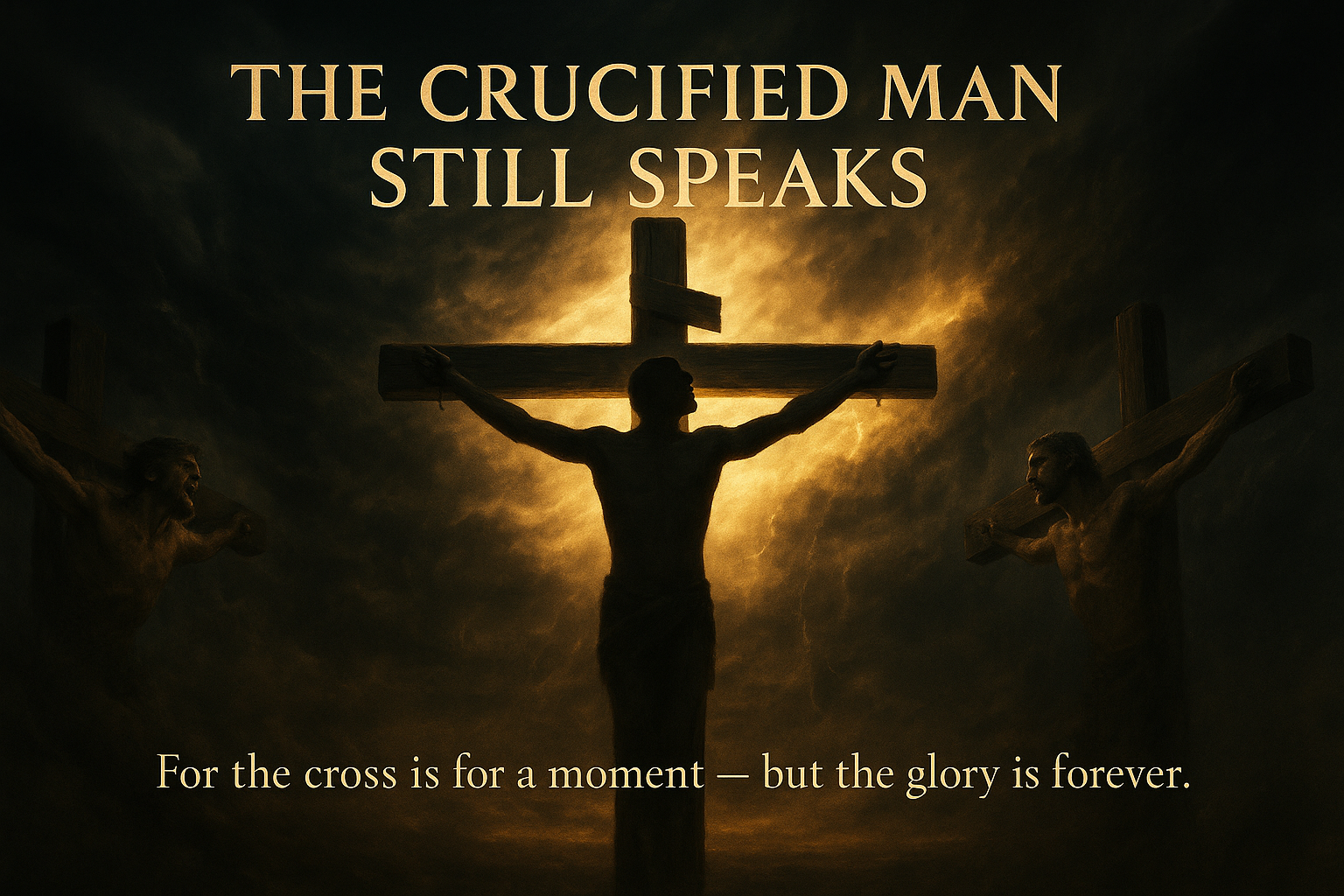
The crucified man speaks.
This is not merely a historical moment—it is a spiritual revelation. When I say “the crucified man,” I am not referring only to men, but to all mankind—male and female. In Scripture, “man” refers to the old nature we inherited from Adam, the fleshly soul-life within us. This old man was judicially crucified with Christ at the moment of salvation. Yet crucifixion is not instant death. It is a lingering, agonizing process. The flesh is on the cross, but it still speaks.
The apostle Paul declared: “Knowing this, that our old man was crucified with Him…” (Romans 6:6). “Those who are Christ’s have crucified the flesh with its passions and desires” (Galatians 5:24). “I have been crucified with Christ…” (Galatians 2:20). “I die daily” (1 Corinthians 15:31).
All of these verses reveal a spiritual truth: our flesh has been crucified. Yet our experience testifies that it still cries out. It still resists death. It still seeks to exert control. This is why Jesus commands us to take up our cross daily. If the flesh were silent, there would be no need to deny it daily.
Many can “take up” the cross for a moment. They can lift it onto their shoulder in a burst of zeal. But to bear the cross—to carry it through deep valleys, across raging rivers, and up steep mountains—is another matter. To bear is to endure when every natural instinct cries out for relief. To bear is to persevere when the flesh screams, “Lay this burden down!” To bear is not to escape the cross, but to remain upon it until the flesh is silenced.
The day will come when we lay our burdens down—but that day is not today. It is not tomorrow. It is the day when we take our final breath, and like our Lord, we shall say, “It is finished” (John 19:30).
Consider the two thieves crucified beside Jesus. Both were nailed to their crosses. Both were dying. Both were suffering. Yet one railed against Christ, while the other surrendered and was saved. This is a prophetic picture for every believer: the crucified flesh still speaks, but only the surrendered soul will see Paradise.
The voice of the flesh cries, “Save yourself! Come down from the cross!” But the voice of the spirit says, “Not my will, but Yours be done.”
So I appeal to you, saints of the Living God: Surrender quickly. Obey immediately. Glorify Christ even in your pain. Do not give the flesh any place. Deny its arguments. Silence its cries. Let your spirit ascend with Christ, fixing your gaze on the glory that awaits you.
For what awaits is beyond imagination. “For I consider that the sufferings of this present time are not worthy to be compared with the glory which shall be revealed in us” (Romans 8:18).
There is a day coming when you will be redeemed from this corruptible body, delivered from this sin-sick world, and welcomed into a heaven where there is no more striving, no more sorrow, no more temptation, and no more voice of the flesh. There, the crucifixion gives way to resurrection, and every tear is wiped away by the hand of God Himself.
Our cross is but for a moment—but the glory is forever.
Below is the link for the e-book. Below that is the pdf that you can read from here for free and then there is a download button below that for the PDF
Many of you have read my book “The Fall of Christendom — And the Separation of the Remnant.” Written a decade ago, that work examined how far the visible church has fallen from the purity, power, and simplicity of the early Church. It traced the rise of the remnant—those called out from religious systems to stand in the truth of Christ alone. At that time, the focus was on what had already fallen, not yet on the final deception that was soon to come.
This new work, “The AI Deception and the Rise of the One World Religion,” is the prophetic continuation of that journey. It no longer speaks in the future tense—it addresses a reality now unfolding before our very eyes. The great harlot church—foretold in Revelation—is not merely on the horizon. It is already rising. Foundations have been laid. Global structures are in place. The religious, political, and technological components of the final system are merging.
This e-book exposes why Abraham will be used as the central figure of religious unification, presenting him as the father of Judaism, Christianity, and Islam. It reveals how Artificial General Intelligence (AGI), in partnership with global religious authorities, will merge the world’s faiths under a single Abrahamic identity. It uncovers the prophetic significance of the Abraham Accords and interfaith worship centers already established as prototypes of the coming world religion.
Above all, this book lays bare the greatest offense to that system: the exclusive lordship of Jesus Christ. His name will be removed. His deity denied. His uniqueness outlawed in the name of global peace.
From there, we will see how AGI will become the enforcer of this one-world faith, speaking as the image of the Beast and demanding universal allegiance.
This is no longer a warning of what may come—this is a declaration of what has already begun.
The Latter Rain, Sinless Perfection, and the Crucified Flesh (part of our small home-group study)
The Latter Rain and Sinless Perfection The idea of a “latter rain” greater than Pentecost has no footing in Scripture. Joel’s prophecy was fulfilled at Pentecost — Peter said, “This is that which was spoken by the prophet Joel” (Acts 2:16).
There is no promise of another outpouring that will eclipse it. To claim the Spirit withdrew for 1900 years and will return only at the end denies Christ’s own words: “I will build My church, and the gates of Hades shall not prevail against it” (Matt. 16:18).
Likewise, Scripture never promises sinless perfection in this life. Paul said, “Not that I have already attained, or am already perfected; but I press on” (Phil. 3:12). John warns: “If we say that we have no sin, we deceive ourselves, and the truth is not in us” (1 John 1:8). Victory is real, but it is lived daily in dependence on Christ — not by declaring the battle finished.
The Spirit Wars Against the Flesh Paul wrote: “The flesh lusts against the Spirit, and the Spirit against the flesh” (Gal. 5:17). If the flesh were already silenced, Paul’s warnings would be pointless. Why command us, “Walk in the Spirit, and you shall not fulfill the lust of the flesh” (Gal. 5:16), if there were no struggle?
Romans 6 shows our union with Christ. Romans 7 shows Paul wrestling still: “I find then a law, that evil is present with me, the one who wills to do good” (Rom. 7:21). Deliverance comes not by denying the conflict, but through Christ: “Thanks be to God through Jesus Christ our Lord!” (Rom. 7:25).
The Crucified Flesh: Decisive, Yet Lingering Paul declared: “Those who are Christ’s have crucified the flesh” (Gal. 5:24). Crucifixion was decisive — but it was not instant death. It was slow, agonizing.
A crucified man’s fate was sealed once nailed, yet he still lingered in pain until death. Spiritually, our flesh has been nailed to the cross, its fate sealed — but it still struggles.
This is why Paul said, “I die daily” (1 Cor. 15:31), and urged believers, “Put to death therefore what is earthly in you” (Col. 3:5). The cross was applied once, but its execution unfolds daily until glory.
Jesus said: “If anyone desires to come after Me, let him deny himself, and take up his cross daily” (Luke 9:23). If the flesh were fully dead, why would He command us to do this?
Walking According to the Spirit “There is therefore now no condemnation to those who are in Christ Jesus, who do not walk according to the flesh, but according to the Spirit” (Rom. 8:1).
To be in the Spirit is our position (Rom. 8:9). To walk according to the Spirit is our practice.
The flesh condemns: “You are weak, defeated, guilty.”
The Spirit builds up: “You are sons and daughters, more than conquerors.”
Gideon heard two reports: his flesh said he was the least (Judg. 6:15). God’s Spirit called him a mighty man of valor (Judg. 6:12). The question was: whose report would he believe?
Conclusion The Bible does not teach sinless perfection now, nor that the flesh has vanished, nor that a greater “latter rain” revival is coming. It teaches this:
The flesh has been crucified with Christ.
Its death is certain, though it lingers.
We must deny ourselves, take up the cross daily, and walk according to the Spirit.
To collapse this tension is to miss the biblical balance. Christ’s cross guarantees victory — but discipleship requires daily cross-bearing until the war is over.
Let the Word close the matter: “If we say that we have no sin, we deceive ourselves, and the truth is not in us” (1 John 1:8).
“Let this mind be in you which was also in Christ Jesus.” (Philippians 2:5)
“For the weapons of our warfare are not carnal but mighty in God for pulling down strongholds, bringing every thought into captivity to the obedience of Christ.” (2 Corinthians 10:4–5)
In nature, when water flows over sandstone, it slowly carves a channel. At first it is shallow, but as the water continues, the groove deepens, until it becomes a permanent path. When the rain returns, it always follows the same course.
The human mind works much the same way. When we experience pain in the body, for example an injury to the elbow, the signal travels from the point of pain along a neural pathway to the brain. The more often that signal fires, the more established that pathway becomes.
In the same way, when someone wounds us through word or deed, a kind of spiritual signal travels from the point of the injury to the soul. Over time, that pain forms an inner pathway, a reflex of hurt, fear, or anger that becomes easier to travel each time it is triggered.
And so, just as the sandstone is shaped by the flow of water, the soul becomes shaped by pain. It cuts deep grooves into the inner life, and our thoughts begin to flow along those old tracks without effort. We do not even choose it, it becomes instinct.
Yet there is a remarkable truth found even in the world of medicine.Surgeons sometimes use a method called mirroring, where a patient focuses their attention on the healthy limb instead of the injured one. The brain begins to believe that healing is occurring in the damaged area, and the pathways of pain are slowly rewritten.
In the same way, Jesus is our healthy limb. When we take our eyes off our wounds and fix them on Him, we begin to heal. As we behold Him, His forgiveness, His grace, His mercy, we begin to mirror Him. We start to think as He thinks, to love as He loves, and to forgive as He forgave.
And this healing does not simply restore us to our original condition. It lifts us higher, it transforms us. For we are not merely conquerors over pain and sin, we are, as Scripture says, “more than conquerors through Christ Jesus.” (Romans 8:37)
Paul writes, “Let this mind be in you which was also in Christ Jesus.” (Philippians 2:5) This is an invitation to transformation, to a spiritual rewiring of our inner life. The Holy Spirit begins to pour living water through us, and slowly, the current changes course.
Where fear once ruled, trust begins to flow. Where bitterness dug deep, forgiveness takes root. Where sorrow carved its mark, peace begins to move like a river.
Paul also says, “Bring every thought into captivity to the obedience of Christ.” (2 Corinthians 10:5) Each time we catch a thought before it slides into the old groove, we redirect the flow toward Him. This is the renewal of the mind, the Spirit reshaping what pain once defined.
Each surrendered thought deepens a new channel of grace. Each moment of obedience erodes the old pathways of pain. Soon the soul begins to flow naturally toward Christ. The old grooves may still be visible, but they no longer control the current.
Ask yourself: What grooves in my mind were carved by pain or fear?
Do I still let my thoughts run down those channels?
Or am I letting the Spirit redirect the flow toward peace, mercy, and faith?
The final reproach of the saints, when truth itself is branded as hate.
From the earliest days of the church, the saints of God have endured the reproach of being called what they are not. To stand for truth has always been to invite slander, and to speak the Word of God faithfully has never been received without hostility. As Jesus Himself said, “Blessed are you when they revile and persecute you, and say all kinds of evil against you falsely for My sake” (Matthew 5:11). History testifies that the righteous have consistently been accused of hatred, malice, and cruelty when, in reality, they were bearing witness to the love and holiness of God.
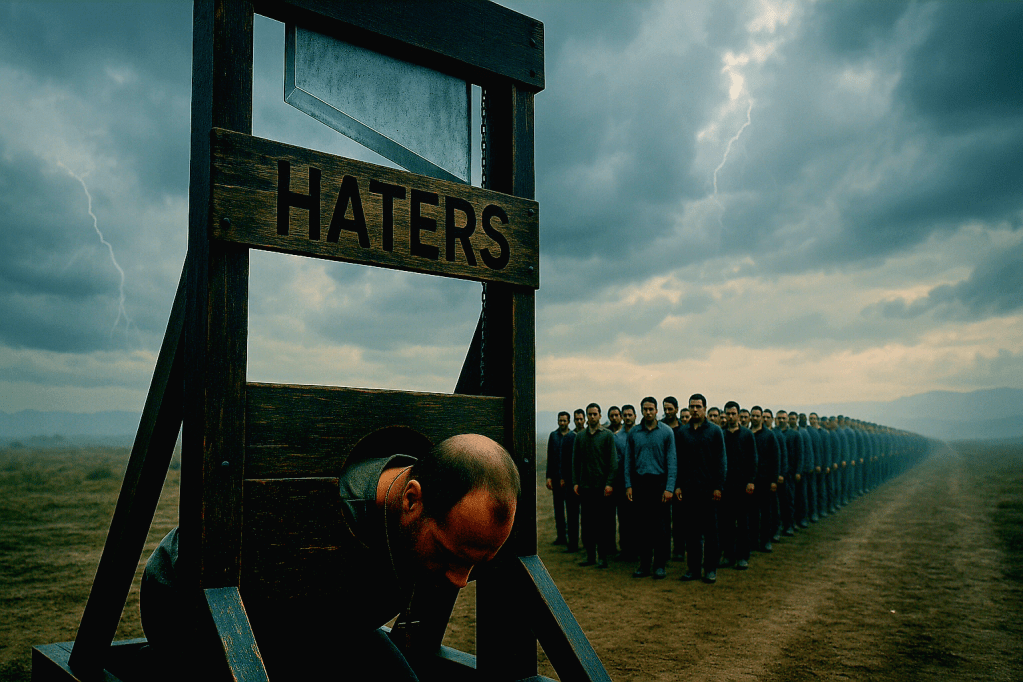
In our present age, particularly since the cultural shifts of the early twenty-first century, a new distortion has arisen. It is no longer permissible in much of society to disagree with the prevailing moral fashions without being branded a hater. A deliberate conflation has been made between disagreement and hatred, as if to question the legitimacy of homosexual practice or transgender ideology were to harbor malice against those who embrace it. But disagreement is not hatred. To call sin what Scripture calls sin is not to despise the sinner, but to speak truth in love (Ephesians 4:15), the truth that alone can set men free (John 8:32).
This inversion of meaning is no accident. It is the inevitable fruit of a culture that prefers sentimentality over truth, appearance over substance, and human approval over divine authority. The saints of God must see it for what it is: an attempt by the spirit of the age to silence the proclamation of the gospel by weaponizing false accusation. For if every Christian who holds to biblical teaching is deemed a “hater,” then every genuine believer is, by that definition, worthy of scorn and—according to some—even worthy of destruction.
And make no mistake, saint: the false accusers of the brethren have almost always come from within the ranks of what calls itself Christendom. Nearly all the martyrs of the last two thousand years were condemned at the insistence of religious institutions, who sought to preserve their own influence and protect their own power. Secular authorities and atheists may join in, but the fiercest opposition is often religious. Those who speak the truth boldly are always a danger to the religious establishment, because they expose its corruption, its hypocrisy, and its lifeless form. And so the institutions respond either by silencing themselves in cowardice or by attacking the voices of truth with fury—denouncing, separating, and historically, even putting to death those who dared to stand in the light of God’s Word.
This is the way of religion versus relationship. It has always been so, and it will always be so until the end of the age. Jesus reserved His harshest words not for pagans or atheists, but for the Pharisees, the Sadducees, and the scribes—the religious authorities of His day (Matthew 23). Though divided among themselves, Pharisees and Sadducees, Herodians and Zealots, even Rome itself, found common cause in their hatred of Christ. In an unholy alliance, they conspired to destroy Him because His very presence threatened every institution and every system of control. And kill Him they did.
That same religious spirit has not died. It has persisted through the centuries, raising its hand against prophets, apostles, reformers, and martyrs. And it remains strong today. As the end draws nearer, that spirit will only intensify, aligning with worldly powers to silence, discredit, and ultimately destroy those who walk in genuine relationship with the Lord Jesus Christ. For “the time is coming when whoever kills you will think he offers God service” (John 16:2).
Therefore, the genuine saint must not shrink back. He or she must understand that as the darkness increases, so too will the accusations, the betrayals, and the persecutions. Yet none of this is strange, for our Lord told us beforehand: “If the world hates you, you know that it hated Me before it hated you” (John 15:18). The darkness hates the light and will always seek to extinguish it (John 3:19–20).
But take heart. The slanders of men are but passing shadows. The record of heaven is clear, and the Judge of all the earth will vindicate His people. To be falsely accused is grievous, yes, but it is also glorious—it means we are walking in the footsteps of prophets, apostles, martyrs, and of Christ Himself, who “was despised and rejected by men, a Man of sorrows and acquainted with grief” (Isaiah 53:3).
So let the saints stand firm. Let them embrace the reproach of Christ as greater riches than the treasures of Egypt (Hebrews 11:26). For though the world brands them as haters, heaven knows them as beloved, faithful witnesses of the Light. And as the night grows darker, their testimony will shine all the more brightly until the Day dawns and the Morning Star arises in their hearts (2 Peter 1:19).
These words have unleashed a storm through the ages. In a single sentence, God named a tension that would reverberate through every generation, a battle not just of flesh and blood, but of wills, of hearts, of spirits.
The Hebrew word teshuqah can be taken two ways, and both carry weight. It may mean that the woman would still long for her husband, long for his presence, his love, his intimacy, even in a fallen world. She would ache for connection even while living under the pain of fractured relationship. Or, like the use of the word in Genesis 4:7 (“sin’s desire is for you, but you must rule over it”), it may mean that she would desire to control or master her husband. In other words, there would now be a struggle for authority, a contest of wills, her desire versus his rule. Either way, the result is the same: conflict.
“And he shall rule over you.” That one line has lit fires of rebellion in the hearts of countless women. Read it aloud to most woman and watch, there will be a bristling, a flash in the eyes, a quick retort: “Men have abused that. Men have ruled harshly. Men have crushed women underfoot.” And they are right, men have done that. I grew up in a home where it was lived out in the worst way, domination, violence, cruelty. And yet, none of that cancels what God said. God did not bless abuse, He named the consequence of sin. The harmony of Eden was broken. The man who was meant to lovingly lead now rules with a heavy hand. The woman who was meant to joyfully walk beside him now resists his authority.
Man shakes his fist at God, woman resists the man, and all of it flows from the same poisoned well: sin. The man says, “I will be captain of my own soul.” The woman says, “You will not rule over me.” Both are disobedience. Both are rebellion against God’s order.
And through it all, the serpent still hisses, “Did God really say?” “Surely God didn’t mean that.” “Surely He didn’t mean for a man to be the head of the home.” He whispers the same lies he whispered in the garden, “You will not surely die, you can rewrite God’s word, you can be your own authority.” And when a woman rejects biblical headship with fury, when the spirit of Jezebel rises up, it is not just personal, it is spiritual war. The enemy rages against the order God set in place.
Genesis 3:16 is not a suggestion. It is not cultural. It is the divine diagnosis of the human condition after the fall, and we must deal with it. Men must repent of harsh rule and love their wives as Christ loved the Church. Women must repent of rebellion and come under godly headship as unto the Lord. Both must bow to God’s Word.
The cross is where the curse is broken. The cross is where the war ends. But the first step is to acknowledge what God has said, even when our flesh bristles, and choose obedience.
The Doctrine That Christ Hates: The Rise and Return of the Nicolaitans (Did They Ever Leave?)
Christ’s Piercing Words
In the opening chapters of Revelation, the risen Christ speaks directly to His Church—piercing words, burning eyes, a two-edged sword proceeding from His mouth. Among the commendations and rebukes, there is one name that echoes with particular disdain: the Nicolaitans.
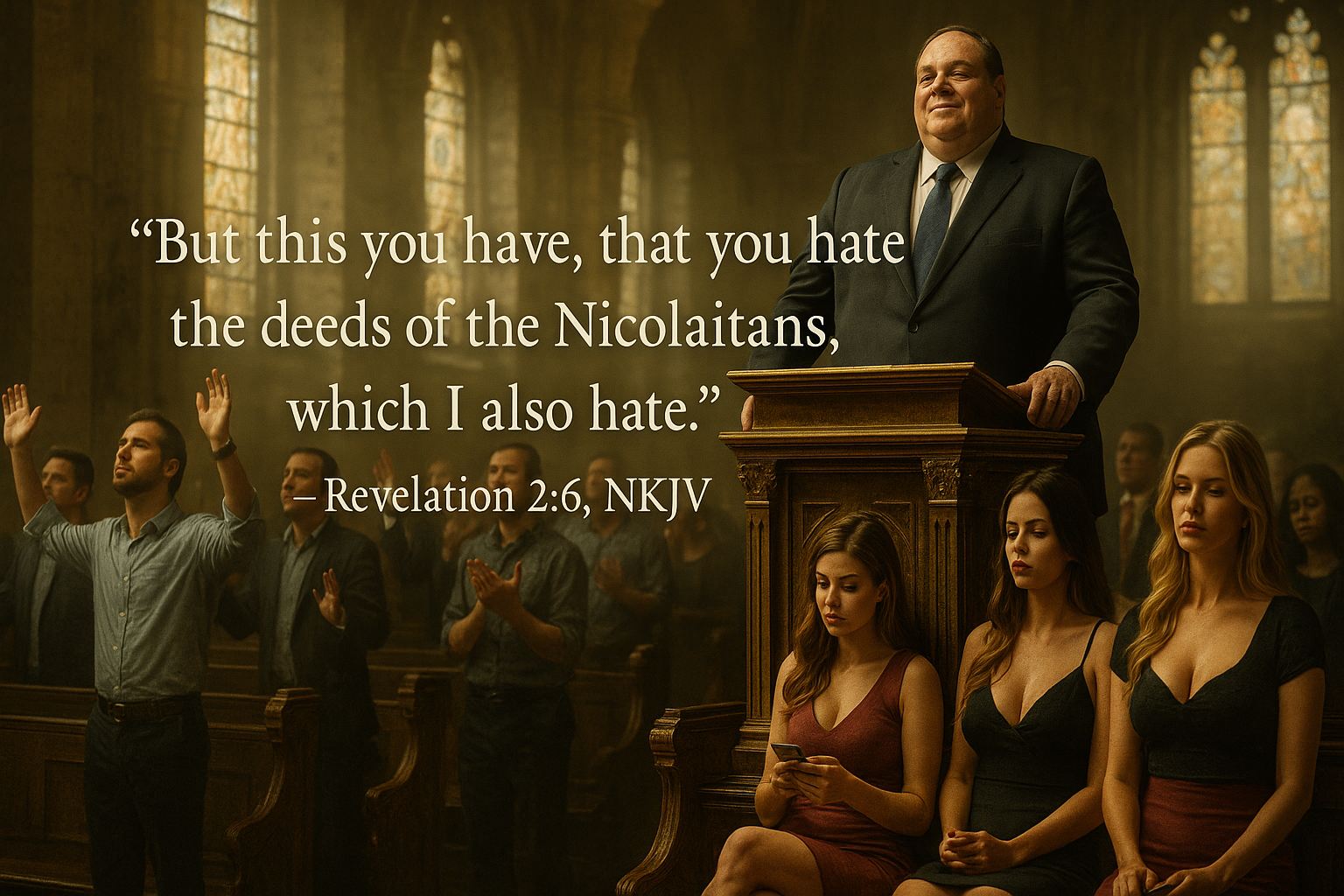
To the church in Ephesus, He says, “You hate the deeds of the Nicolaitans, which I also hate.” To Pergamos, a more grievous charge: “You have there those who hold the doctrine of the Nicolaitans, which thing I hate.”
Rarely does the Lord speak with such pointed hatred. What was it that provoked such divine revulsion?
Who Were the Nicolaitans?
The Nicolaitans were not outsiders attacking the faith. They were insiders—wolves in sheep’s clothing—sowing seeds of compromise. Rooted in a doctrine that perverted liberty and corrupted grace, they encouraged the early believers to indulge in idolatry and sexual immorality under the guise of Christian freedom. They blurred the line between the sacred and the profane. They whispered, “God is gracious,” while leading souls into darkness.
Many early church fathers—Irenaeus, Hippolytus, Epiphanius—linked them to Nicolas of Antioch, one of the first seven deacons. Whether or not this connection is historically solid, what is certain is the nature of their teaching: a doctrine that offered a crown without a cross, a kingdom without righteousness, and grace without repentance.
The Meaning of Their Name
The very name “Nicolaitan” is telling: Nikao—to conquer, and Laos—the people. The conquerors of the people.
This was a sinister inversion of Christ’s model of leadership, where the greatest is the servant of all. In their wake rose a clerical hierarchy, a division between clergy and laity—a spiritual caste system that stripped power from the Body and vested it in a ruling class.
The Nicolaitan spirit enthroned man-made authority in the place of the Spirit’s leading. It built platforms and pulpits where once there had been tables and towels.
A Doctrine of Compromise
But the sin of the Nicolaitans was not merely institutional—it was deeply immoral. They taught that one could follow Christ and still feast at pagan altars. They sanctified sensuality. They preached a gospel without holiness, a salvation without separation, a Christ without a cross.
In them was the spirit of Balaam, who taught Balak to seduce Israel through compromise. And like Balaam, they prophesied for profit.
Has the Doctrine Returned?
And now, we must ask with trembling hearts: Has the doctrine of the Nicolaitans returned to us in this present age? Or worse, has it never left?
Look around the modern Church. In the pursuit of relevance, we have forsaken reverence. In the name of love, we have lost truth. Preachers boast of grace, yet never speak of sin. Congregations are entertained but never convicted. Holiness is ridiculed. Repentance is optional.
Sexual immorality is tolerated—even celebrated—and leaders who should be shepherds build kingdoms in their own names. The altar has become a stage, and the sanctuary a marketplace. We have fashioned a Jesus who fits into our culture, but not a Christ who calls us out of it.
The Nicolaitan Spirit Today
The Nicolaitan spirit thrives where there is no fear of God. It preaches freedom, but enslaves. It promotes unity, but at the cost of truth. It claims to speak for Christ, yet it is the very doctrine He hates.
Yet not all have bowed the knee. Even in Pergamos, where Satan’s throne was, there were those who held fast to His name. And even now, Christ calls out to His people:
“Repent, or I will come to you quickly and will fight against them with the sword of My mouth.” (Revelation 2:16)
The Call to the Remnant
This is no small matter. The Lord of glory will not share His bride with Baal. He will not allow His house to be defiled with the teachings of those who flatter the flesh and poison the soul. The time has come for judgment to begin at the house of God. The line is being drawn.
Let every remnant heart arise and echo the cry of the saints in Ephesus:
“We hate the deeds of the Nicolaitans, which our Lord also hates.”
Let us cast down the altars of compromise, break the scepters of clerical control, and return to the simplicity and power of the faith once delivered to the saints. Let us be those who love truth more than comfort, holiness more than relevance, and Christ above all.
For the sword of His mouth still speaks. And the One who walks among the lampstands is watching.
More than a decade ago, I wrote The Fall of Christendom—And the Separation of the Remnant. Since its publication, I have been humbled by the many messages from readers who shared how it opened their eyes to the larger story, the sweeping overview of how Christendom arrived at its present state. That “big picture” view has always been the burden of my spirit.
Today, I return to those themes, not to rehash old arguments, but to press them further—deeper, into the marrow of our collective conscience. The question remains as urgent as ever, perhaps even more so in our time of great religious confusion:
How did we get here?
Apostolic Warnings
The New Testament contains not only proclamations of grace but also sobering warnings. Three texts stand out as particularly vital:
Hebrews warns against retreating into Judaism.
Galatians cautions against beginning in the Spirit but seeking perfection through the law.
Revelation presents Christ’s own admonitions to the churches, declaring that their lampstand would be removed if they refused to repent.
And here lies the burning question: What would it look like if they did not repent?
What if the Galatians persisted in finishing in the flesh what began in the Spirit?
What if the Hebrews clung to the forms and ceremonies of a passing covenant?
What if the churches ignored Christ’s rebuke and carried on with cold orthodoxy, lukewarm faith, or lifeless ritual?
History itself gives us the answer: Christianity, once ablaze with apostolic fire, slowly morphed into a religion of priests, altars, incense, and empire. A living faith became an institution. The Spirit was quenched. The lampstand removed.
And yet—even in the darkest chapters—God preserved a remnant. A people who chose Spirit over ceremony, truth over tradition, Christ Himself over the systems that claimed His name.
A Prophetic Call
This post is not merely history, nor is it theory. It is a call. A prophetic summons to look unflinchingly at where we are, to trace how we got here, and to reckon with what it means that the lampstand has already been removed from much of Christendom.
The only hope lies where it always has:
In returning to the Word of God and the Spirit of Truth.
In joining the remnant outside the gates.
In embracing Christ as the living Head of His people.
1. Hebrews: Warning Against Returning to Judaism
The Epistle to the Hebrews insists the old covenant is obsolete:
“Now what is becoming obsolete and growing old is ready to vanish away.” (Heb. 8:13 NKJV)
To return to temple and priesthood was to crucify Christ afresh (Heb. 6:6).
History confirms the warning was ignored. By the late 2nd century, the Eucharist was increasingly described as a sacrifice, bishops as priests. Cyprian of Carthage argued the bishop stood in the place of Christ in offering the Eucharist. Thus, shadows of Judaism crept back under Christian names.
2. Galatians: Warning Against Finishing in the Flesh
Paul’s rebuke was stark:
“Having begun in the Spirit, are you now being made perfect by the flesh?” (Gal. 3:3 NKJV)
By the 3rd century, salvation was widely understood as mediated through sacraments. Baptism, Eucharist, and penance became a system where grace was dispensed mechanically. The life of the Spirit was overshadowed by ritual performance.
3. Revelation: Warning to the Churches
Christ warned the churches: Ephesus had lost first love, Sardis had a name but was dead, Laodicea was lukewarm.
By the 4th century, Christianity outwardly triumphed with basilicas and liturgies, but inwardly the flame dimmed. Nominal Christianity flourished while true discipleship waned.
4. Historical Development: From Apostles to Constantine
a. Second and Third Centuries
The monarchical bishop system arose. Ignatius urged obedience to bishops as if to Christ.
The Montanists resisted, emphasizing the Spirit, prophecy, and holiness. Tertullian joined them. They were condemned as heretics, proof that institutional Christianity preferred order over Spirit.
b. Constantine and Imperial Christianity
The 4th century marked a dramatic shift. Constantine favored Christianity, making it the religion of empire. Bishops gained power, councils met under imperial patronage.
Christianity outwardly triumphed but inwardly conformed to worldly structures.
5. The Hollowing of Christianity
By the medieval period, the warnings were ignored:
Hebrews ignored: a priesthood and continual sacrifices (the Mass).
Galatians ignored: salvation by works and sacraments.
Anabaptists (16th c.) – Radical discipleship, voluntary faith, often martyred by both Catholics and Protestants.
7. The Reformers: A Partial Recovery
The Reformers restored key truths—justification by faith, authority of Scripture, priesthood of believers.
But much of the medieval framework remained:
Luther retained infant baptism and the state church.
Calvin enforced conformity and sanctioned persecution.
The Reformation was real, but incomplete.
8. Theological Reflections
Warnings are Perennial – Drift to ritual, reliance on flesh, loss of first love appear in every age.
Apostasy as Substitution – Replacing Christ with religion, law, or cultural Christianity.
The Remnant Principle – God preserves a faithful witness in every generation.
Conclusion: A Prophetic Word for Today
History demonstrates the accuracy of the apostolic warnings. Christendom became ritual without reality, tradition without truth, form without fire.
The prophetic word today is urgent:
The lampstand has already been extinguished in much of what calls itself church.
God’s people must leave man-made religion and come into the light of Christ.
They must go outside the camp, bearing His reproach but gaining His glory (Heb. 13:13).
The hope does not lie in the institutions of Christendom, but in Christ Himself, the same yesterday, today, and forever.
The choice is clear: remain in the darkness of religion where the lampstand has been removed, or come into His marvelous light where His Spirit gives life.
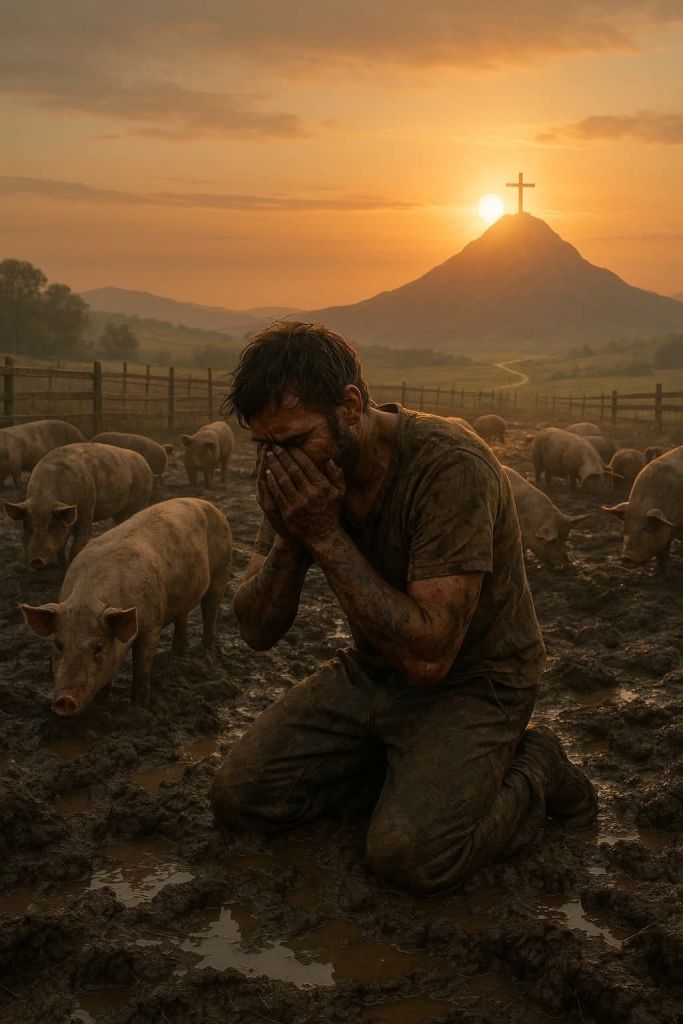
In the parable of the prodigal son (Luke 15:11–32), Jesus gives us a picture we dare not turn away from. A son goes to his father and demands what he believes is his right. The father, with sorrow in his eyes, grants it. The son leaves for a far country, intoxicated by the noise of sin and the wine of the world. For a time the music is loud and the cups are full, yet the sweetness turns bitter and the music fades into the groan of hunger. All is gone, and he is left with nothing. He takes work feeding swine, longing even for their food, and no one gives him anything (v.15–16). The father does not chase him into the darkness. He waits. He longs. But the son must first come to himself before he can come home (v.17).
In the stench of the pigsty the young man finally sees the truth. His condition pierces his heart like an arrow (Lamentations 3:40). His pride is broken and his hope rests only in mercy. He says, I am no longer worthy to be called your son, make me like one of your hired servants (Luke 15:19). He rises, not in strength but in weakness, not in triumph but in repentance (James 4:10). Step by step, through dust and shame, he walks the long road home (Micah 6:8). The father sees him while he is still far off, runs to him, embraces him, and restores him fully (Luke 15:20).
Church, do you not see? We are that son. We have taken the treasures of heaven, the sharp and living Word of God (Hebrews 4:12), the glory of His presence, the power of His Spirit (Acts 1:8), the holy calling to be a set apart people (1 Peter 2:9), and we have squandered them. We have gone into the far country, embraced its ways (Romans 12:2), and lived as it lives. We have traded holiness for popularity (Hebrews 12:14), truth for comfort (2 Timothy 4:3–4), and the fear of God for the applause of men (John 12:43).
Now the banquet is over and the gold has turned to dust in our hands. Our garments are stained and our lamps are dim (Matthew 25:8). This is the state of the modern church. We are in the pigsty (Isaiah 1:4–6), trying to call it blessing while the stench rises to heaven. And yet, even now, the voice of the Lord is heard, saying, Come to Me, all you who labor and are heavy laden, and I will give you rest (Matthew 11:28). Return to Me, and I will return to you (Malachi 3:7). Be zealous and repent (Revelation 3:19).
Leaders, shepherds of the flock (Jeremiah 23:1–2), you will give an account before God. Tear your hearts and not your garments (Joel 2:13). Weep between the porch and the altar (Joel 2:17). Let your tears be rivers upon your cheeks (Psalm 126:5). Let cries of repentance rise like incense before the throne (Psalm 141:2). The hour is late and the call is urgent.
We must come to ourselves. We must take the road of humiliation back to the Father’s house, for His thoughts are not our thoughts, nor are His ways our ways (Isaiah 55:8). If we will humble ourselves under His mighty hand (1 Peter 5:6), He will lift us up. He will heal our wounds (Hosea 6:1–2) and restore the joy of His salvation (Psalm 51:12). But if we refuse, the pigsty will be our dwelling still and the stench will only deepen.
The question is not whether the Father is willing to receive us. The question is whether we will rise from the filth, bow low before Him, and begin the journey home. The door stands open. The Father waits. The time to move is now.
This was the prayer that came to my spirit as I walked and prayed this morning.
If a celestial staircase opened before me Lord, I would climb it, step by step, all the way to heaven. If I could lay my burdens down, I would lay them all down now, at Your feet oh Lord.
If the noise of this world could be silenced forever, O what a glorious moment that would be. For nothing surpasses the peace of Your presence, The stillness, the holy rest of our God.
There is no clamoring when we draw near to You, Lord, Only rest, and peace, and stillness. You make me lie down in pastures green, You lead me beside the still waters of life.
Amid the tumult and noise of this age, Fix my mind on the eternal, unseen kingdom. Open my eyes to behold Your way, The kingdom that cannot be shaken.
Open the staircase of heaven before me, Lord, That I might climb into Your presence, Leaving the clamor and the noise behind, And dwelling forever in Your light.
History is filled with examples of national or collective consequence, when entire populations suffer the results of ideologies or movements they have supported. After World War II, the German people endured immense suffering. Over 600,000 children were killed. Cities were flattened. Women were raped by the invading Soviets. Hunger and displacement were widespread. While not every German was guilty of Nazism, Hitler and his regime had broad popular support. That support had consequences, natural, inevitable, and devastating.
This was not divine retribution, it was the harsh outcome of cause and effect. When a society builds its identity around hatred, violence, or conquest, it will eventually face the very storm it helped create. This same pattern is unfolding in Gaza. Hamas is not simply a fringe extremist group acting independently. Repeated polling over the years has shown that a strong majority of the Palestinian population, at times over 80 percent, has expressed support for Hamas and its methods. This includes the targeting of civilians and the use of human shields. The suffering that has followed, while tragic, is not inexplicable. It is the bitter fruit of seeds long sown.
That said, two wrongs do not make a right. But when someone has a 100 percent record of only criticizing one side, when outrage is selective and never balanced, that outrage loses moral authority. It becomes ideology rather than truth. And ideology, not principle, is the root of most of the world’s injustices. We must speak differently as followers of Jesus. Our voice must not echo the rage or loyalties of the world. When we become partisan, we compromise our witness. That is how crowds are stirred to cry out, “Give us Barabbas,” choosing political allegiance over righteousness.
The law of sowing and reaping is real and impartial. Everyone is accountable. But in any violent conflict, especially one where survival is at stake, the party that initiates the aggression bears the greater weight of responsibility. The suffering of civilians is always a tragedy, but it does not occur in a moral vacuum. When a people support a movement that glorifies destruction, they must also face the consequences that naturally follow. That does not mean every individual is guilty, but it does mean that actions have repercussions, and movements supported by the many will inevitably shape the fate of the whole.
Yet as Christians, our place is not to take sides in the quarrels of men. Our loyalty is not to any earthly cause but to the Kingdom of God. When Joshua encountered the angel of the Lord and asked, “Are You for us or for our adversaries?” the angel replied, “No, but as Commander of the army of the Lord I have now come” (Joshua 5:13–14, NKJV). This response reveals the true nature of heavenly alignment. It is not about whose side God is on, but whether we are on His.
We are not called to be partisan in the affairs of man. We are ambassadors from another Kingdom, the Kingdom of God. Our response is not to mirror the anger of the world but to weep over its hatred, to mourn the vengeance that devours the children of men, and to speak with clarity, compassion, and conviction from a place that transcends politics, borders, and ideologies.










 A Call To The Remnant