“When He had stopped speaking, He said to Simon, ‘Launch out into the deep and let down your nets for a catch.’”
When Jesus had finished speaking, He said, “Launch out into the deep.”
But no vessel can move into the deep while it is still tied to the dock. The mooring lines must be cast off. The lines that hold it fast, the lines that keep it safe, the lines that bind it to what is known must be thrown.
And so it is with us. We hear the Word of God, clear, piercing, unmistakable, and yet we remain tethered, held by what is familiar, held by what feels secure, held by the shorelines of this world.
But the call of Christ is not to remain. It is to release, to cast off every line, to throw off every restraint, to abandon every false security and trust the voice that speaks, “Launch out into the deep.”
There is a moment when obedience demands movement, a moment when hearing is no longer enough. The lines must be thrown, and often caution itself must be thrown to the wind, and in this case the wind is the Holy Spirit, carrying us beyond what we can see and into what only He can accomplish.
And when they are thrown, there is no turning back. The shore begins to fade, the depths begin to open.
And there, in the deep, we meet the limits of ourselves. All our effort, all our striving, all our experience comes to nothing. “We have toiled all night and caught nothing.” This is the place where human strength fails.
But then comes the turning word, “Nevertheless.”
Nevertheless at Your word.
Nevertheless beyond my understanding.
Nevertheless against my experience.
Nevertheless in full surrender, I will obey.
And it is there, in that place of yielded obedience, after the lines are cast off, after the shore is left behind, after failure has stripped us bare, that the power of God is revealed.
The deep is not entered casually. It is entered by surrender, by casting off what holds us, by trusting what calls us, and by following Him beyond the safety of the shore into the depths where only His word can sustain us and only His power can fill the nets.
And so brothers and sisters, are you ready to cast off your lines? Are you ready to throw them to the wind, to cut the ties that bind you to this world?
For this is the call of the Lord. Not to drift, not to remain near the shore, but to launch out into the deep. You may not want the deep. That is your choice, we saints all face tgis choice. The shore is familiar, it is safe, it asks little. Maybe the four walls of your church is the line that tethers you?
Maybe it is some loyalty to something other than Jesus? Perhaps our ties to this world and the things it has to offer is the line that tethers, the cares of this world? Only you can know this. Search your heart.
But to those who hear something deeper, to those who feel the pull of His voice, its time to cut any remaining lines
Look carefully at what holds you, what tethers you, what restrains you, what keeps you bound to the docks of this world.
And then you must decide how you will cut them.
Because no man drifts into the deep, no vessel wanders there by accident. The lines must be cast off, the ties must be broken, the call must be obeyed.
And only then will you know what it is to truly launch out into the deep.
Our small house church is reading a book by George Watson entitled “Soul Food.” I highly recommend it. It is really about the battle against self, and taking up the cross. I actually wrote this a number of years ago, but the issues of the heart never really change.
2Co 10:5 Casting down imaginations, and every high thing that exalteth itself against the knowledge of God, and bringing into captivity every thought to the obedience of Christ;
It’s a terrible thing to be held captive by our own thoughts. How exhausting it can be when we allow them to consume and overwhelm us? Its the voice of self. Self always has a victim, typically itself, and a perpetrator. It lifts itself up, and tears others down while burning every bridge.
The thoughts of self begin to eat away at us. They rob us of sleep and leave us tired and weary and walking the floor at night. Self, our own self, is our deadliest enemy, and typically it morphs into self-righteousness. Look at me Lord, I am not as wicked as these others. They should be more like me. There is no justification in this.
I thank the Lord that He freed us and gave us the ability to take every thought into captivity and focus on Him. You can always tell when a saint is focused on the Lord, they elevate Jesus, they lift up, they do not tear down.
If a specific situation or trial has taken hold of your mind today, know that there is a way of escape. You are no longer slaves to the flesh, no longer slaves to your own thoughts. Our own thoughts and “imaginations,” elevate us and sit us on the throne of our own hearts.
If you have been set free by the Lord then you are free indeed. You now have the power to take those thoughts captive; they must bow to the Spirit of God in you. You will know this man because he is humbled in his own sight and his cry will be “be merciful to me.” The other man will loudly tell you what he has and is doing.
“Come to Me all you who labor and are heavy laden, and I will give you rest. Take My yoke on you and learn of Me, for I am meek and lowly in heart, and you shall find rest to your souls. For My yoke is easy, and My burden is light.” (Matt. 11:28-30)
In 1 Corinthians 14:23, the wording really matters, and we need to read it exactly as it is written:
“Therefore if the whole church comes together in one place, and all speak with tongues, and there come in those who are uninformed or unbelievers, will they not say that you are out of your mind?”
The weight of this verse rests on two words, “if” and “whole.”
The word “if” comes from the Greek “ean.” It is a conditional word. It is not describing what normally happens. Paul is not saying when the church comes together. He is saying if a certain situation takes place. That is very important. He is presenting a scenario, not defining the regular pattern of church life.
Then he says, “the whole church.” That comes from the Greek “holē hē ekklēsia,” which means the entire assembly, the complete body, nothing missing.
That raises an obvious question. Why say “whole church” unless, for the most part, the whole church is not together?
This confirms what we already know from other scriptures, that the early church met in multiple house gatherings. They were not all meeting together all the time. So when Paul says “the whole church,” he is talking about something different from those normal, smaller gatherings.
So now read it again slowly.
“If the whole church comes together in one place…”
This is not a house meeting. This is the entire body, all those smaller gatherings, coming together as one in a single location.
And that explains what follows.
“…and there come in those who are uninformed or unbelievers…”
That only really makes sense in a setting that is accessible, visible, and large enough for others to enter and observe. This is not a closed, private setting. This is something that can be witnessed and would be open to the public.
And to strengthen this point even further, we know historically that the early believers met behind closed doors in homes. These gatherings were not openly accessible to the general public. Because of that, it gave rise to rumors and misunderstanding among outsiders.
There were accusations of things like cannibalism and the drinking of blood, clearly a distortion of the Lord’s Supper, but it shows how little was understood by those on the outside looking in.
So when Paul speaks about unbelievers and the uninformed coming in, he is describing a different kind of setting, one where access is possible, where what is happening can be seen and heard.
So what we are seeing here is very clear.
The early church met in houses, in smaller gatherings.But there were also occasions when the whole church came together in one place.
And when that happened, what took place in that gathering mattered, because it was being seen by those outside, the uninformed and the unbelieving.
And so this leads to an important conclusion.
The regular gatherings of the early church were not public in the way gatherings are today. They were not open meetings in the modern sense. They were primarily within homes, more contained, and not freely accessible to the general public.
Public visibility appears in this passage as something connected to a specific condition, when the whole church comes together.
So the argument from this passage is not just about order in a meeting. It also points to a pattern.
The normal life of the church was in smaller, more private gatherings. The larger, more public setting was the exception, not the rule.
And that raises a question for us now.
Have we reversed what was normal and what was occasional?
Because Paul’s words suggest that when the whole church comes together, something distinct is happening. And if that is the case, then not every gathering was meant to function in that same open, public way.
Knowing how the world ends fills the saint with deep, unshakable comfort. We are not utopian dreamers, endlessly disappointed by the condition of this fallen world. To live that way would reveal something far more serious, a practical atheism, as though we did not truly believe what the Word of God declares about the end of all things.
But we do believe.
And that belief produces something altogether different within us. Not dread. Not despair. But a profound and even holy fascination, as we watch the very Word of God unfold before our eyes. Every shaking, every upheaval, every turning of the age only confirms what He has already spoken.
And in it all, we know this, He is with us.
While the world is consumed with the temporary, the shifting, unstable state of things, we are captivated by something far greater. We are taken up with the eternal Kingdom of God, a Kingdom not merely coming, but already alive, already advancing, already unfolding within us.
And this causes us to walk in a peace that surpasses understanding, a peace that, when the world sees it, marvels at it. A witness of peace to a world in turmoil.
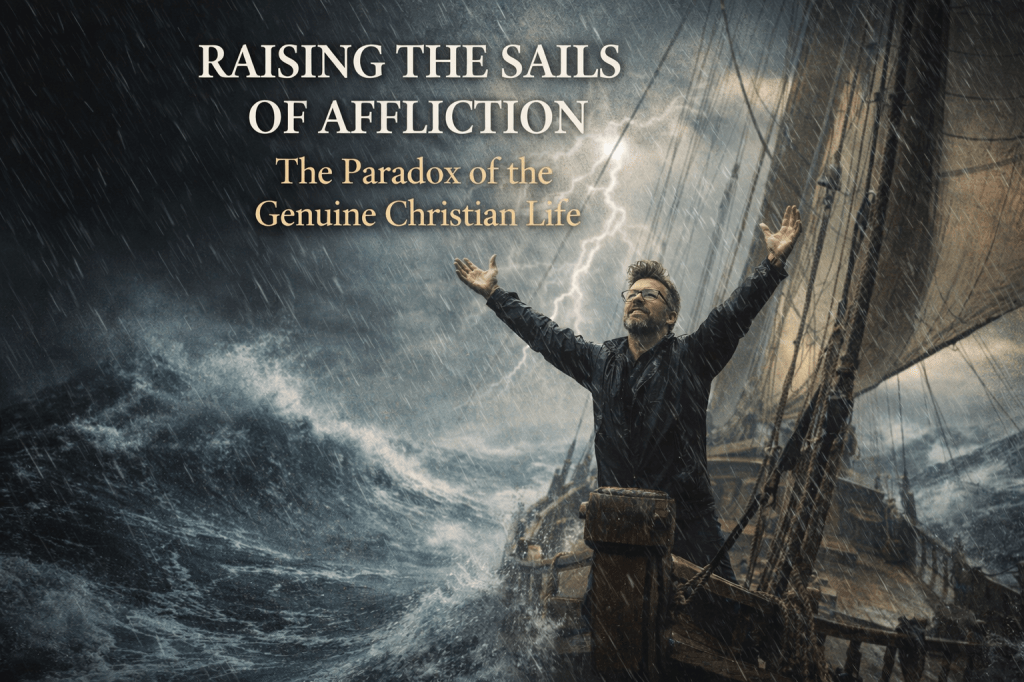
Raising the sails of affliction. The paradox of the genuine Christian life. Men and women who become entangled in the affairs of this world, who allow the headlines of the day or their present circumstances to draw their eyes away from the Lord, are those who lower their sails rather than power them when the winds of affliction begin to blow.
The storm is not the problem. The issue is where the eyes are fixed. When the eyes are fixed on the storm, fear rises. When fear rises, faith recedes. And when faith recedes, the sails come down. Look at the storm and you will sink. Look to Jesus and you will rise, carried by the wind above the waves. The same wind that terrifies one man will carry another. The difference is not the storm. It is the direction of the gaze and whether the sails are raised.
𝗧𝗛𝗘 𝗗𝗢𝗟𝗗𝗥𝗨𝗠𝗦 𝗢𝗙 𝗧𝗛𝗘 𝗦𝗢𝗨𝗟
Racing across the sea with the wind in your face, hurtling toward home, or finding yourself stalled and drifting in the spiritual doldrums of life. Brothers and sisters, the doldrums is a real place. It lies between five degrees north and five degrees south of the equator, shifting slightly throughout the year.
It stretches across the great oceans of the world, the Atlantic, the Pacific, and the Indian. Sailors of old, when sails were king, dreaded being trapped there. It was a place of weak or absent wind, of oppressive heat and heavy air, of sudden and violent storms that rose without warning. To be caught there was to make no forward progress. Supplies would dwindle. Water would run dry. The danger was real, not to perish in a raging storm, but to languish in a place where you are stuck, where you cannot move forward, and where the unseen currents of this world begin to drag you backward, and you do not even notice.
𝗦𝗧𝗨𝗖𝗞 𝗕𝗘𝗧𝗪𝗘𝗘𝗡 𝗦𝗧𝗢𝗥𝗠 𝗔𝗡𝗗 𝗦𝗧𝗜𝗟𝗟𝗡𝗘𝗦𝗦
Brothers and sisters, do you find yourself caught in the headlines of today. Do the circumstances of your life dominate your horizon. Either way, whether overwhelmed by storm or suffocated by inertia, the result is the same. The soul begins to sink into the morass of this world. Progress slows. Vision fades. Growth stalls. A life once moving toward the Lord becomes weighed down by what is seen, rather than lifted by what is unseen.
𝗟𝗜𝗙𝗧 𝗬𝗢𝗨𝗥 𝗘𝗬𝗘𝗦
Lift your eyes. For it is in Him, and Him alone, that we live and move and have our being. He alone is the answer to the storm. He alone is the answer to being stuck. There is no circumstance, no headline, no moment that exists outside of His authority. When the eyes are lifted, the soul is steadied. When the gaze returns to Him, direction returns, strength returns, life returns. The alternative is that headlines or the circumstances which you find yourself in dominate your life. Rather than taking your thoughts captive you are taken captive by them.
𝗧𝗛𝗘 𝗣𝗔𝗥𝗔𝗗𝗢𝗫 𝗢𝗙 𝗧𝗛𝗘 𝗦𝗧𝗢𝗥𝗠
Here is the paradox. We are called to raise our sails in the very teeth of the storm. Not to fight it, not to resist it in our own strength, but to yield to the wind of the Spirit. The storm that appears to threaten destruction becomes the very means by which we are carried forward. What seems contrary becomes the pathway. What appears dangerous becomes the vehicle of progress.
𝗥𝗜𝗗𝗘 𝗧𝗛𝗘 𝗪𝗜𝗡𝗗
Fight the storm and you will perish. Ride upon it, carried by His power, and you will not only live, you will live abundantly. The winds of affliction, when met with faith, do not destroy. They drive us forward. They press us onward. They hasten our journey. And so with the wind in your face and your sails lifted high, you are not drifting, you are not stalled, you are not overcome. You are being carried, steadily and powerfully, ever closer toward home.
I was speaking with a brother the other day, a man seasoned by many years. He has been a pastor for more than three decades and also served for many years as a police officer. Before all of that, he once drove a concrete truck.
He told me about a day in Texas when the truck broke down while carrying ten yards of concrete. The drum stopped turning. Time passed, and before the load could be poured, the concrete had set solid inside the bowl. It took him nearly a week with a jackhammer to break it free. Concrete must keep moving until it is ready to be laid, otherwise it hardens without mercy and becomes unusable.
So it is with our hearts. When the Spirit’s work is resisted, delayed, or neglected, what was meant to be formed and poured out becomes hardened instead. What should have been usable for God’s purpose becomes difficult to break and costly to restore.
He spoke about the slump. Concrete must meet a precise measure. If it does not rise to the required standard, the entire load is rejected and discarded. There is no partial acceptance. If it does not meet the specification, it cannot be used.
So it is with the work God is doing in us. God does not measure by appearance or intention, but by what meets His standard. What does not rise to the measure of obedience and faith cannot be blended in or excused, it must be dealt with before the work can continue.
I shared with him what I had learned in construction. Samples are taken from the pour, allowed to harden, and weeks later crushed beneath great pressure. Only then is its strength revealed. Only then is it known whether it can bear the load for which it was made.
So it is with our faith. What God has formed in us is not proven in comfort, but under pressure. The crushing does not create the strength, it reveals whether the strength is truly there to bear the weight God has assigned.
There is also the matter of composition. Water, sand, aggregate, and cement must all be present, and each must be measured carefully. Too much or too little of any one part weakens the whole. The mixture determines the endurance.
So it is with the life God forms in us. Truth, obedience, suffering, grace, and patience each have their place, and none can be removed without consequence. When we favor one at the expense of the others, the strength of the whole is compromised, and what remains cannot endure the load it was meant to bear.
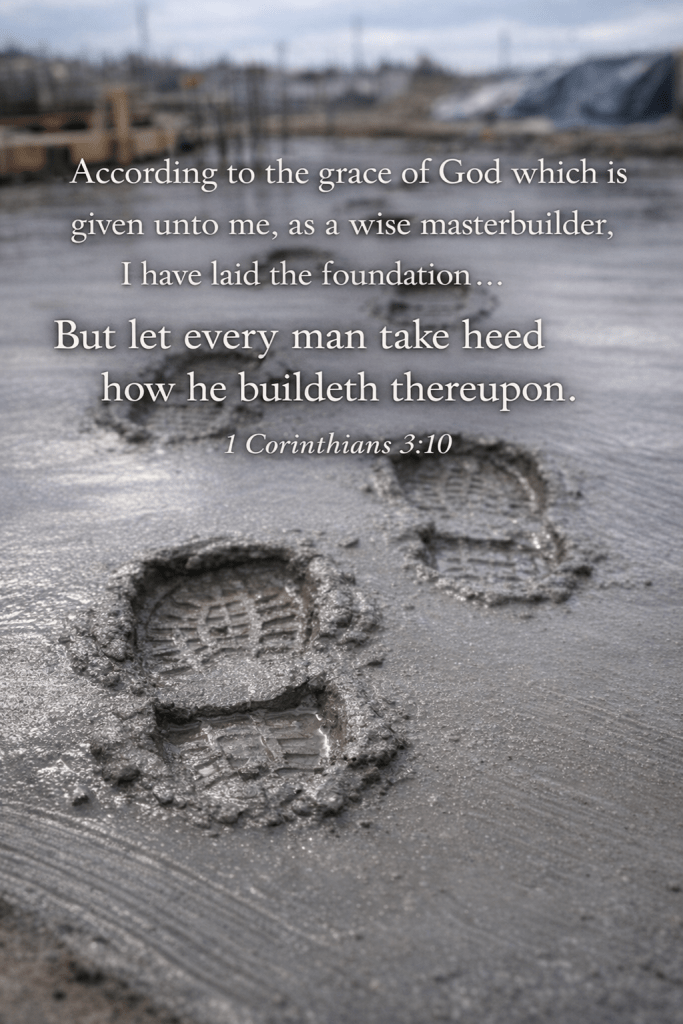
He then spoke of the freshly poured surface, smooth and carefully troweled. Sometimes someone comes walking toward it. You can see it happening and men shout warnings, but at times the person keeps going and walks straight through the concrete.
When that happens, the work is ruined. Either it must be torn up and done again, or the footprints remain forever, a permanent mark where none was meant to be.
Here the lesson becomes clear. When the Lord is doing a work, it is holy ground. When He is forming, shaping, and strengthening something, it is not to be trampled by careless feet.
God determines the mixture of our lives. He measures joy and sorrow, strength and weakness. He allows the testing and the crushing, not to destroy us, but to reveal whether we can bear the load appointed to us.
The strength that grows in us is not accidental, and the endurance is not self-made. It is the result of a careful and deliberate work of God. And even then, He does not leave us to carry the load alone. He bears it with us.
I want to respond to some objections raised against my initial piece on Yancey, though in truth it was never really about Yancey at all. It was about grace, what it is, how Scripture defines it, and why it matters. If the Body of Christ is ever to walk in true holiness and righteousness, so that a dying world can genuinely contrast us with itself, then grace must be taught and held in its proper biblical place. We have not been called to soothe the conscience of the saint, nor to dull the edge of God’s holiness, but to bear faithful witness to a God who is righteous, holy, and not to be treated lightly.
Philip Yancey presents a grace-first theology in which God’s mercy precedes human response, repentance is real but functions relationally rather than judicially, and the fear of God is redefined primarily as reverence and relational grief rather than warning or dread.
In this framework, repentance restores fellowship but does not place salvation genuinely at risk, and passages that warn of falling away are treated pastorally rather than with the full weight that tge words carry.. Yet Scripture speaks of those who were “once enlightened,” who “shared in the Holy Spirit,” and still “fell away,” and of judgment that is described as “a fearful thing to fall into the hands of the living God.” Jesus Himself warned that not everyone who says “Lord, Lord” will enter the kingdom, and that “the one who endures to the end will be saved.” The tension lies in whether these words are allowed to carry their full weight.
“Those once enlightened… who shared in the Holy Spirit… and then fell away.”
Hebrews and the warnings of Jesus present a gospel in which grace and holy fear coexist without contradiction.
Grace initiates salvation, yet believers are repeatedly urged to “hold fast,” to “take care lest there be an evil, unbelieving heart,” and to remember that “our God is a consuming fire.” This fear is not terror for the weak or the repentant, but sober awareness that holiness is real, covenant is serious, and perseverance matters. Scripture never pits love against Godly fear, but assumes they walk together in a proper union.
“Take care… lest there be an evil, unbelieving heart… for our God is a consuming fire.”
This tension is made unmistakable in the account of Ananias and Sapphira.
They were not outsiders but members of the church, and God judged deliberate hypocrisy in such a way that “great fear came upon the whole church.” The text offers no apology and no softening. The early believers learned, in a single moment, that the God who pours out grace also disciplines His people, and that His presence is not merely comforting but holy.
“Great fear came upon the whole church and upon all who heard these things.”
Throughout Scripture, promises are consistently attached to endurance and overcoming.
Life is promised to “the one who overcomes,” rest to those who “do not draw back,” and reigning with Christ to those who “remain faithful.” The other side of that promise is never hidden: hardening the heart, refusing to repent, or presuming upon grace carries consequence. These warnings are not written to frighten the faithful, but to awaken the complacent.
“To the one who overcomes… do not draw back… hold fast.”
This is why a softened, purely pastoral presentation of grace is ultimately dangerous. Grace was never meant to remove fear altogether, but to place it rightly. When grace is framed mainly to comfort, it risks producing peace without perseverance and assurance without obedience. There has always been a market for teachers who tell people what they want to hear, but Scripture was not written to soothe the unwatchful — it was written to form a people who endure, overcome, and remain faithful to the end.
“They will not endure sound teaching… turning aside to what they want to hear.”
The Latter Rain, Sinless Perfection, and the Crucified Flesh (part of our small home-group study)
The Latter Rain and Sinless Perfection The idea of a “latter rain” greater than Pentecost has no footing in Scripture. Joel’s prophecy was fulfilled at Pentecost — Peter said, “This is that which was spoken by the prophet Joel” (Acts 2:16).
There is no promise of another outpouring that will eclipse it. To claim the Spirit withdrew for 1900 years and will return only at the end denies Christ’s own words: “I will build My church, and the gates of Hades shall not prevail against it” (Matt. 16:18).
Likewise, Scripture never promises sinless perfection in this life. Paul said, “Not that I have already attained, or am already perfected; but I press on” (Phil. 3:12). John warns: “If we say that we have no sin, we deceive ourselves, and the truth is not in us” (1 John 1:8). Victory is real, but it is lived daily in dependence on Christ — not by declaring the battle finished.
The Spirit Wars Against the Flesh Paul wrote: “The flesh lusts against the Spirit, and the Spirit against the flesh” (Gal. 5:17). If the flesh were already silenced, Paul’s warnings would be pointless. Why command us, “Walk in the Spirit, and you shall not fulfill the lust of the flesh” (Gal. 5:16), if there were no struggle?
Romans 6 shows our union with Christ. Romans 7 shows Paul wrestling still: “I find then a law, that evil is present with me, the one who wills to do good” (Rom. 7:21). Deliverance comes not by denying the conflict, but through Christ: “Thanks be to God through Jesus Christ our Lord!” (Rom. 7:25).
The Crucified Flesh: Decisive, Yet Lingering Paul declared: “Those who are Christ’s have crucified the flesh” (Gal. 5:24). Crucifixion was decisive — but it was not instant death. It was slow, agonizing.
A crucified man’s fate was sealed once nailed, yet he still lingered in pain until death. Spiritually, our flesh has been nailed to the cross, its fate sealed — but it still struggles.
This is why Paul said, “I die daily” (1 Cor. 15:31), and urged believers, “Put to death therefore what is earthly in you” (Col. 3:5). The cross was applied once, but its execution unfolds daily until glory.
Jesus said: “If anyone desires to come after Me, let him deny himself, and take up his cross daily” (Luke 9:23). If the flesh were fully dead, why would He command us to do this?
Walking According to the Spirit “There is therefore now no condemnation to those who are in Christ Jesus, who do not walk according to the flesh, but according to the Spirit” (Rom. 8:1).
To be in the Spirit is our position (Rom. 8:9). To walk according to the Spirit is our practice.
The flesh condemns: “You are weak, defeated, guilty.”
The Spirit builds up: “You are sons and daughters, more than conquerors.”
Gideon heard two reports: his flesh said he was the least (Judg. 6:15). God’s Spirit called him a mighty man of valor (Judg. 6:12). The question was: whose report would he believe?
Conclusion The Bible does not teach sinless perfection now, nor that the flesh has vanished, nor that a greater “latter rain” revival is coming. It teaches this:
The flesh has been crucified with Christ.
Its death is certain, though it lingers.
We must deny ourselves, take up the cross daily, and walk according to the Spirit.
To collapse this tension is to miss the biblical balance. Christ’s cross guarantees victory — but discipleship requires daily cross-bearing until the war is over.
Let the Word close the matter: “If we say that we have no sin, we deceive ourselves, and the truth is not in us” (1 John 1:8).
“Let this mind be in you which was also in Christ Jesus.” (Philippians 2:5)
“For the weapons of our warfare are not carnal but mighty in God for pulling down strongholds, bringing every thought into captivity to the obedience of Christ.” (2 Corinthians 10:4–5)
In nature, when water flows over sandstone, it slowly carves a channel. At first it is shallow, but as the water continues, the groove deepens, until it becomes a permanent path. When the rain returns, it always follows the same course.
The human mind works much the same way. When we experience pain in the body, for example an injury to the elbow, the signal travels from the point of pain along a neural pathway to the brain. The more often that signal fires, the more established that pathway becomes.
In the same way, when someone wounds us through word or deed, a kind of spiritual signal travels from the point of the injury to the soul. Over time, that pain forms an inner pathway, a reflex of hurt, fear, or anger that becomes easier to travel each time it is triggered.
And so, just as the sandstone is shaped by the flow of water, the soul becomes shaped by pain. It cuts deep grooves into the inner life, and our thoughts begin to flow along those old tracks without effort. We do not even choose it, it becomes instinct.
Yet there is a remarkable truth found even in the world of medicine.Surgeons sometimes use a method called mirroring, where a patient focuses their attention on the healthy limb instead of the injured one. The brain begins to believe that healing is occurring in the damaged area, and the pathways of pain are slowly rewritten.
In the same way, Jesus is our healthy limb. When we take our eyes off our wounds and fix them on Him, we begin to heal. As we behold Him, His forgiveness, His grace, His mercy, we begin to mirror Him. We start to think as He thinks, to love as He loves, and to forgive as He forgave.
And this healing does not simply restore us to our original condition. It lifts us higher, it transforms us. For we are not merely conquerors over pain and sin, we are, as Scripture says, “more than conquerors through Christ Jesus.” (Romans 8:37)
Paul writes, “Let this mind be in you which was also in Christ Jesus.” (Philippians 2:5) This is an invitation to transformation, to a spiritual rewiring of our inner life. The Holy Spirit begins to pour living water through us, and slowly, the current changes course.
Where fear once ruled, trust begins to flow. Where bitterness dug deep, forgiveness takes root. Where sorrow carved its mark, peace begins to move like a river.
Paul also says, “Bring every thought into captivity to the obedience of Christ.” (2 Corinthians 10:5) Each time we catch a thought before it slides into the old groove, we redirect the flow toward Him. This is the renewal of the mind, the Spirit reshaping what pain once defined.
Each surrendered thought deepens a new channel of grace. Each moment of obedience erodes the old pathways of pain. Soon the soul begins to flow naturally toward Christ. The old grooves may still be visible, but they no longer control the current.
Ask yourself: What grooves in my mind were carved by pain or fear?
Do I still let my thoughts run down those channels?
Or am I letting the Spirit redirect the flow toward peace, mercy, and faith?
These words have unleashed a storm through the ages. In a single sentence, God named a tension that would reverberate through every generation, a battle not just of flesh and blood, but of wills, of hearts, of spirits.
The Hebrew word teshuqah can be taken two ways, and both carry weight. It may mean that the woman would still long for her husband, long for his presence, his love, his intimacy, even in a fallen world. She would ache for connection even while living under the pain of fractured relationship. Or, like the use of the word in Genesis 4:7 (“sin’s desire is for you, but you must rule over it”), it may mean that she would desire to control or master her husband. In other words, there would now be a struggle for authority, a contest of wills, her desire versus his rule. Either way, the result is the same: conflict.
“And he shall rule over you.” That one line has lit fires of rebellion in the hearts of countless women. Read it aloud to most woman and watch, there will be a bristling, a flash in the eyes, a quick retort: “Men have abused that. Men have ruled harshly. Men have crushed women underfoot.” And they are right, men have done that. I grew up in a home where it was lived out in the worst way, domination, violence, cruelty. And yet, none of that cancels what God said. God did not bless abuse, He named the consequence of sin. The harmony of Eden was broken. The man who was meant to lovingly lead now rules with a heavy hand. The woman who was meant to joyfully walk beside him now resists his authority.
Man shakes his fist at God, woman resists the man, and all of it flows from the same poisoned well: sin. The man says, “I will be captain of my own soul.” The woman says, “You will not rule over me.” Both are disobedience. Both are rebellion against God’s order.
And through it all, the serpent still hisses, “Did God really say?” “Surely God didn’t mean that.” “Surely He didn’t mean for a man to be the head of the home.” He whispers the same lies he whispered in the garden, “You will not surely die, you can rewrite God’s word, you can be your own authority.” And when a woman rejects biblical headship with fury, when the spirit of Jezebel rises up, it is not just personal, it is spiritual war. The enemy rages against the order God set in place.
Genesis 3:16 is not a suggestion. It is not cultural. It is the divine diagnosis of the human condition after the fall, and we must deal with it. Men must repent of harsh rule and love their wives as Christ loved the Church. Women must repent of rebellion and come under godly headship as unto the Lord. Both must bow to God’s Word.
The cross is where the curse is broken. The cross is where the war ends. But the first step is to acknowledge what God has said, even when our flesh bristles, and choose obedience.
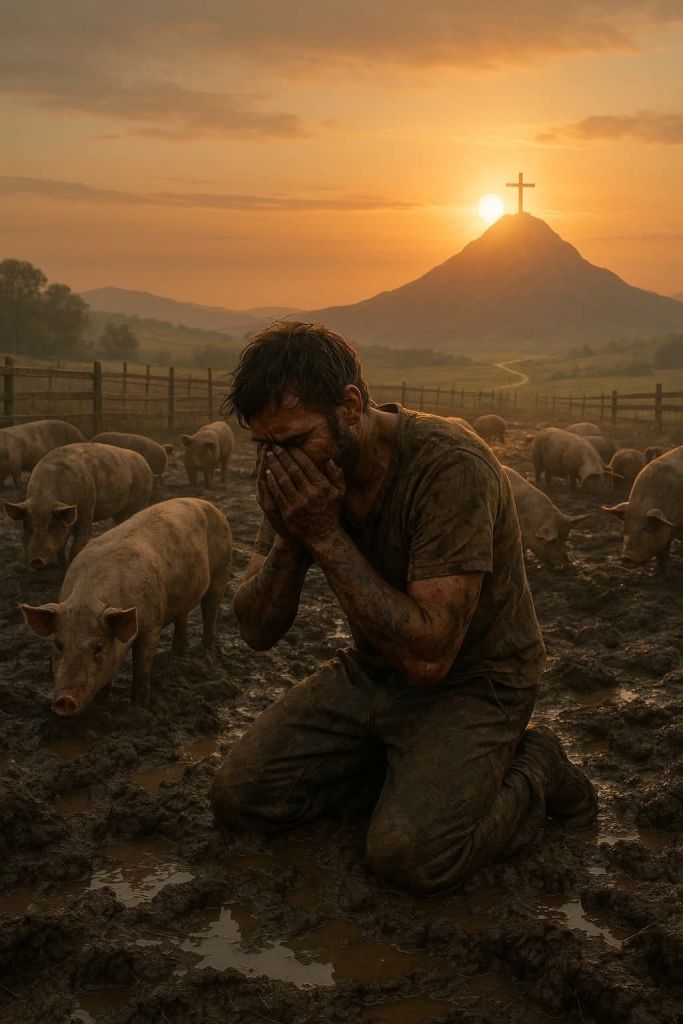
In the parable of the prodigal son (Luke 15:11–32), Jesus gives us a picture we dare not turn away from. A son goes to his father and demands what he believes is his right. The father, with sorrow in his eyes, grants it. The son leaves for a far country, intoxicated by the noise of sin and the wine of the world. For a time the music is loud and the cups are full, yet the sweetness turns bitter and the music fades into the groan of hunger. All is gone, and he is left with nothing. He takes work feeding swine, longing even for their food, and no one gives him anything (v.15–16). The father does not chase him into the darkness. He waits. He longs. But the son must first come to himself before he can come home (v.17).
In the stench of the pigsty the young man finally sees the truth. His condition pierces his heart like an arrow (Lamentations 3:40). His pride is broken and his hope rests only in mercy. He says, I am no longer worthy to be called your son, make me like one of your hired servants (Luke 15:19). He rises, not in strength but in weakness, not in triumph but in repentance (James 4:10). Step by step, through dust and shame, he walks the long road home (Micah 6:8). The father sees him while he is still far off, runs to him, embraces him, and restores him fully (Luke 15:20).
Church, do you not see? We are that son. We have taken the treasures of heaven, the sharp and living Word of God (Hebrews 4:12), the glory of His presence, the power of His Spirit (Acts 1:8), the holy calling to be a set apart people (1 Peter 2:9), and we have squandered them. We have gone into the far country, embraced its ways (Romans 12:2), and lived as it lives. We have traded holiness for popularity (Hebrews 12:14), truth for comfort (2 Timothy 4:3–4), and the fear of God for the applause of men (John 12:43).
Now the banquet is over and the gold has turned to dust in our hands. Our garments are stained and our lamps are dim (Matthew 25:8). This is the state of the modern church. We are in the pigsty (Isaiah 1:4–6), trying to call it blessing while the stench rises to heaven. And yet, even now, the voice of the Lord is heard, saying, Come to Me, all you who labor and are heavy laden, and I will give you rest (Matthew 11:28). Return to Me, and I will return to you (Malachi 3:7). Be zealous and repent (Revelation 3:19).
Leaders, shepherds of the flock (Jeremiah 23:1–2), you will give an account before God. Tear your hearts and not your garments (Joel 2:13). Weep between the porch and the altar (Joel 2:17). Let your tears be rivers upon your cheeks (Psalm 126:5). Let cries of repentance rise like incense before the throne (Psalm 141:2). The hour is late and the call is urgent.
We must come to ourselves. We must take the road of humiliation back to the Father’s house, for His thoughts are not our thoughts, nor are His ways our ways (Isaiah 55:8). If we will humble ourselves under His mighty hand (1 Peter 5:6), He will lift us up. He will heal our wounds (Hosea 6:1–2) and restore the joy of His salvation (Psalm 51:12). But if we refuse, the pigsty will be our dwelling still and the stench will only deepen.
The question is not whether the Father is willing to receive us. The question is whether we will rise from the filth, bow low before Him, and begin the journey home. The door stands open. The Father waits. The time to move is now.
The Pentecostal and Charismatic world has been shaped by movements such as “name it and claim it” and the so-called “word of faith” message. Add to that the prosperity gospel, and what remains is a witches brew, a kind of spiritual confusion brewed in our own theological cauldron. These movements have often shifted the focus of faith from trusting in God to demanding from God, turning faith into a formula for material gain rather than a pathway to spiritual depth. What was once a holy dependence on the sovereignty of God has, in many circles, become a technique for manipulating outcomes.
Yet Scripture offers a deeper, more sobering view. Depending on the translation, the word “faith,” appears around 270 times in the Bible. The vast majority of these references are not about miracles or breakthrough, but about trust, trust in God’s character, His promises, and His sovereign will.
Hebrews 11:6 says, “But without faith it is impossible to please Him, for he who comes to God must believe that He is, and that He is a rewarder of those who diligently seek Him.”
The kind of faith that pleases God is not transactional, but relational. It is the quiet, unwavering confidence in who God is, even when heaven is silent and the way is dark.
Romans 8:8 reinforces this truth: “So then, those who are in the flesh cannot please God.” Faith and flesh are incompatible. One walks by sight, the other by belief. To walk in the flesh is, functionally, to walk without faith.
Romans 8:5 explains, “For those who live according to the flesh set their minds on the things of the flesh.” The word mind here, phroneó, speaks of setting one’s affections, fixing one’s thoughts and desires. To “mind” the things of the flesh is to be consumed with the visible, temporal world. The Greek word for flesh, sarx, in this context means “the symbol of what is external.”
What does that look like in practical terms? It means being consumed with our careers, our possessions, our reputations, our politics, our social standing, our image, gaining our miracles, our health, rather than being absorbed in the things of God. A mind dominated by these mostly earthly concerns is incompatible with the Spirit-led life. Such a person is not walking in the Spirit, and therefore cannot please God. Being obsessed with miracles often flows, not from the heart of God, rather , it flows from the depths of our flesh.
“For to be carnally minded is death, but to be spiritually minded is life and peace.” (Romans 8:6)
The spiritual mind is one that seeks first the Kingdom of God and His righteousness (Matthew 6:33). It is a life oriented toward the eternal, not the temporary.
Hebrews 11, that great chapter of faith, gives us a dual picture. We rejoice in the stories of deliverance:
“By faith the walls of Jericho fell” (v.30), “Through faith they subdued kingdoms, worked righteousness, obtained promises, stopped the mouths of lions” (v.33). These are victories worth celebrating.
Yet the chapter shifts abruptly. “Others were tortured, not accepting deliverance, that they might obtain a better resurrection. Still others had trial of mockings and scourgings, yes, and of chains and imprisonment. They were stoned, they were sawn in two… being destitute, afflicted, tormented, of whom the world was not worthy.” (vv.35–38)
The common thread?
“And all these, having obtained a good testimony through faith, did not receive the promise.” (v.39)
Their faith was not measured by immediate reward, but by enduring trust in the unseen. Job expressed it best:
“Though He slay me, yet will I trust Him.” (Job 13:15)
Habakkuk echoes the same heart: “Though the fig tree may not blossom… yet I will rejoice in the Lord.” (Habakkuk 3:17–18)
This kind of faith is not swayed by trials or silence. It is rooted in relationship, not reward. Psalm 23 reminds us that God does not remove the enemies, but prepares a table in their midst.
“You anoint my head with oil, my cup runs over.” (Psalm 23:5) The oil flows not in times of ease, but in times of pressure. The true reward of faith is not what we receive, but who we receive—His presence.
“In Your presence is fullness of joy.” (Psalm 16:11)
The last 2,000 years of Church history bear witness to this truth. Millions have suffered for Christ, not because their faith failed, but because their faith endured. They possessed a spiritual mind and a heart anchored in another world. Their lives pleased God. Their testimonies still speak.
So the question is this: will you walk in the Spirit today? Will you cast aside the fleeting things of this world and set your affections on things above (Colossians 3:2)? Will you walk by faith and not by sight (2 Corinthians 5:7)? Will you trust God even when there is no sign of deliverance?
This is the faith that pleases God. And without it, we cannot.
The apostolic revelation given to Paul, as recorded in Colossians 1:26, presents one of the most profound disclosures in redemptive history—a mystery once concealed from ages and generations, now gloriously revealed to the saints. This mystery, long hidden in the counsels of God, was not perceived by the prophets nor comprehended by the wise of this world. It is the astounding truth that in Christ Jesus, Jew and Gentile are no longer divided, but made one—a new humanity, a single body in the Messiah. This is the long-anticipated fulfillment of the promise to Abraham, that in his seed all the nations of the earth would be blessed. No merely ethnic boundary remains, for in Christ there is neither Jew nor Greek. This is a revelation of cosmic consequence and divine ingenuity, wholly unforeseen in its breadth and intimacy.
Yet, astonishingly, the mystery deepens. As Paul continues in Colossians 2:2–3, he reveals that the purpose of this unity is not an end in itself, but a divine conduit by which the saints are brought into the very heart of God. He prays that their hearts might be encouraged, being knit together in love, and that they may attain to all the riches of the full assurance of understanding—to the knowledge of the mystery of God, both of the Father and of Christ.
Herein lies the surpassing dimension of the mystery: not merely reconciliation between former enemies, but an invitation into divine communion. In Christ are hidden all the treasures of wisdom and knowledge. Through union with Him, the veil is lifted and the Father—once unknowable and inscrutable—is made known. The mystery begins with the joining of the divided, but it climaxes in the revelation of the Divine. It is not only that Jew and Gentile are made one in Christ, but that in being made one, they are ushered into the very life of God.
This is the formation of the true Israel of God—a people sanctified, a royal priesthood, whose minds are being renewed and whose hearts are being enlarged by the Spirit. The saints are not left with mere doctrine, but are drawn into the riches of divine intimacy, discovering the boundless wisdom and knowledge hidden in Christ. This is the full arc of the mystery: reconciliation leading to revelation, unity giving way to glory, and the Church—Christ’s body—growing in grace as it beholds the face of God in the person of Jesus Christ.
The short post below is my reply to a sister in Christ who asked ” What does absolute surrender look like?” I thought it worthy of a post since it is such a great question……bro Frank
I believe absolute surrender comes at genuine salvation. It is a hearts attitude that says to God ” I give you my life, my whole life, holding nothing back.” I then believe that sanctification is a process whereby God takes what has been freely given to Him. We are not now our own, we have been bought by a price, the blood of Jesus. The more we give to God, the more we live out that surrender actually. The more we empty ourselves of the things of this world and the flesh, the more the world will see Jesus. We must decrease and He must increase. Yet, the work is all the Lord’s and He gets all the glory. He does this work for his will and good pleasure. He heals, He restores He replaces the things that the locusts have devoured, He refines. He, through the Holy Spirit sanctifies, we surrender. So, ultimately surrender is a response to God. How we respond determines how we live and how we glorify God, which is our chief end in this life.