


Are We Doing It All Wrong?
Posted by appolus on April 14, 2026
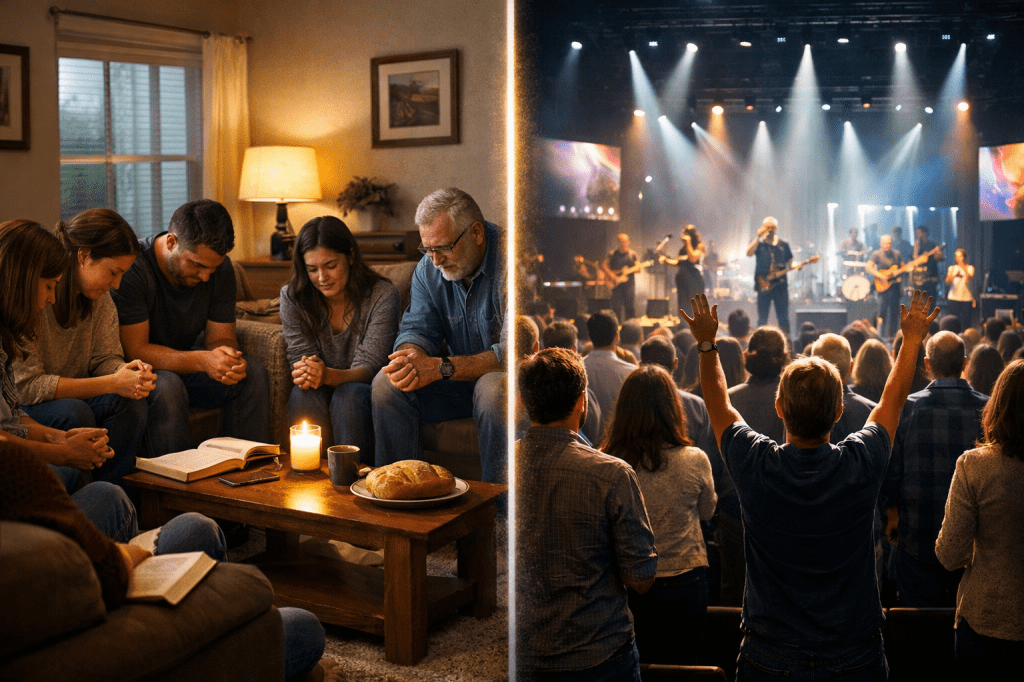
Are we doing it all wrong?
In 1 Corinthians 14:23, the wording really matters, and we need to read it exactly as it is written:
“Therefore if the whole church comes together in one place, and all speak with tongues, and there come in those who are uninformed or unbelievers, will they not say that you are out of your mind?”
The weight of this verse rests on two words, “if” and “whole.”
The word “if” comes from the Greek “ean.” It is a conditional word. It is not describing what normally happens. Paul is not saying when the church comes together. He is saying if a certain situation takes place. That is very important. He is presenting a scenario, not defining the regular pattern of church life.
Then he says, “the whole church.”
That comes from the Greek “holē hē ekklēsia,” which means the entire assembly, the complete body, nothing missing.
That raises an obvious question. Why say “whole church” unless, for the most part, the whole church is not together?
This confirms what we already know from other scriptures, that the early church met in multiple house gatherings. They were not all meeting together all the time. So when Paul says “the whole church,” he is talking about something different from those normal, smaller gatherings.
So now read it again slowly.
“If the whole church comes together in one place…”
This is not a house meeting. This is the entire body, all those smaller gatherings, coming together as one in a single location.
And that explains what follows.
“…and there come in those who are uninformed or unbelievers…”
That only really makes sense in a setting that is accessible, visible, and large enough for others to enter and observe. This is not a closed, private setting. This is something that can be witnessed and would be open to the public.
And to strengthen this point even further, we know historically that the early believers met behind closed doors in homes. These gatherings were not openly accessible to the general public. Because of that, it gave rise to rumors and misunderstanding among outsiders.
There were accusations of things like cannibalism and the drinking of blood, clearly a distortion of the Lord’s Supper, but it shows how little was understood by those on the outside looking in.
So when Paul speaks about unbelievers and the uninformed coming in, he is describing a different kind of setting, one where access is possible, where what is happening can be seen and heard.
So what we are seeing here is very clear.
The early church met in houses, in smaller gatherings.But there were also occasions when the whole church came together in one place.
And when that happened, what took place in that gathering mattered, because it was being seen by those outside, the uninformed and the unbelieving.
And so this leads to an important conclusion.
The regular gatherings of the early church were not public in the way gatherings are today. They were not open meetings in the modern sense. They were primarily within homes, more contained, and not freely accessible to the general public.
Public visibility appears in this passage as something connected to a specific condition, when the whole church comes together.
So the argument from this passage is not just about order in a meeting. It also points to a pattern.
The normal life of the church was in smaller, more private gatherings.
The larger, more public setting was the exception, not the rule.
And that raises a question for us now.
Have we reversed what was normal and what was occasional?
Because Paul’s words suggest that when the whole church comes together, something distinct is happening. And if that is the case, then not every gathering was meant to function in that same open, public way.
That is the force of the passage.


madrekins said
PATTERN the Key Word for me there Brother Frank.
Our GOD is ALL about, Pattern, Example & Order.
GOD told Moses to follow the Pattern when building HIS Tent/Tabernacle.
(Exo 25:9) According to all that I shew thee, after the pattern of the tabernacle, and the pattern of all the instruments thereof, even so shall ye make it.
There are at least 13 verses with the word pattern in reference to the tent/Tabernacle.
GOD is revealing something to us.
Praise God Brother Frank for your continued faithfulness revealing HIS TRUTH.
appolus said
Amen sister!…..bro Frank