The tragedy of our generation is not that the world has become worldly. The world has always been worldly. The tragedy is that multitudes of Christians have become dependent upon religious institutions to mediate to them what Christ Himself died to give them directly. 𝐓𝐡𝐞 𝐯𝐞𝐢𝐥 𝐡𝐚𝐬 𝐛𝐞𝐞𝐧 𝐭𝐨𝐫𝐧, 𝐲𝐞𝐭 𝐦𝐞𝐧 𝐚𝐫𝐞 𝐛𝐮𝐬𝐢𝐥𝐲 𝐬𝐞𝐰𝐢𝐧𝐠 𝐢𝐭 𝐛𝐚𝐜𝐤 𝐭𝐨𝐠𝐞𝐭𝐡𝐞𝐫.
The Lord Jesus Christ did not shed His blood in order to create another priestly class standing between Himself and His people. He died that every believer might enter boldly into the Holiest. Every saint has access to the throne. Every believer may eat of the hidden manna. Every child of God may hear the voice of the Shepherd. Yet modern Christianity has largely produced spectators rather than priests.
𝐓𝐇𝐄 𝐆𝐑𝐄𝐀𝐓 𝐄𝐗𝐂𝐇𝐀𝐍𝐆𝐄
In many places, the simplicity of Christ has been exchanged for religious machinery. The gathering of the saints has become a production. Participation has become observation.𝐓𝐡𝐞 𝐩𝐫𝐢𝐞𝐬𝐭𝐡𝐨𝐨𝐝 𝐨𝐟 𝐚𝐥𝐥 𝐛𝐞𝐥𝐢𝐞𝐯𝐞𝐫𝐬 𝐡𝐚𝐬 𝐛𝐞𝐜𝐨𝐦𝐞 𝐭𝐡𝐞 𝐦𝐢𝐧𝐢𝐬𝐭𝐫𝐲 𝐨𝐟 𝐭𝐡𝐞 𝐟𝐞𝐰. The Headship of Christ has often been replaced by the practical headship of men.
𝐎𝐧𝐞 𝐦𝐚𝐧 𝐬𝐩𝐞𝐚𝐤𝐬 𝐰𝐡𝐢𝐥𝐞 𝐭𝐡𝐞 𝐫𝐞𝐬𝐭 𝐬𝐢𝐭 𝐬𝐢𝐥𝐞𝐧𝐭𝐥𝐲. One man ministers while the rest observe. One man hears from God while the rest wait for instructions. This was never the pattern of the New Testament. When every member supplies, the Body grows. When only a few function, the Body becomes crippled. The greatest enemy of the royal priesthood is not persecution. It is passivity.
𝐓𝐇𝐄 𝐒𝐀𝐂𝐑𝐄𝐃 𝐂𝐎𝐖 𝐌𝐔𝐒𝐓 𝐅𝐀𝐋𝐋
Many sacred cows have been protected for so long that men assume they must be biblical. They are not. The clergy and laity system is one of the greatest tragedies in church history. A professional class of ministers has arisen, and the t𝐡𝐞 𝐨𝐫𝐝𝐢𝐧𝐚𝐫𝐲 𝐛𝐞𝐥𝐢𝐞𝐯𝐞𝐫 𝐡𝐚𝐬 𝐮𝐧𝐜𝐨𝐧𝐬𝐜𝐢𝐨𝐮𝐬𝐥𝐲 𝐬𝐮𝐫𝐫𝐞𝐧𝐝𝐞𝐫𝐞𝐝 𝐡𝐢𝐬 𝐢𝐧𝐡𝐞𝐫𝐢𝐭𝐚𝐧𝐜𝐞.The average Christian has been taught that ministry belongs to the experts. The New Testament knows nothing of this.
The early believers gathered under the direct government of the Holy Spirit. Every brother and sister had access to Christ. “Whenever you come together, each of you has…” (1 Cor. 14:26). Not one. Each. The gathering belonged to Christ and to His Body.
𝐂𝐎𝐌𝐄 𝐎𝐔𝐓 𝐅𝐑𝐎𝐌 𝐃𝐄𝐏𝐄𝐍𝐃𝐄𝐍𝐂𝐄 𝐔𝐏𝐎𝐍 𝐌𝐄𝐍
This is not a call to isolation. It is not a call to bitterness. It is not a call to division. It is a call to liberty.
There comes a moment when every believer must decide whether Christ Himself is enough. Can He teach you? Can He lead you? Can He speak to you? Can He sustain you outside of religious systems? The remnant throughout history has always answered, “Yes.”
There are always the few. The few who leave the camp in order to find His presence. The few who would rather meet in a home, a field, a forest, or a prison cell than remain where Christ no longer has the preeminence. They leave, not because they despise the Church, but because they love her too much to watch her remain in bondage.
𝐓𝐇𝐄 𝐖𝐈𝐋𝐃𝐄𝐑𝐍𝐄𝐒𝐒 𝐒𝐀𝐈𝐍𝐓𝐒
God has often called His people into the wilderness. Israel. David. Elijah. John the Baptist. The early believers. Again and again, God separates His people from dependence upon men in order that they might learn dependence upon Himself.
The remnant are often misunderstood. They are accused of rebellion, pride, and division. Yet history bears witness that renewal almost always begins outside the camp.
The Lord still says, “Come to Me.” Not to a movement. Not to a denomination. Not to a personality. To Me.
𝐓𝐇𝐄 𝐂𝐇𝐔𝐑𝐂𝐇 𝐘𝐄𝐓 𝐓𝐎 𝐂𝐎𝐌𝐄
I believe with all of my heart that a people are being prepared in these last days. A people who know their God. A people who have learned to hear His voice. A people who function under His direct Headship. A people among whom every gift can flourish.
A people who understand that the Church is not a building, an institution, or a denomination. The Church is Christ in His people.
The coming days may strip away many things. Buildings may be lost. Organizations may fail. Institutions may crumble. Yet the true Church cannot be destroyed. She can meet anywhere. She needs no cathedral. She needs no machinery. She needs only Christ.
𝐀 𝐅𝐈𝐍𝐀𝐋 𝐖𝐎𝐑𝐃
The question before every believer is this: Has Christ truly set us free? Or have we merely exchanged one religious system for another?
The remnant must recover what has been lost: the priesthood of all believers, the direct Headship of Christ, the liberty of the Spirit, the functioning of every member, and the simplicity that is in Christ.
The hour is late. The systems of men are shaking. The Lord is calling His people back to their spiritual roots. And there are always the few who hear His voice.
“Let us go forth therefore unto Him, outside the camp, bearing His reproach.” (Hebrews 13:13)
The call of this hour is not to another movement, another celebrity, another denomination, or another institution. It is a call back to Christ Himself. The remnant must once again become a kingdom of priests and a habitation of God in the Spirit.
“I have commanded my sanctified ones, I have also called my mighty ones for mine anger, even them that rejoice in my highness.”
There is a burden, and it lies heavily upon the sanctified saints of the Lord. They see what is coming as clearly as they see the sun setting, and they know that the end is at hand. Yet this burden does not drive them to despair, but to the Word. It presses them down, but only that they might be found lower still at the feet of God.
For those who ignore the burden of the Lord, it shall one day crush them like a heavy load. What the saints carried in prayer and trembling, the world shall carry in terror and judgment. The burden that sanctifies the obedient shall break the back of the proud.
The weapons God chooses to use are indignation. Not the anger of the flesh, but that holy indignation which rises when the name of the living God is mocked. David heard the giant defy the armies of Israel, and his heart burned within him. He took a few smooth stones from the brook and ran toward the enemy.
So are the saints of God. They are the smooth stones, sanctified by the river, shaped only by the hand of God. Hidden, reduced, and made ready, they shall be used to bring down all that exalts itself above the Lord. God does not need the proud and polished weapons of men. He takes what has been formed in the waters of affliction and places it in His sling.
The hearts of men shall fail them when they see the signs in the heavens and know that the Son of Man approaches. The heavens shall be shaken, and the earth shall move out of her place as that terrible day draws near. A banner shall be lifted high upon the mountain for all the world to see. It is the Lord’s standard, and every other standard must fall beneath it.
In the Old Testament, God used even the wicked as His instruments. He called them, in a type, His anointed ones, His rods of judgment. But a greater day is coming. The Lord shall return with His saints at His side. The dead in Christ shall rise, and those who are alive and remain shall be caught up to join the heavenly hosts.
Then the hearts of the whole world shall melt like wax in the presence of the Lord. His enemies shall be subdued, and His peace shall break forth like the dawning of a brand-new day. The wolf shall dwell with the lamb, the leopard shall lie down with the kid, and the calf and the young lion together, and a little child shall lead them. The earth shall be full of the knowledge of the Lord as the waters cover the sea.
And the saints shall dwell high upon the mountain of God. They shall rejoice in His exaltation. They shall praise the Lord, and the whole earth shall be filled with the praises of God.
Therefore, let the saints carry the burden faithfully. Let them find their rest in the Word. Let them be shaped by the river and held in the hand of God. For the day of the Lord is at hand, and blessed are they who rejoice in His exaltation.
“Except the LORD of hosts had left unto us a very small remnant, we should have been as Sodom, and we should have been like unto Gomorrah.” — Isaiah 1:9
Isaiah does not speak as one observing a slight disorder, but as a prophet standing before a people whose whole condition has been laid bare by God. The whole head is sick, the whole heart faints, and from the sole of the foot even to the head there is no soundness, only wounds, bruises, and putrefying sores. This is not merely ancient Israel; it is the world as it now stands before God. There is no nation that can rise up and distinguish itself as righteous. The disease is universal, the wound is deep, and the whole order of things lies under the shadow of judgment. Yet judgment has not fallen in its fullness. Why? Because the LORD of hosts has left unto Himself a very small remnant. Not a movement, not a great institution, not a religious machine with silver and gold in its coffers, but a remnant. They are small in the eyes of men, but precious in the sight of God. They are the hidden salt, the lamp that has not gone out, the last living witness in the midst of a corrupt and collapsing age. Were it not for them, we should have been as Sodom, and we should have been like unto Gomorrah.
Christendom, as a system, has become a forsaken house. Its glory has departed, though its buildings still stand and its treasuries may still be full. It has learned to worship the works of its own hands, to function without the presence of God, and to clothe spiritual poverty in religious success. To such a people Isaiah still cries, “Enter into the rock, and hide in the dust from the terror of the LORD and the glory of His majesty.” The proud shall not endure that day. The lofty looks of man shall be humbled, and all that has been built in the strength of flesh shall tremble before His appearing. But the very small remnant shall not flee from the glory of His majesty; they shall flee into it. What is terror to the proud is refuge to the broken. What is judgment to the self-sufficient is life to those who have no confidence in the flesh. His glory is their high tower. His majesty is their life blood. His presence is not an ornament to their religion; it is their breath, their bread, their very existence. And in a world without soundness, that remnant is the mercy of God still standing in the earth.
He has stretched out the heavens like a curtain, and the stars light up at His command. His ministers are a flaming fire. The clouds are His chariots, and He walks upon the wings of the wind. He looks upon the earth, and it trembles beneath His gaze. He hides His face, and the whole world is troubled. His glory shall endure forever, though the kingdoms of men rise and fall like dust before the storm.
And yet His hand, for this brief and trembling moment, is still stretched out to an undeserving people. Mercy still calls. The door still stands open. The voice of God still cries out to the proud, the religious, the self-satisfied, and the blind. Shall the haughty humble themselves? Shall they cast down the idols of their own hands? Shall they forsake the dead traditions of centuries, those polished pathways of men that have led them farther and farther from the fountain of all life?
For there is no life outside of Him. None. All else is shadow, dust, and death dressed in religious garments. When He arises to shake the earth, and surely He will arise, what then shall become of the proud? What then shall become of those who loved their systems more than His presence, their traditions more than His truth, their own works more than His living glory?
Will He be a terror to you in that day? Will you flee from the glory of His majesty when the mountains tremble and the works of men collapse before Him? Fall down now and live. Bow low now and find mercy. Kiss the Son while His hand is still extended. Or else enter into the rock, hide yourself in the dust, and see whether the caves of the earth can shelter you from the terror of the Lord when He comes in the fullness of His glory.
There is an unfathomable mercy in the way God deals with men. We enter our lives in Christ with our plans, our expectations, our presumptions about ourselves, our strengths, our usefulness, even our spirituality. Yet sooner or later the hand of God permits the furnace, the trials and the tribulations and all the confidence of the flesh, often masquerading as spirit, begins to collapse beneath the weight of an often crushing reality.
Scripture declares, “The Lord tested Abraham” not to destroy him, but to reveal what could only be wrought through trial. The great saints were not men preserved from breaking; but, through brokenness, they were led into a deep fellowship. Much is spoken about victory, but very little about the wildernesses through which God forms a man.
Moses is not merely led into the wilderness, he is led to “the back of the desert.” There, stripped of ambition, hidden from the eyes of men, he encounters God in the fire. Typically, its in the fire, that the Lord can truly reach us. And there the Lord speaks the only promise that ultimately matters: “Certainly I will be with thee…….and this to you will be a sign.” (Exodus 3:12 NKJV).
The tragedy of modern Christianity is that many seek the promises of God without desiring the awful (full of awe) presence of God. Yet the true servant of God reaches the place where even the promised land itself means nothing apart from Him.
Moses stood before the Lord after Israel had fallen into corruption and idolatry after only 40 days, and when God declared that He would send an angel before them, Moses answered with holy boldness: “If Your Presence does not go with us, do not bring us up from here” (Exodus 33:15 NKJV).
That is the language of a man who has gone beyond religion, beyond ministry, beyond ambition, and has discovered that God Himself is the inheritance. Moses himself would not enter into the promise. In the end, for Moses, it was not about the promise, rather, it was about the presence. Can we say that? Or to one degree or another is our relationship with God still transactional?
Moses and David stand before us as two broken men stripped of every confidence except the mercy of God. Moses stands amidst the ashes of Israel’s idolatry, with judgment hanging over the camp, and does not presume upon previous promises, but ratger cries out and appeals to the mercy of God “If I have found grace in Thy sight, show me now Thy way.” He does not demand the presence of God because Israel had been chosen, nor because he is their appointed leader. He pleads as a man conscious that unless God Himself goes with them, then none of the journey has any true meaning.
David also understandsthis. Before the throne, before the crown, before the full appearing of the promise, there was the long years in the wilderness. The rejection. The persecution….the testing….and then…. Ziklag, that dreadful place where everything had turned to ashes.
Scripture says, “David and the people who were with him lifted up their voices and wept, until they had no more power to weep” (1 Samuel 30:4 NKJV). He cried until there were no tears left to cry. And even his own men, those broken rebels and rejects, who had followed him, spoke of stoning him. Yet there, in that crushing hour, “David strengthened himself in the Lord his God” (1 Samuel 30:6 NKJV).
Later, in the hour of Absalom’s rebellion, David flees Jerusalem barefoot and weeping beneath the shadow of his own failure and the rebellion of his son. Yet when the priests bring the ark to follow him into exile, he refuses to cling even to that sacred symbol. “Carry the ark of God back into the city. If I find favor in the eyes of the Lord, He will bring me back” (2 Samuel 15:25 NKJV). There is something profoundly beautiful in that surrender. There is in both men the same holy trembling before God, the same refusal to presume upon divine mercy.
Neither man attempts to compel heaven by office, anointing, history, or sacred things. Moses cries for the presence of God; David leaves the ark behind. Both understand that the outward symbol is empty if the Lord Himself withdraws. This is the profound difference between true faith and religious presumption. Presumption demands that God stand with man because of position, ministry, inheritance, doctrine, or past experience.
But the man who has truly seen God no longer bargains with Him. He casts himself wholly upon mercy. Moses pleads, “Show me Thy way.” David says, “Let Him do to me as seemeth good unto Him.” Here is the deep work of the cross in the soul, a man emptied of self-defense, stripped of spiritual pride, no longer seeking to use God, but surrendering himself utterly to Him.
And this is where grace is truly discovered. Not in the triumph of self-confidence, but in the collapse of it. Not in demanding that God vindicate us, but in yielding ourselves to His sovereign will. David does not defend himself before God, Moses does not presume upon Israel’s standing.
Both stand upon mercy alone. Such men discover that grace is not merely God giving blessings , it is God giving Himself. For when every outward support is shaken, when religious certainty, symbols, strength, and reputation are stripped away, the soul discovers that its only hope has always been the presence of God Himself.
And this is the mystery few understand until they walk through suffering themselves: there are revelations of grace that cannot be discovered in ease. The Apostle Paul speaks of “the power of Christ” resting upon him in weakness (2 Corinthians 12:9 NKJV). Not merely visiting him, not giving him fleeting moments of blessing, but resting upon him.
The Greek word carries the idea of Christ’s power tabernacling over a man , spreading itself over him like the holy covering of God. It is the presence of God coming down and abiding, like the cloud over the tabernacle, like the fire in the wilderness. There is a communion found only in the fire, where the clouds descend low upon the soul and the presence of God becomes more real than earthly comfort, reputation, or success.
I know something of this myself. In the midst of stage four cancer, with my body ravaged by disease and chemotherapy, the power of God came down and rested upon me. I was not merely touched by a passing sense of His nearness; I walked in the cloud of His presence by day. I walked in the fire of His glory in the night watches. I discovered grace not as a doctrine, but as a living, sustaining, overshadowing reality. It was a masterclass in grace, and I would not trade that holy nearness for anything this world could offer.
The three Hebrews discovered this in Babylon, for it was only in the furnace that they found “One like the Son of God” walking in the midst of the flames (Daniel 3:25 NKJV). And so the saint learns at last that the ultimate gift of God is not escape from the trial, but Himself in the midst of it. “When thou passest through the waters, I will be with thee… when thou walkest through the fire, thou shalt not be burned” (Isaiah 43:2 KJV). That is the inheritance of the tested man: not the absence of suffering, but the abiding presence of God in the midst of it.
Scriptures: Exodus 3:12; Exodus 33:12–17; Exodus 34:8–9; 1 Samuel 30:4–6; 2 Samuel 15:24–26; Psalm 51:16–17; 2 Corinthians 12:9; Daniel 3:25; Isaiah 43:2.
One of the subtle dangers of much modern talk about grace is that it can become a refuge for the flesh rather than a pathway to the Cross. Men speak of grace while quietly building for themselves a license to avoid the painful confrontation of sin before a holy God. They presume upon forgiveness without ever passing through brokenness. Yet Scripture never presents grace as God’s permission to remain unchanged, but as His divine provision for the man who has come to the end of himself. “My grace is sufficient for you” reveals the sufficiency of Christ in the life of one who has been emptied of self-reliance.
David understood the nature of grace in Psalm 51. He did not discover grace while defending himself, justifying himself, or minimizing his sin. He discovered it after exposure, after collapse, after the unbearable weight of conviction had brought him low before God. “The sacrifices of God are a broken spirit, a broken and a contrite heart.” It is there, in that secret place of inward dealings, that grace becomes more than doctrine. There the soul encounters the mercy of God not as a theological idea, but as a living reality that cleanses, restores, and renews. Grace is sweetest to the man who knows the bitterness of his own corruption.
The tragedy today is that many wish to speak continually of unconditional love while fleeing the very dealings that would bring them into intimacy with God. For true intimacy is never born through presumption, but through surrender. The Holy Spirit does not expose sin to destroy us, but to bring us to the place where Christ alone becomes our righteousness, our cleansing, and our sufficiency. Grace never comforts the sinner in his bondage. It is the love of God, revealed in mercy and grace, that breaks the sinner when he realizes that despite his state, and despite the horror of being exposed before a holy God, this same holy God has extended His hand to lead him out of bondage and into life.
There are foods I used to eat in my youth growing up in Scotland that seemed to carry very little consequence. Rich foods. Greasy foods. Things deep fried in oil and soaked with heart clogging grease. They tasted very good going down, and for many many years I was “strong,” enough to bear the effects.
As I got older I compensated. I kept medicines nearby. Tums, Pepto Bismal and so on. I would take something before the meal and then something afterward to manage the indigestion which was getting worse. I learned to manage the consequences while still indulging the appetite.
But time has a way of exposing reality.
Eventually my body no longer tolerated what once seemed harmless. The medications lost their power to shield my system from the effects. I had my Gall Bladder taken out. What once brought pleasure began to bring immediate distress. I came at last to a simple conclusion: “I cannot eat this food anymore.” Not because the food ceased to taste good, but because the cost became too great and was often immediate.
So it is with the flesh.
There are indulgences of the old nature that I may have tolerated in earlier years of spiritual life. Words spoken in pride. Reactions born of self. Ambition clothed in spirituality. Vanity. Bitterness. The subtle and oftentimes less than subtle exaltation of self. For many seasons these things may have appeared manageable. The conscience was disturbed, yet not deeply enough to produce true abandonment. I continued indulging the flesh to one degree or another while attempting to quiet the inward consequences through religious activity, self delusion, explanations, emotion, or outward devotion.
But the Holy Spirit is faithful.
As Christ gained ground within me, the inward man become increasingly sensitive. What once scarcely registered now grieved my soul almost immediately. A wrong spirit leaves an inward bitterness. A spiritual indegestion. A careless word clouds fellowship with God. A movement of pride becomes unbearable to the heart that longs for Christ alone.
This is one of the marks of true spiritual growth.
The worldly man sins freely because he feels little. The immature believer can still indulge the flesh while imagining recovery will come easily. But the man who walks with God discovers something terrible and wonderful at once: the flesh and the spirit can never dwell together in peace. Quenching the Holy Spirit has real consequences in our lives.
The deeper life…. is not learning how to better manage the flesh. It is coming to the Cross concerning it.
There comes a point where I no longer ask, “How far may I go and still recover?” but rather, “How may Christ be fully formed within me?” And to be honest, I never once thought “how far may I go,” but in practice it amounted to the same thing.
For the Spirit of God does not merely oppose the outward acts of the flesh; He wars against its very principle. Self-life in all its forms must eventually come under the sentence of the Cross.
And thus I have learned, often painfully, that some things simply cannot continue. Not because they are no longer pleasurable to the natural man, but because they now wound the inward fellowship with Christ too deeply to be tolerated. The pleasure one gets out of indulging the flesh, has ever diminishing rates of return for the man or woman who is determined to walk in the depths with the Lord.
“For the flesh lusteth against the Spirit, and the Spirit against the flesh: and these are contrary the one to the other.” — Galatians 5:17
For I Am Not Ashamed Of The Gospel Of Jesus Christ.
When Peter the Apostle stood before the crowd after being filled with the Holy Spirit, how did he preach? Did he not declare that they had crucified the Christ? And were they not cut to the heart when they heard it?
And what of Stephen? When he addressed the religious leaders, did he soften his words, or did he call them stiff-necked, resisting the Holy Spirit? We know how it ended for him and for Paul the Apostle as well.
Paul himself said he was not ashamed of the Gospel of Jesus Christ, because it is the power of God unto salvation. So the real question is this: what is the Gospel? The whole Gospel, not just the parts that carry no offense.
The cross is an offense to those who are perishing. The Gospel confronts those who remain in their sins. When truth is spoken, it pierces the heart. If it does not, then perhaps what is being preached has been stripped of the weight and guilt of Calvary.
It may be that part of the weakness we see in the church today, particularly in places like Britain, comes from generations raised to avoid offense at all costs. A faith that fears offending anyone, even when truth is at stake, becomes hollow.
At the very center of the Gospel are the words of Jesus: “I am the way, the truth, and the life. No one comes to the Father except through Me.”
There is no way to present that truth without it offending a world set against it.
Now, if a man speaks simply to offend, his heart is wrong. But if there is a fire within him, lit by God Himself, then he must speak. And if that truth unsettles, if it troubles the comfortable, then so be it.
There was a time when I counted things as gain. I measured my life by what I could hold, what I could build, what I could claim as mine. But I have seen something greater. Those things I once held so tightly, I now count as loss for Christ.
Not reluctantly. Not with hesitation. But with a burning passion that drives me forward. The fire is His, He lit it inside of me, but I have been called to fuel the fire. To diligently seek Him is fuel. To forgive is fuel. To love and to show mercy is fuel. All of these things, exercised, inflames the passionate fire of our heart.
Yes, I count all things loss for the excellence of the knowledge of Christ Jesus my Lord.
There is nothing that compares to knowing Him. Not knowing about Him but knowing Him. This is not head knowledge. This is not mere doctrine. This is an intimate knowing. A living union. A relationship that deepens as everything else falls away.
I suffer loss……. that I may gain Christ.
And what a gain that is.
To be found in Him not standing in my own righteousness, not clinging to anything I have produced but clothed in a righteousness that is not my own, given by God through faith in Christ.
I lose what is mine, and I receive what is His and there is no comparison.
There is nothing I could ever lose that could measure up to what I have gained. I have gained Christ. And in gaining Him, I have gained everything.
I suffer loss that I may know Him……
To know Him not from a distance, not as an observer but to walk with Him, to be known by Him, to live in Him. And in that knowing, there is life. Real life. Abundant life.
I suffer loss…… that I may know the power of His resurrection.
Because it is in the dying of my flesh that His life rises within me. The more I let go, the more He lives. The more I die, the more He is revealed. When I am weak then He is strong in me.
This is not some theory. This is life out of death. This is the light that God has commanded to shine forth from darkness. When I surrender, surrender to God and tge life He has called me to, then light and life bursts forth. It may be on a mountaintop, but its more likely to be in the depths of the valley.
I suffer loss……. that I may enter into the fellowship of His sufferings.
This is “the way,” He walked.
He left the glory of heaven. He took on the form of a servant. He walked this earth as a man of sorrows. He was rejected. He was despised. He suffered loss at every step not because He had to but because He chose to fulfill the will of the Father. This was our Lords ministry.
And this is our calling, to walk that same narrow way.
Not chasing comfort. Not seeking ease. But entering into that same fellowship that same life that same surrender.
Because it leads us back to God.
I suffer loss …….that I may be conformed to Him.
That His image would be formed in me. That my life would reflect His. That the old man would be crucified, and Christ would be seen.And in this, I learn something.
It no longer matters what state I am in.
We have been called to learn to be content. Its the burning force of Christ in our hearts that steadies the ship. Its His passion in us that is our anchor in the storm. This immovable foundation, the anchor of our soul
In Him I know how to be brought low. I know how to abound. I know what it is to be full, and I know what it is to be hungry. I know what it is to have, and I know what it is to lack.
And in Him, none of it moves me.
Because I can do all things through Christ who strengthens me.
This is what I have been given strength for not to avoid loss, but to endure it. Not to cling to life, but to lay it down.
To suffer loss until loss itself has no hold on me. Until whether I have or have not, whether I am full or empty, clothed or stripped bare it makes no difference.
Because when I have come into the place where Christ walked, then this is how I walk.
And in that place, that place of loss, thst place of suffering I have found great gain. Whether dancing on the tops of mountains or in the depths of the sea, the only thing that matters is that He is with me. This is why we are called to count it “pure joy,” when we face trials of many kinds. For in the midst of those trials He is never closer to us, and proximity to the Lord leads us in the path of holibess
And in finding Him in the midst of life, I have found everything.
Everything is made to center upon the initial act of “accepting” Christ (a term, incidentally, which is not found in the Bible) and we are not expected thereafter to crave any further revelation of God to our souls. We have been snared in the coils of a spurious logic which insists that if we have found Him, we need no more seek Him.
This is set before us as the last word in orthodoxy, and it is taken for granted that no Bible-taught Christian ever believed otherwise. Thus the whole testimony of the worshiping, seeking, singing church on that subject is crisply set aside. The experiential heart-theology of a grand army of fragrant saints is rejected in favor of a smug interpretation of Scripture which would certainly have sounded strange to an Augustine, a Rutherford or a Brainerd.
In the midst of this great chill there are some, I rejoice to acknowledge, who will not be content with shallow logic. They will admit the force of the argument, and then turn away with tears to hunt some lonely place and pray, “O God, show me Thy glory.” They want to taste, to touch with their hearts, to see with their inner eyes the wonder that is God.
I want deliberately to encourage this mighty longing after God. The lack of it has brought us to our present low estate. The stiff and wooden quality about our religious lives is a result of our lack of holy desire. Complacency is a deadly foe of all spiritual growth. Acute desire must be present or there will be no manifestation of Christ to His people. He waits to be wanted. Too bad that with many of us He waits so long, so very long, in vain (Pursuit of God)
A heart that has not been enraptured by love, is a heart that has not had an encounter with the Living God. Revival is encounter! In the agony of illumination, we cry out to God and from the very altar of the living God, with tongs mind you, the angel touches you with fire, refining fire. THIS IS REVIVAL. One man or woman will agonize at his or her state, he or she will cry out to God, and God will send fire from the altar itself. The impenitent will harden and will flee, and those who linger in the light from the coal from the altar will be revived and refined and the fire will spread and it will consume. And a people will cry out and worship God and they too will cry “Holy, Holy, Holy is the Lord God almighty.” ……bro Frank.
The Prodigal’s Lament is a journey from ruin to return. This is my story. I am 61 and have been saved for 35 years, yet I gave my heart to the Lord as a small boy. As a teenager I walked away from my precious Lord and wandered far, far away and would find myself in pigsty of life, the very bottom of the bottomless pit! I gloriously returned to my Father’s house at the age of 26, and He threw His arms around me and His almighty love and forgiveness ruined me for this life. I wrote this a number of years after my return to the Lord.
It begins in darkness , a soul laid bare, surrounded by loss, silence, and the consequences of wandering far from my Father. But in that place of breaking, a cry arose in my spirit… and everything turns.
Because the story does not end with the prodigal’s return……
It ends with The Father running.
Not rejection, but mercy. Not distance, but restoration. The robe, the ring, the feast — all waiting.
If you know a prodigal, share this with them. And if you are one… the way back is still open.
In 1 Corinthians 14:23, the wording really matters, and we need to read it exactly as it is written:
“Therefore if the whole church comes together in one place, and all speak with tongues, and there come in those who are uninformed or unbelievers, will they not say that you are out of your mind?”
The weight of this verse rests on two words, “if” and “whole.”
The word “if” comes from the Greek “ean.” It is a conditional word. It is not describing what normally happens. Paul is not saying when the church comes together. He is saying if a certain situation takes place. That is very important. He is presenting a scenario, not defining the regular pattern of church life.
Then he says, “the whole church.” That comes from the Greek “holē hē ekklēsia,” which means the entire assembly, the complete body, nothing missing.
That raises an obvious question. Why say “whole church” unless, for the most part, the whole church is not together?
This confirms what we already know from other scriptures, that the early church met in multiple house gatherings. They were not all meeting together all the time. So when Paul says “the whole church,” he is talking about something different from those normal, smaller gatherings.
So now read it again slowly.
“If the whole church comes together in one place…”
This is not a house meeting. This is the entire body, all those smaller gatherings, coming together as one in a single location.
And that explains what follows.
“…and there come in those who are uninformed or unbelievers…”
That only really makes sense in a setting that is accessible, visible, and large enough for others to enter and observe. This is not a closed, private setting. This is something that can be witnessed and would be open to the public.
And to strengthen this point even further, we know historically that the early believers met behind closed doors in homes. These gatherings were not openly accessible to the general public. Because of that, it gave rise to rumors and misunderstanding among outsiders.
There were accusations of things like cannibalism and the drinking of blood, clearly a distortion of the Lord’s Supper, but it shows how little was understood by those on the outside looking in.
So when Paul speaks about unbelievers and the uninformed coming in, he is describing a different kind of setting, one where access is possible, where what is happening can be seen and heard.
So what we are seeing here is very clear.
The early church met in houses, in smaller gatherings.But there were also occasions when the whole church came together in one place.
And when that happened, what took place in that gathering mattered, because it was being seen by those outside, the uninformed and the unbelieving.
And so this leads to an important conclusion.
The regular gatherings of the early church were not public in the way gatherings are today. They were not open meetings in the modern sense. They were primarily within homes, more contained, and not freely accessible to the general public.
Public visibility appears in this passage as something connected to a specific condition, when the whole church comes together.
So the argument from this passage is not just about order in a meeting. It also points to a pattern.
The normal life of the church was in smaller, more private gatherings. The larger, more public setting was the exception, not the rule.
And that raises a question for us now.
Have we reversed what was normal and what was occasional?
Because Paul’s words suggest that when the whole church comes together, something distinct is happening. And if that is the case, then not every gathering was meant to function in that same open, public way.
When Paul spoke of the “most eminent apostles,” he was not honoring them. He was exposing them. His words were edged with holy sarcasm. He was tearing down men who had exalted themselves, men who drew disciples after their own name, men who clothed pride in the language of Christ.
So ask yourself plainly:Who would Paul call “super apostles” today? (hyperlian apostolon) 2 Cor 11:5
Who, in our own time, has taken to themselves titles of authority, power, and spiritual supremacy? Who has stood before multitudes and presented themselves not merely as servants of Christ, but as the voice to be obeyed, the authority not to be questioned?
These are not outsiders. Not pagans. Not those who openly reject Christ.
These are men who speak His name. Men who preach in His name. Men who build vast followings under His banner.
And yet, like those in Corinth, they exalt themselves.
They boast in power. They boast in revelation. They boast in influence, in miracles, in numbers. They draw attention to themselves, and in doing so, they rob Jesus of His preeminence and take that preeminence for themselves. You will never hear them boasting of their infirmities. They wouldn’t do it and their audience dont want to hear that.
Paul would not be impressed.
For he said, “Though we walk in the flesh, we do not war according to the flesh.” His weapons were not carnal. They were not built on personality, persuasion, or platform. They were mighty in God, for pulling down strongholds.
And what were those strongholds?
Arguments. Prideful reasonings. Every high thing that exalts itself against the knowledge of God.
These men, then and now, construct systems of thought and authority that rise up, not against religion in general, but against the true knowledge of Christ. They speak of Him, yet elevate themselves. His name is invoked only so their own name can be elevated.
This is why Paul says: “Bringing every thought into captivity to the obedience of Christ.”
Not to a man. Not to a movement. Not to a personality.
To Christ.
These leaders exercise enormous influence. Hundreds of thousands, even millions, sit under them. Their words shape thinking, their authority directs lives.
But we are without excuse.
We have the Spirit of God. We have the Word of God.
And we are commanded to take every thought captive.
Every sermon. Every claim. Every display of power. Every declaration of authority.
All must be brought under Christ.
Paul refused to compete with these men on their terms. He would not boast in greatness.
Instead, he says, “I will boast in the things which concern my infirmities.”
Weakness. Suffering. Dependence on God.
That is the mark of a true servant.
So the question is not merely who these men are.
The question is this:
Will we recognize the difference?
Will we discern between those who exalt Christ, and those who exalt themselves in His name?
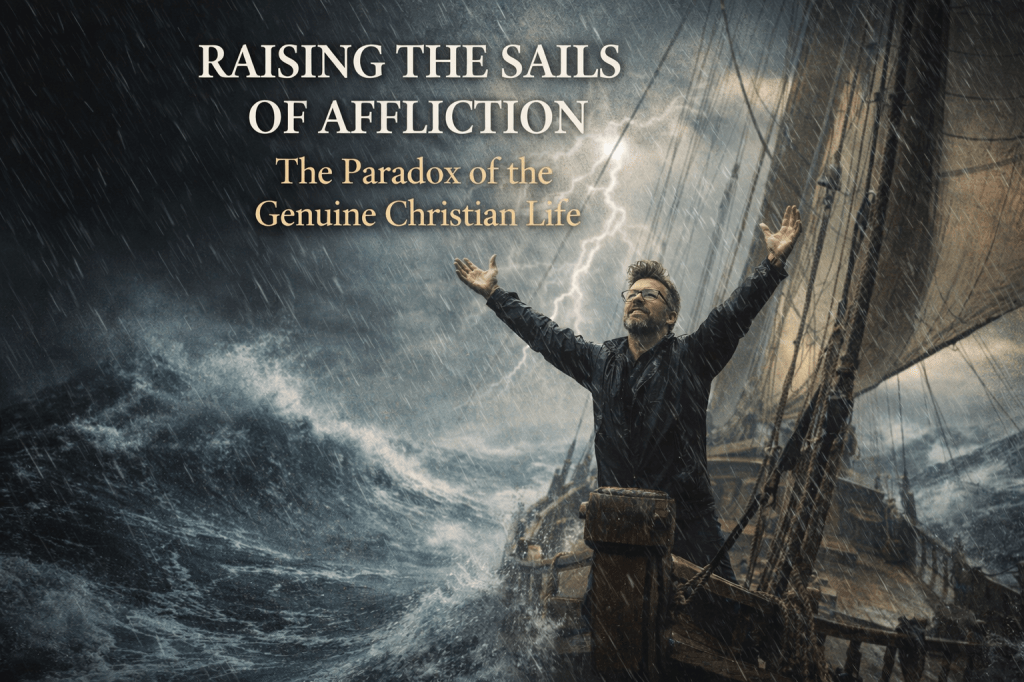
Raising the sails of affliction. The paradox of the genuine Christian life. Men and women who become entangled in the affairs of this world, who allow the headlines of the day or their present circumstances to draw their eyes away from the Lord, are those who lower their sails rather than power them when the winds of affliction begin to blow.
The storm is not the problem. The issue is where the eyes are fixed. When the eyes are fixed on the storm, fear rises. When fear rises, faith recedes. And when faith recedes, the sails come down. Look at the storm and you will sink. Look to Jesus and you will rise, carried by the wind above the waves. The same wind that terrifies one man will carry another. The difference is not the storm. It is the direction of the gaze and whether the sails are raised.
𝗧𝗛𝗘 𝗗𝗢𝗟𝗗𝗥𝗨𝗠𝗦 𝗢𝗙 𝗧𝗛𝗘 𝗦𝗢𝗨𝗟
Racing across the sea with the wind in your face, hurtling toward home, or finding yourself stalled and drifting in the spiritual doldrums of life. Brothers and sisters, the doldrums is a real place. It lies between five degrees north and five degrees south of the equator, shifting slightly throughout the year.
It stretches across the great oceans of the world, the Atlantic, the Pacific, and the Indian. Sailors of old, when sails were king, dreaded being trapped there. It was a place of weak or absent wind, of oppressive heat and heavy air, of sudden and violent storms that rose without warning. To be caught there was to make no forward progress. Supplies would dwindle. Water would run dry. The danger was real, not to perish in a raging storm, but to languish in a place where you are stuck, where you cannot move forward, and where the unseen currents of this world begin to drag you backward, and you do not even notice.
𝗦𝗧𝗨𝗖𝗞 𝗕𝗘𝗧𝗪𝗘𝗘𝗡 𝗦𝗧𝗢𝗥𝗠 𝗔𝗡𝗗 𝗦𝗧𝗜𝗟𝗟𝗡𝗘𝗦𝗦
Brothers and sisters, do you find yourself caught in the headlines of today. Do the circumstances of your life dominate your horizon. Either way, whether overwhelmed by storm or suffocated by inertia, the result is the same. The soul begins to sink into the morass of this world. Progress slows. Vision fades. Growth stalls. A life once moving toward the Lord becomes weighed down by what is seen, rather than lifted by what is unseen.
𝗟𝗜𝗙𝗧 𝗬𝗢𝗨𝗥 𝗘𝗬𝗘𝗦
Lift your eyes. For it is in Him, and Him alone, that we live and move and have our being. He alone is the answer to the storm. He alone is the answer to being stuck. There is no circumstance, no headline, no moment that exists outside of His authority. When the eyes are lifted, the soul is steadied. When the gaze returns to Him, direction returns, strength returns, life returns. The alternative is that headlines or the circumstances which you find yourself in dominate your life. Rather than taking your thoughts captive you are taken captive by them.
𝗧𝗛𝗘 𝗣𝗔𝗥𝗔𝗗𝗢𝗫 𝗢𝗙 𝗧𝗛𝗘 𝗦𝗧𝗢𝗥𝗠
Here is the paradox. We are called to raise our sails in the very teeth of the storm. Not to fight it, not to resist it in our own strength, but to yield to the wind of the Spirit. The storm that appears to threaten destruction becomes the very means by which we are carried forward. What seems contrary becomes the pathway. What appears dangerous becomes the vehicle of progress.
𝗥𝗜𝗗𝗘 𝗧𝗛𝗘 𝗪𝗜𝗡𝗗
Fight the storm and you will perish. Ride upon it, carried by His power, and you will not only live, you will live abundantly. The winds of affliction, when met with faith, do not destroy. They drive us forward. They press us onward. They hasten our journey. And so with the wind in your face and your sails lifted high, you are not drifting, you are not stalled, you are not overcome. You are being carried, steadily and powerfully, ever closer toward home.
There’s a phrase we use in the world: “The devil is in the details.”
It’s usually applied to negotiations or contracts, a warning to examine how things will actually work out. But there is another application to that phrase.
When you are in a trial, in a tribulation, and you allow your mind to go over and over and over every aspect of the circumstance, something begins to happen. You surrender control of your mind. We are told to take every thought captive to the obedience of Christ (2 Corinthians 10:5).
Yet when we rake over every detail of what has happened, rehearsing it, replaying it, analyzing it, and then telling one person, and then another, and another, adding to it each time, we are not walking in that obedience. We are multiplying our sorrows.
The Scripture says, “You will keep him in perfect peace, whose mind is stayed on You, because he trusts in You” (Isaiah 26:3).
Notice, peace is connected to where the mind stays.
Think about this.
How does a bird feed its young? It regurgitates food from its stomach back into the mouths of its chicks. That is how nature works.
But when we regurgitate, and let’s use the plain word, vomit, our circumstances to five other people, and then they begin to add their own details to our story, we are not seeking peace. We are reliving it. We are feeding on it again.
The apostle Paul instructs us clearly: “Be anxious for nothing, but in everything by prayer and supplication, with thanksgiving, let your requests be made known to God; and the peace of God, which surpasses all understanding, will guard your hearts and minds through Christ Jesus” (Philippians 4:6–7).
The guarding of the heart and mind comes after we bring it to God, not after we rehearse it before men.
Instead, when we continually retell and relive the circumstance, we rake over the ashes and coals of what has happened. We fan embers back into flame. We reset the fire of the circumstance rather than bringing it to the Lord and finding peace in Him.
We forget that the Lord was not in the wind, nor in the earthquake, nor in the fire, but in the still small voice (1 Kings 19:11–12).
And that stillness cannot be heard in a mind that is constantly agitated.
So remember this, brothers and sisters: Unless you are in a place of peace, unless you have quieted your mind enough to hear the still, small voice of God, do not regurgitate the story. Do not relive it again and again.
“For where your treasure is, there your heart will be also” (Matthew 6:21).
If the treasure becomes the injury, the offense, the trial, then the heart will remain there.But if the treasure is Christ, then the mind will return to Him. You are not glorifying the Lord by rehearsing the wound.You are not edifying your brothers and sisters by spreading the ashes.
And you are not strengthening yourself by reliving the fire.
We stand in a time when the Lord’s description of the harvest is no longer theoretical, but increasingly observable, to the point that what once lay hidden within the field can now be discerned as the age moves toward its consummation.
The Lord did not frame the close of the age as a single moment, but as a harvest season, as He Himself declared when opening the parable of the field [Matthew 13:24].
A closing span in which what has long grown together can no longer conceal its nature, for the harvest, He said, is the end of the age [Matthew 13:39].
When the grain reaches fullness, weight comes upon the head of the true wheat. It bows, heavy with formed life, while the tare, light and fruitless, remains upright, exposed by its own barrenness.
This is why there must be a period of unveiling. The distinction, once hidden in the green blade, becomes undeniable in the ripened field, just as He taught that both must grow together until the harvest [Matthew 13:30].
What could not safely be touched in the early growth can now be handled without harm to the wheat, because maturity has made separation just, visible, and irreversible. So within the synteleia tou aiōnos (Matthew 13:39), the consummation of the age, there unfolds a measured work of exposure and removal.
It is not haste, but precision. Not impulse, but ripeness that governs the reaping. The tares are taken from among the wheat because their habitation was never separate, reflecting His own words that the enemy sowed them among the wheat while men slept [Matthew 13:25].
They shared the same soil, the same rain, the same sun, yet bore no grain. And when the reapers move, they do so in a window of divine timing, for He said the reapers are the angels sent forth at the close of the age [Matthew 13:39–41].
In that solemn interval, the uprightness of the tare becomes its own testimony, and the harvest, long foretold, proceeds without injury to the wheat, fulfilling His declaration that all things that offend would be gathered out of His kingdom [Matthew 13:41].
And in an actual field, as the season turns and the wind moves across the ripened grain, another distinction appears.
The wheat does not only bow from weight, it moves differently.
When the gusts come, the true wheat sways in unified rhythm, heavy heads yielding, bending without breaking, the whole field rolling like waves of gold.
But the tares, stiffer and lighter, resist the movement. They jut upward, visually discordant, unable to flow with the humbled harvest around them, a living contrast between fruitfulness and barrenness. Farmers have long known that near reaping time, the mixed field reveals itself not merely by fruit, but by motion, posture, and response to pressure.
And so too in the closing span of this age, when the winds of testing, exposure, and judgment begin to blow across the house of God, ministries once indistinguishable from the surrounding wheat find themselves revealed by how they stand, echoing the apostolic warning that judgment must begin at the house of God [1 Peter 4:17].
The recent unravelings surrounding International House of Prayer Kansas City and controversies touching streams connected to Bethel Church have, for many, felt like that late season wind moving across the field.
Not creating what was hidden, but revealing what maturity and pressure made visible. For the first labor of the harvest is not the gentle gathering of the wheat, but the careful and deliberate removal of the tares from among it.
Separation is the primary work. For they did not grow in distant fields, but intertwined in the same soil, their roots wrapped together beneath the surface, their blades indistinguishable in the early season. And so when the harvest begins, the more exacting task comes first, just as the Lord instructed, gather the tares first and bind them [Matthew 13:30].
The tares must be identified, drawn out, and gathered away with precision, lest the wheat be harmed in the process. It is a judicial work before it is a restorative one, a clearing of the field before the securing of the grain.
Only when that difficult labor has been sufficiently accomplished does the harvest of the wheat proceed with swiftness and clarity. For once the choking growth has been removed, the bowed heads stand unobstructed, ready for the reaper’s hand.
Then the work becomes one of gathering rather than separating, of bringing in rather than casting out, fulfilling His promise that the righteous would be gathered into His barn [Matthew 13:30].
The barn awaits what the field has produced, and the weight of the wheat, once hidden among the tares, is now brought safely home. The paradigm shift has taken place in the world.
Thus the parable and the apostolic warning converge, revealing that the exposure of the tares is not reserved for a distant day, but is taking place even now.
What was planted in secrecy is being uncovered in the present hour. The likeness that once concealed is breaking down, and the field itself is bearing witness to the difference.
For the harvest is advancing, the separation is underway, and the righteous stand on the threshold of that moment when they will shine forth as the sun in the kingdom of their Father [Matthew 13:43].
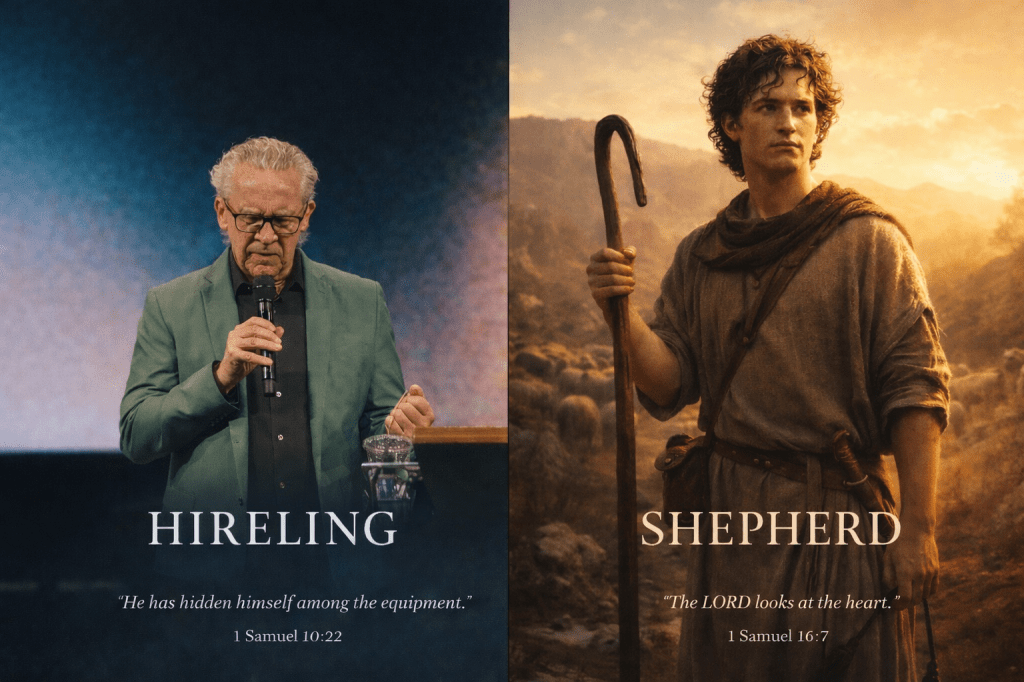
There is a profound contrast in Scripture between Saul and David, and it is not merely the difference between two kings, but between two kinds of men, two kinds of callings, and two kinds of authority. Saul is chosen by men. He fits the visible criteria. He is tall, impressive, outwardly commanding. He looks like a king. Yet when the moment comes for him to step into what God has spoken, he is found hiding among the equipment. The one selected to lead is crouched among baggage.
He has already spoken of his small tribe, his insignificant family, and while those words sound humble, they reveal a man measuring himself by human categories and shrinking beneath the weight of them. His humility is not rooted in trust, but in fear. When pressure comes, he preserves himself.
David is altogether different.
David’s story does not begin on a battlefield or in a palace, but in obscurity. He is the youngest. He is forgotten by his own father when Samuel comes to anoint a king. Yet long before any man sees him, the eye of the Lord is already upon him.
Scripture reminds us that God knows His own before they ever draw breath, that He forms them and calls them while they are yet in the womb. David is such a man. The hand of God, the presence of God, and the purpose of God are upon him from the beginning.
This is no man hiding among the equipment. While Saul hides, David fights. While Saul shrinks from visibility, David embraces responsibility. Alone in the fields, with no audience and no reward, David lays his life on the line for the sheep.
When the lion comes, when the bear comes, David does not calculate his odds. He does not preserve himself. He runs toward danger, because something in him already understands what it means to be a shepherd. The sheep matter more than his own safety.
This is the true shepherd, contrasted with the king men choose.
Men look for height, strength, charisma, and persuasive speech. God looks for the heart. Men crown what impresses them outwardly. God entrusts authority to those who are faithful inwardly. Saul is anointed first, but David is formed first.
David’s courage does not begin after anointing, it precedes it. His confidence is not in himself, but in the Lord who has already delivered him before anyone was watching.
This distinction is not confined to ancient Israel. It is painfully relevant today.
In every generation, men continue to choose leaders who are tall, handsome, articulate, and compelling. They gather crowds, build platforms, and command loyalty. Yet many have never been touched or shaped by the Spirit of God in secret. They are appointed by men, affirmed by numbers, and sustained by applause.
When the crux of the matter comes, when the cost is high and the wolves are near, they preserve themselves. They protect the institution, the reputation, the platform, rather than laying down their lives for the sheep.
David stands as God’s rebuke to this pattern. God is not impressed by appearance. He is not moved by charisma. He does not entrust His flock to those who hide when the cost becomes personal. He looks for shepherds who have already proven, in hidden places, that they will bleed for what is His. He looks for hearts that run toward danger when others retreat, for men who fear God more than visibility, and obedience more than survival.
The tragedy of Saul is not that he was small. The glory of David is not that he was strong. The difference is this: Saul belonged to himself.David belonged to God.
I was speaking with a brother the other day, a man seasoned by many years. He has been a pastor for more than three decades and also served for many years as a police officer. Before all of that, he once drove a concrete truck.
He told me about a day in Texas when the truck broke down while carrying ten yards of concrete. The drum stopped turning. Time passed, and before the load could be poured, the concrete had set solid inside the bowl. It took him nearly a week with a jackhammer to break it free. Concrete must keep moving until it is ready to be laid, otherwise it hardens without mercy and becomes unusable.
So it is with our hearts. When the Spirit’s work is resisted, delayed, or neglected, what was meant to be formed and poured out becomes hardened instead. What should have been usable for God’s purpose becomes difficult to break and costly to restore.
He spoke about the slump. Concrete must meet a precise measure. If it does not rise to the required standard, the entire load is rejected and discarded. There is no partial acceptance. If it does not meet the specification, it cannot be used.
So it is with the work God is doing in us. God does not measure by appearance or intention, but by what meets His standard. What does not rise to the measure of obedience and faith cannot be blended in or excused, it must be dealt with before the work can continue.
I shared with him what I had learned in construction. Samples are taken from the pour, allowed to harden, and weeks later crushed beneath great pressure. Only then is its strength revealed. Only then is it known whether it can bear the load for which it was made.
So it is with our faith. What God has formed in us is not proven in comfort, but under pressure. The crushing does not create the strength, it reveals whether the strength is truly there to bear the weight God has assigned.
There is also the matter of composition. Water, sand, aggregate, and cement must all be present, and each must be measured carefully. Too much or too little of any one part weakens the whole. The mixture determines the endurance.
So it is with the life God forms in us. Truth, obedience, suffering, grace, and patience each have their place, and none can be removed without consequence. When we favor one at the expense of the others, the strength of the whole is compromised, and what remains cannot endure the load it was meant to bear.
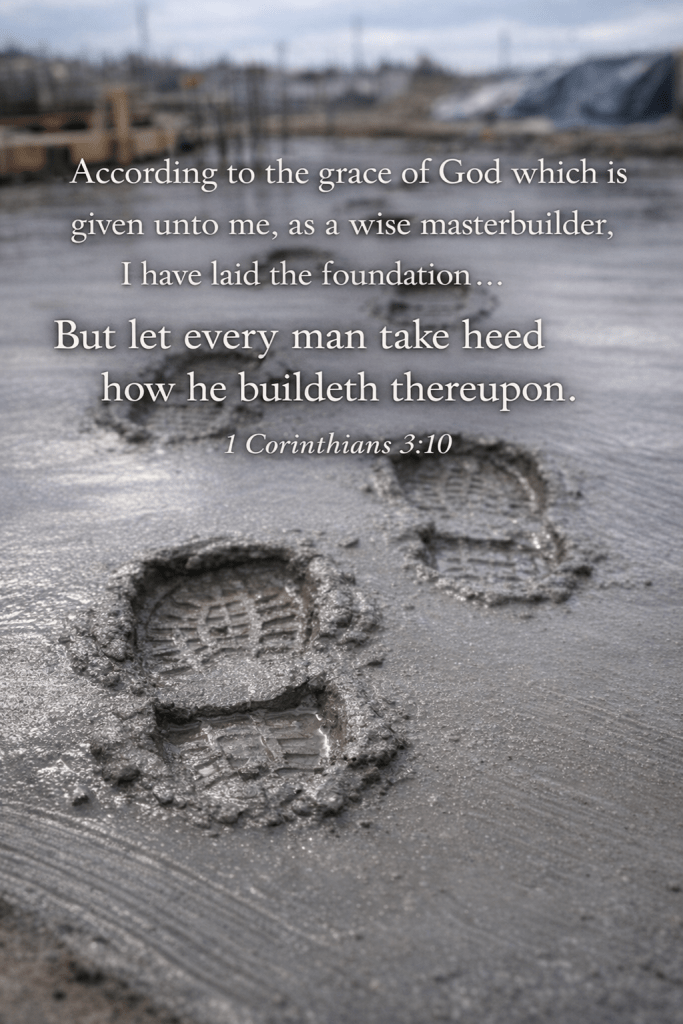
He then spoke of the freshly poured surface, smooth and carefully troweled. Sometimes someone comes walking toward it. You can see it happening and men shout warnings, but at times the person keeps going and walks straight through the concrete.
When that happens, the work is ruined. Either it must be torn up and done again, or the footprints remain forever, a permanent mark where none was meant to be.
Here the lesson becomes clear. When the Lord is doing a work, it is holy ground. When He is forming, shaping, and strengthening something, it is not to be trampled by careless feet.
God determines the mixture of our lives. He measures joy and sorrow, strength and weakness. He allows the testing and the crushing, not to destroy us, but to reveal whether we can bear the load appointed to us.
The strength that grows in us is not accidental, and the endurance is not self-made. It is the result of a careful and deliberate work of God. And even then, He does not leave us to carry the load alone. He bears it with us.
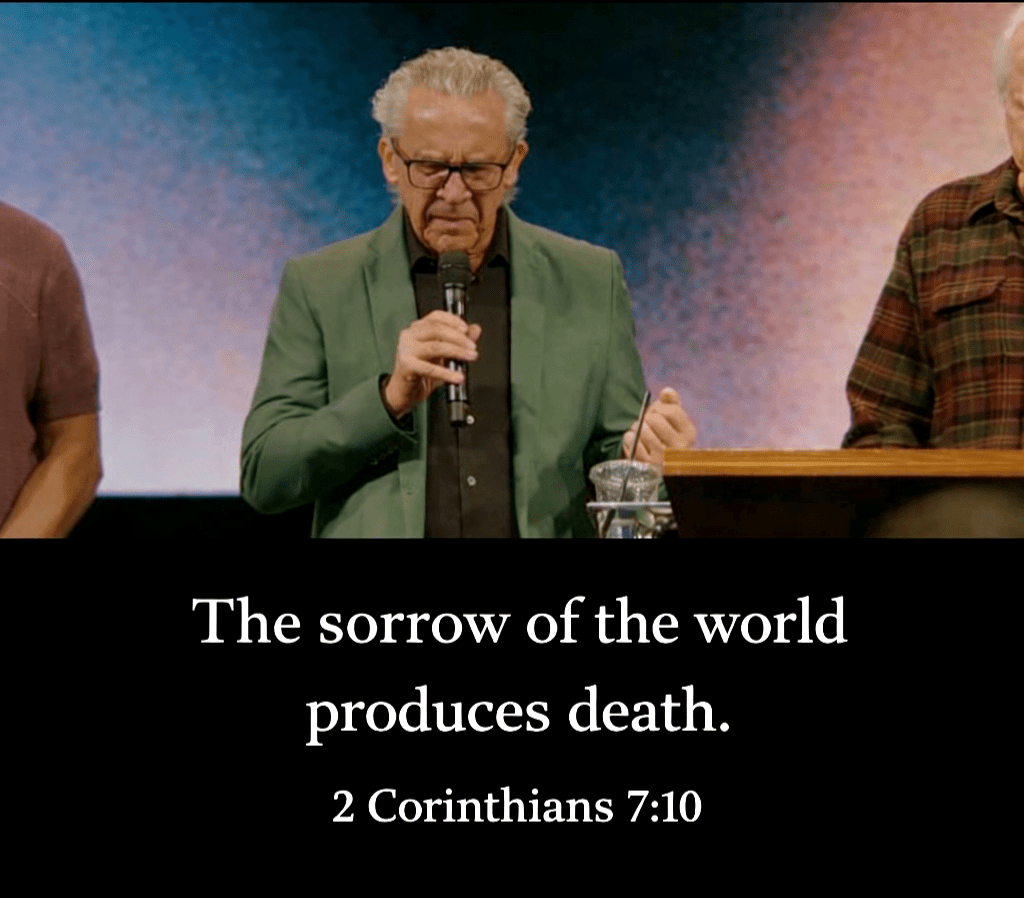
You get caught, the pressure builds, the crisis reaches critical mass, and suddenly something must be done. So the machinery groans into motion, statements are issued, gestures are made, hands are wrung. Damage control. Optics. Containment. It’s what politicians do, it’s what Hollywood does, it’s what the world does when exposure becomes unavoidable.
But it is not repentance. It is not the brokenness that comes when the Holy Spirit convicts a soul and strips it bare before God. It is theater, not truth. We’ve seen it before, paraded as humility, recycled as reform, trotted out whenever the spotlight burns too hot. But the repentance of the world does not lead to life, it leads to death.
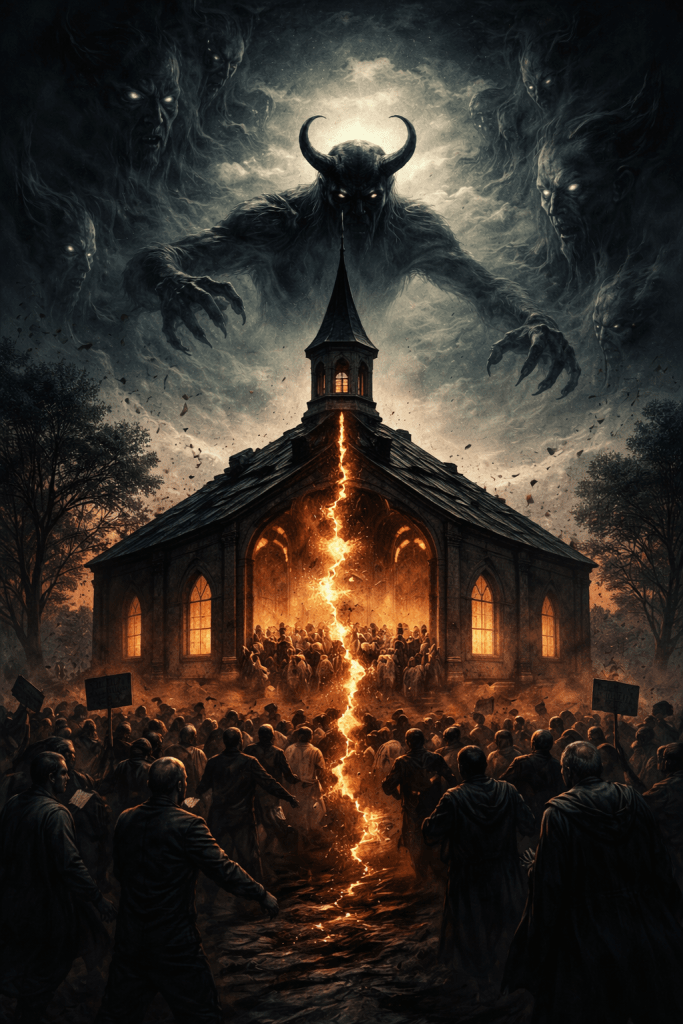
And the system that birthed this spectacle, the swollen engine of charismania, is rotten clear through. It has flooded the earth with slogans instead of Scripture, promises instead of obedience, “name it and claim it” in place of the fear of the Lord.
Health and wealth, prosperity without holiness, gold dust and feathers, signs without substance, every unclean counterfeit dressed up as revival. Its leaders have fattened themselves on the flock and boasted in their excess without shame. This road has only one destination. It does not end in awakening. It ends in judgment.
Agitprop, short for agitation propaganda, is not a modern invention, nor a harmless media trend. It was systematized by Lenin and perfected under Mao as a tool to emotionally mobilize populations, fracture societies, and replace truth with narrative loyalty. Its method is simple and ruthless, reduce reality to moral binaries, inflame grievance, personalize victims, demonize opponents, and keep people in a constant state of agitation so they no longer think, discern, or rest. What began as a political weapon has proven to be an extraordinarily effective spiritual one, because a soul kept in outrage is a soul distracted, divided, and cut off from peace, clarity, and communion with God.
For the Christian, this is not merely a cultural concern but a spiritual one. Agitprop trains the heart to live in reaction rather than reflection, to respond more quickly to headlines than to Scripture, and to feel moral urgency without seeking divine wisdom. It slowly displaces prayer with outrage and discernment with slogans. The result is not deeper faith, but constant inner noise, and where there is no stillness, the voice of God is easily drowned out.
Its fruit is division. Agitprop fractures families, friendships, and even churches by collapsing complex realities into a false righteousness, they are evil, we are good. Once this lens is adopted, love becomes conditional and unity becomes impossible. This is not accidental. Division has always been the enemy’s strategy, because a divided people lose their peace, their clarity, and ultimately their witness. The call for believers is not withdrawal, but vigilance, guarding the heart, resisting agitation, and remaining anchored in the peace and truth of Christ.
“For God is not the author of confusion, but of peace, as in all churches of the saints.” 1 Corinthians 14:33
“See to it that no one takes you captive through hollow and deceptive philosophy, which depends on human tradition and the elemental spiritual forces of this world rather than on Christ.” Colossians 2:8
“You will keep him in perfect peace, whose mind is stayed on You, because he trusts in You.” Isaiah 26:3