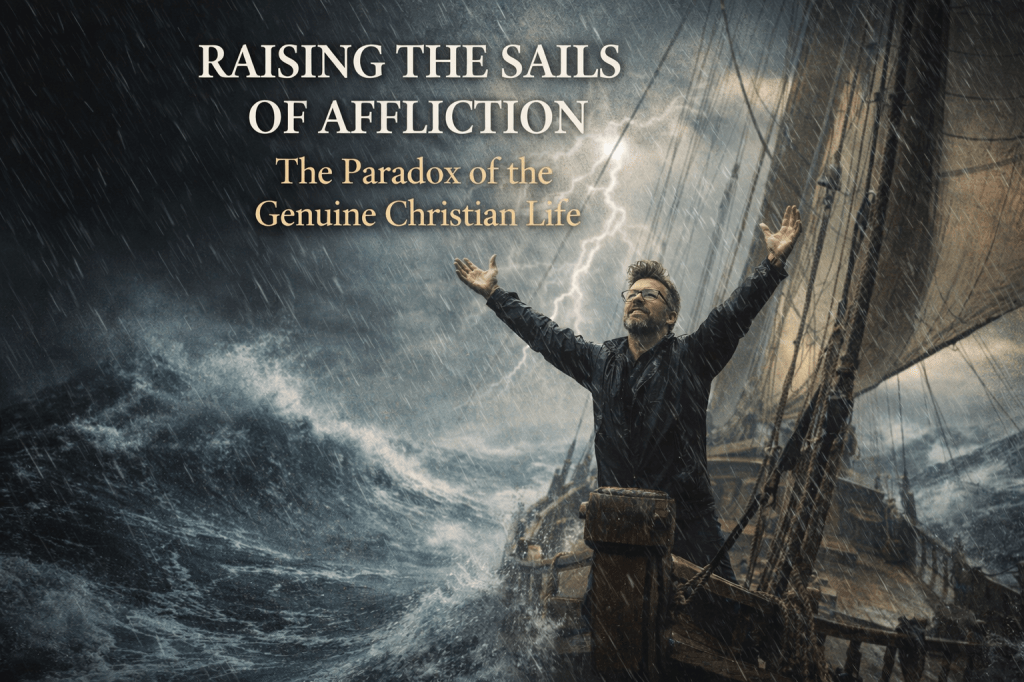
Raising the sails of affliction. The paradox of the genuine Christian life. Men and women who become entangled in the affairs of this world, who allow the headlines of the day or their present circumstances to draw their eyes away from the Lord, are those who lower their sails rather than power them when the winds of affliction begin to blow.
The storm is not the problem. The issue is where the eyes are fixed. When the eyes are fixed on the storm, fear rises. When fear rises, faith recedes. And when faith recedes, the sails come down. Look at the storm and you will sink. Look to Jesus and you will rise, carried by the wind above the waves. The same wind that terrifies one man will carry another. The difference is not the storm. It is the direction of the gaze and whether the sails are raised.
𝗧𝗛𝗘 𝗗𝗢𝗟𝗗𝗥𝗨𝗠𝗦 𝗢𝗙 𝗧𝗛𝗘 𝗦𝗢𝗨𝗟
Racing across the sea with the wind in your face, hurtling toward home, or finding yourself stalled and drifting in the spiritual doldrums of life. Brothers and sisters, the doldrums is a real place. It lies between five degrees north and five degrees south of the equator, shifting slightly throughout the year.
It stretches across the great oceans of the world, the Atlantic, the Pacific, and the Indian. Sailors of old, when sails were king, dreaded being trapped there. It was a place of weak or absent wind, of oppressive heat and heavy air, of sudden and violent storms that rose without warning. To be caught there was to make no forward progress. Supplies would dwindle. Water would run dry. The danger was real, not to perish in a raging storm, but to languish in a place where you are stuck, where you cannot move forward, and where the unseen currents of this world begin to drag you backward, and you do not even notice.
𝗦𝗧𝗨𝗖𝗞 𝗕𝗘𝗧𝗪𝗘𝗘𝗡 𝗦𝗧𝗢𝗥𝗠 𝗔𝗡𝗗 𝗦𝗧𝗜𝗟𝗟𝗡𝗘𝗦𝗦
Brothers and sisters, do you find yourself caught in the headlines of today. Do the circumstances of your life dominate your horizon. Either way, whether overwhelmed by storm or suffocated by inertia, the result is the same. The soul begins to sink into the morass of this world. Progress slows. Vision fades. Growth stalls. A life once moving toward the Lord becomes weighed down by what is seen, rather than lifted by what is unseen.
𝗟𝗜𝗙𝗧 𝗬𝗢𝗨𝗥 𝗘𝗬𝗘𝗦
Lift your eyes. For it is in Him, and Him alone, that we live and move and have our being. He alone is the answer to the storm. He alone is the answer to being stuck. There is no circumstance, no headline, no moment that exists outside of His authority. When the eyes are lifted, the soul is steadied. When the gaze returns to Him, direction returns, strength returns, life returns. The alternative is that headlines or the circumstances which you find yourself in dominate your life. Rather than taking your thoughts captive you are taken captive by them.
𝗧𝗛𝗘 𝗣𝗔𝗥𝗔𝗗𝗢𝗫 𝗢𝗙 𝗧𝗛𝗘 𝗦𝗧𝗢𝗥𝗠
Here is the paradox. We are called to raise our sails in the very teeth of the storm. Not to fight it, not to resist it in our own strength, but to yield to the wind of the Spirit. The storm that appears to threaten destruction becomes the very means by which we are carried forward. What seems contrary becomes the pathway. What appears dangerous becomes the vehicle of progress.
𝗥𝗜𝗗𝗘 𝗧𝗛𝗘 𝗪𝗜𝗡𝗗
Fight the storm and you will perish. Ride upon it, carried by His power, and you will not only live, you will live abundantly. The winds of affliction, when met with faith, do not destroy. They drive us forward. They press us onward. They hasten our journey. And so with the wind in your face and your sails lifted high, you are not drifting, you are not stalled, you are not overcome. You are being carried, steadily and powerfully, ever closer toward home.
There’s a phrase we use in the world: “The devil is in the details.”
It’s usually applied to negotiations or contracts, a warning to examine how things will actually work out. But there is another application to that phrase.
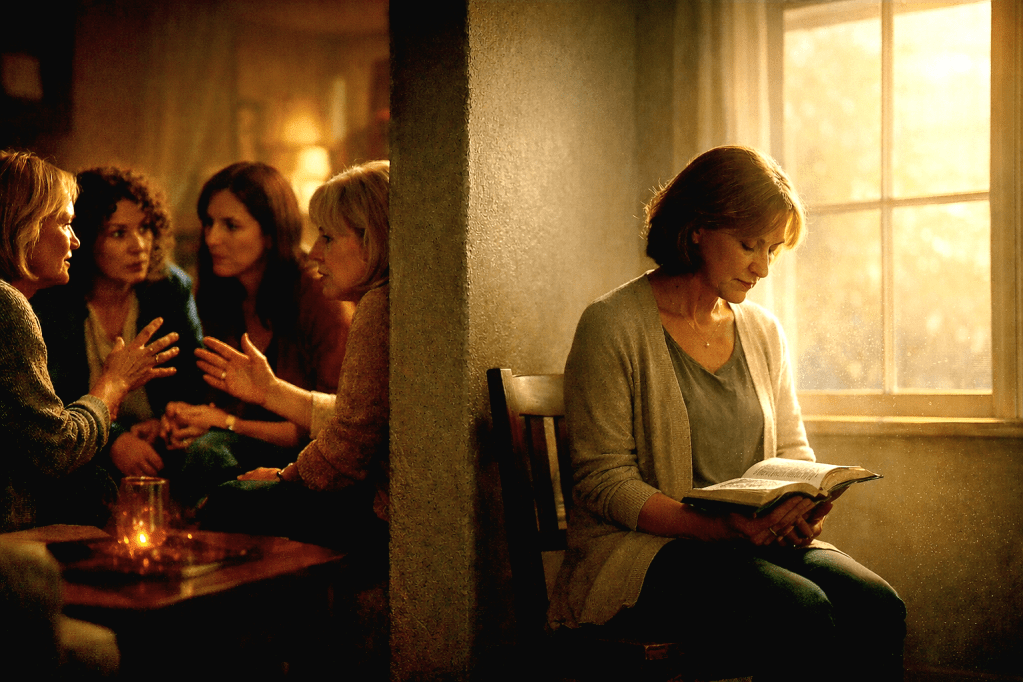
When you are in a trial, in a tribulation, and you allow your mind to go over and over and over every aspect of the circumstance, something begins to happen. You surrender control of your mind. We are told to take every thought captive to the obedience of Christ (2 Corinthians 10:5).
Yet when we rake over every detail of what has happened, rehearsing it, replaying it, analyzing it, and then telling one person, and then another, and another, adding to it each time, we are not walking in that obedience. We are multiplying our sorrows.
The Scripture says, “You will keep him in perfect peace, whose mind is stayed on You, because he trusts in You” (Isaiah 26:3).
Notice, peace is connected to where the mind stays.
Think about this.
How does a bird feed its young? It regurgitates food from its stomach back into the mouths of its chicks. That is how nature works.
But when we regurgitate, and let’s use the plain word, vomit, our circumstances to five other people, and then they begin to add their own details to our story, we are not seeking peace. We are reliving it. We are feeding on it again.
The apostle Paul instructs us clearly: “Be anxious for nothing, but in everything by prayer and supplication, with thanksgiving, let your requests be made known to God; and the peace of God, which surpasses all understanding, will guard your hearts and minds through Christ Jesus” (Philippians 4:6–7).
The guarding of the heart and mind comes after we bring it to God, not after we rehearse it before men.
Instead, when we continually retell and relive the circumstance, we rake over the ashes and coals of what has happened. We fan embers back into flame. We reset the fire of the circumstance rather than bringing it to the Lord and finding peace in Him.
We forget that the Lord was not in the wind, nor in the earthquake, nor in the fire, but in the still small voice (1 Kings 19:11–12).
And that stillness cannot be heard in a mind that is constantly agitated.
So remember this, brothers and sisters: Unless you are in a place of peace, unless you have quieted your mind enough to hear the still, small voice of God, do not regurgitate the story. Do not relive it again and again.
“For where your treasure is, there your heart will be also” (Matthew 6:21).
If the treasure becomes the injury, the offense, the trial, then the heart will remain there.But if the treasure is Christ, then the mind will return to Him. You are not glorifying the Lord by rehearsing the wound.You are not edifying your brothers and sisters by spreading the ashes.
And you are not strengthening yourself by reliving the fire.
I was speaking with a brother the other day, a man seasoned by many years. He has been a pastor for more than three decades and also served for many years as a police officer. Before all of that, he once drove a concrete truck.
He told me about a day in Texas when the truck broke down while carrying ten yards of concrete. The drum stopped turning. Time passed, and before the load could be poured, the concrete had set solid inside the bowl. It took him nearly a week with a jackhammer to break it free. Concrete must keep moving until it is ready to be laid, otherwise it hardens without mercy and becomes unusable.
So it is with our hearts. When the Spirit’s work is resisted, delayed, or neglected, what was meant to be formed and poured out becomes hardened instead. What should have been usable for God’s purpose becomes difficult to break and costly to restore.
He spoke about the slump. Concrete must meet a precise measure. If it does not rise to the required standard, the entire load is rejected and discarded. There is no partial acceptance. If it does not meet the specification, it cannot be used.
So it is with the work God is doing in us. God does not measure by appearance or intention, but by what meets His standard. What does not rise to the measure of obedience and faith cannot be blended in or excused, it must be dealt with before the work can continue.
I shared with him what I had learned in construction. Samples are taken from the pour, allowed to harden, and weeks later crushed beneath great pressure. Only then is its strength revealed. Only then is it known whether it can bear the load for which it was made.
So it is with our faith. What God has formed in us is not proven in comfort, but under pressure. The crushing does not create the strength, it reveals whether the strength is truly there to bear the weight God has assigned.
There is also the matter of composition. Water, sand, aggregate, and cement must all be present, and each must be measured carefully. Too much or too little of any one part weakens the whole. The mixture determines the endurance.
So it is with the life God forms in us. Truth, obedience, suffering, grace, and patience each have their place, and none can be removed without consequence. When we favor one at the expense of the others, the strength of the whole is compromised, and what remains cannot endure the load it was meant to bear.
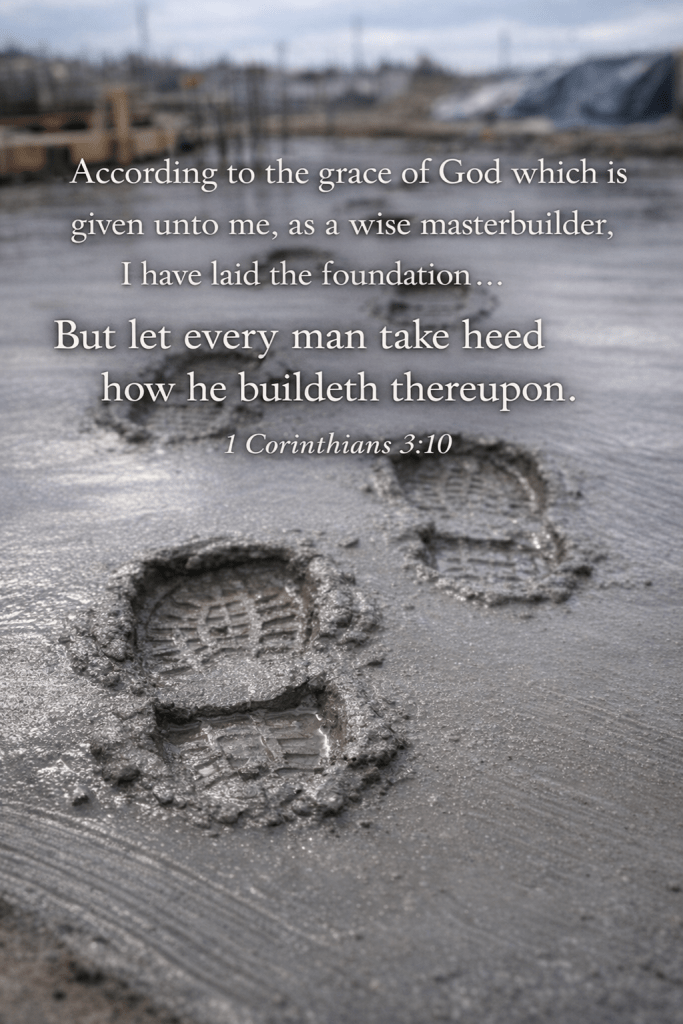
He then spoke of the freshly poured surface, smooth and carefully troweled. Sometimes someone comes walking toward it. You can see it happening and men shout warnings, but at times the person keeps going and walks straight through the concrete.
When that happens, the work is ruined. Either it must be torn up and done again, or the footprints remain forever, a permanent mark where none was meant to be.
Here the lesson becomes clear. When the Lord is doing a work, it is holy ground. When He is forming, shaping, and strengthening something, it is not to be trampled by careless feet.
God determines the mixture of our lives. He measures joy and sorrow, strength and weakness. He allows the testing and the crushing, not to destroy us, but to reveal whether we can bear the load appointed to us.
The strength that grows in us is not accidental, and the endurance is not self-made. It is the result of a careful and deliberate work of God. And even then, He does not leave us to carry the load alone. He bears it with us.
I want to respond to some objections raised against my initial piece on Yancey, though in truth it was never really about Yancey at all. It was about grace, what it is, how Scripture defines it, and why it matters. If the Body of Christ is ever to walk in true holiness and righteousness, so that a dying world can genuinely contrast us with itself, then grace must be taught and held in its proper biblical place. We have not been called to soothe the conscience of the saint, nor to dull the edge of God’s holiness, but to bear faithful witness to a God who is righteous, holy, and not to be treated lightly.
Philip Yancey presents a grace-first theology in which God’s mercy precedes human response, repentance is real but functions relationally rather than judicially, and the fear of God is redefined primarily as reverence and relational grief rather than warning or dread.
In this framework, repentance restores fellowship but does not place salvation genuinely at risk, and passages that warn of falling away are treated pastorally rather than with the full weight that tge words carry.. Yet Scripture speaks of those who were “once enlightened,” who “shared in the Holy Spirit,” and still “fell away,” and of judgment that is described as “a fearful thing to fall into the hands of the living God.” Jesus Himself warned that not everyone who says “Lord, Lord” will enter the kingdom, and that “the one who endures to the end will be saved.” The tension lies in whether these words are allowed to carry their full weight.
“Those once enlightened… who shared in the Holy Spirit… and then fell away.”
Hebrews and the warnings of Jesus present a gospel in which grace and holy fear coexist without contradiction.
Grace initiates salvation, yet believers are repeatedly urged to “hold fast,” to “take care lest there be an evil, unbelieving heart,” and to remember that “our God is a consuming fire.” This fear is not terror for the weak or the repentant, but sober awareness that holiness is real, covenant is serious, and perseverance matters. Scripture never pits love against Godly fear, but assumes they walk together in a proper union.
“Take care… lest there be an evil, unbelieving heart… for our God is a consuming fire.”
This tension is made unmistakable in the account of Ananias and Sapphira.
They were not outsiders but members of the church, and God judged deliberate hypocrisy in such a way that “great fear came upon the whole church.” The text offers no apology and no softening. The early believers learned, in a single moment, that the God who pours out grace also disciplines His people, and that His presence is not merely comforting but holy.
“Great fear came upon the whole church and upon all who heard these things.”
Throughout Scripture, promises are consistently attached to endurance and overcoming.
Life is promised to “the one who overcomes,” rest to those who “do not draw back,” and reigning with Christ to those who “remain faithful.” The other side of that promise is never hidden: hardening the heart, refusing to repent, or presuming upon grace carries consequence. These warnings are not written to frighten the faithful, but to awaken the complacent.
“To the one who overcomes… do not draw back… hold fast.”
This is why a softened, purely pastoral presentation of grace is ultimately dangerous. Grace was never meant to remove fear altogether, but to place it rightly. When grace is framed mainly to comfort, it risks producing peace without perseverance and assurance without obedience. There has always been a market for teachers who tell people what they want to hear, but Scripture was not written to soothe the unwatchful — it was written to form a people who endure, overcome, and remain faithful to the end.
“They will not endure sound teaching… turning aside to what they want to hear.”
I am less interested in his fall than I am in the response. Many who have read anything I have written over the years will note, much of it has been on grace, and of course, Phillip had much to write on that subject. This is my response to much of what I hear, and much of what I hear plays into “cheap grace,” and it’s multiple shades.
Grace That Saves vs. Grace That Reigns: A Cautionary Reflection
The issue before us is not whether sin is real, nor whether grace is necessary. Scripture is clear on both. The question is what kind of grace we are talking about, and what kind of Christianity it ultimately produces.
In recent years, public moral failures among respected Christian figures have often been framed almost exclusively as inevitable expressions of “shared human brokenness.” While this language sounds humble, it subtly shifts sin from a moral failing into some kind of inevitable human failing. In doing so, it does not merely acknowledge weakness, it lowers the expectation of transformation for the redeemed.
Scripture never denies that believers can sin. But it emphatically denies that sin remains our identity, our default, or our governing power. “How shall we who died to sin still live in it?” (Romans 6:2)
When Christian theology repeatedly insists that believers are always on the brink of collapse, always fundamentally the same as before conversion, it may sound realistic, but it is not apostolic. It is Romans 7 isolated from Romans 6, and Romans 7 elevated over Romans 8. It treats ongoing struggle as the final word, rather than the cross, the resurrection, and the indwelling Spirit.
The familiar phrase “we are just sinners saved by grace” is often offered as a summary of humility, yet it is theologically inncorrect. Scripture does not primarily identify believers as sinners with an added provision. It calls them saints, new creations, those freed from sin, those led by the Spirit, those no longer under condemnation.
Grace in the New Testament is not merely pardon after failure. It is power for obedience. It is the power to overcome. “For the grace of God has appeared… training us to renounce ungodliness and worldly passions.” (Titus 2:11–12)
When long-term, concealed patterns of sin emerge in the lives of Christian leaders, the appropriate response is not surprise, but neither is resignation. Scripture does not reduce such failures into “this is simply what humans do.” It speaks instead of accountability, sobriety, discipline, and, in some cases, disqualification. “Be not many teachers, for you will incur a stricter judgment.” (James 3:1)
An extended pattern of deception is not merely a momentary lapse. It reflects a sustained resistance to conscience and to the sanctifying work of the Spirit. To explain such outcomes primarily in terms of “low anthropology” is to misdiagnose the problem. The issue is not that we expected too much of human nature, but that we expected too little of regeneration.
Grace does not erase distinctions between light and darkness, faithfulness and betrayal, maturity and self-indulgence. Nor does it dissolve moral responsibility under the banner of shared frailty.
The New Testament does not warn believers against being shocked so much as it warns them to be sober. It is not unspiritual to be sobered by contradiction between confession and conduct. It is a recognition that truth was professed while obedience was withheld.
Grace does not merely arrive after the wreckage. Grace, when obeyed, prevents the wreckage. “The law of the Spirit of life in Christ Jesus has set you free from the law of sin and death.” (Romans 8:2)
To insist on this is not moralism, nor denial of weakness. It is fidelity to the gospel’s claim that sin no longer reigns, that believers are not trapped in inevitability, and that holiness is not exceptional but normative Christian life.
Grace that only forgives after the fall but never empowers before it is not amazing grace. It is cheap grace.
And cheap grace inevitably reframes defeat as realism and victory as naïveté.
The Latter Rain, Sinless Perfection, and the Crucified Flesh (part of our small home-group study)
The Latter Rain and Sinless Perfection The idea of a “latter rain” greater than Pentecost has no footing in Scripture. Joel’s prophecy was fulfilled at Pentecost — Peter said, “This is that which was spoken by the prophet Joel” (Acts 2:16).
There is no promise of another outpouring that will eclipse it. To claim the Spirit withdrew for 1900 years and will return only at the end denies Christ’s own words: “I will build My church, and the gates of Hades shall not prevail against it” (Matt. 16:18).
Likewise, Scripture never promises sinless perfection in this life. Paul said, “Not that I have already attained, or am already perfected; but I press on” (Phil. 3:12). John warns: “If we say that we have no sin, we deceive ourselves, and the truth is not in us” (1 John 1:8). Victory is real, but it is lived daily in dependence on Christ — not by declaring the battle finished.
The Spirit Wars Against the Flesh Paul wrote: “The flesh lusts against the Spirit, and the Spirit against the flesh” (Gal. 5:17). If the flesh were already silenced, Paul’s warnings would be pointless. Why command us, “Walk in the Spirit, and you shall not fulfill the lust of the flesh” (Gal. 5:16), if there were no struggle?
Romans 6 shows our union with Christ. Romans 7 shows Paul wrestling still: “I find then a law, that evil is present with me, the one who wills to do good” (Rom. 7:21). Deliverance comes not by denying the conflict, but through Christ: “Thanks be to God through Jesus Christ our Lord!” (Rom. 7:25).
The Crucified Flesh: Decisive, Yet Lingering Paul declared: “Those who are Christ’s have crucified the flesh” (Gal. 5:24). Crucifixion was decisive — but it was not instant death. It was slow, agonizing.
A crucified man’s fate was sealed once nailed, yet he still lingered in pain until death. Spiritually, our flesh has been nailed to the cross, its fate sealed — but it still struggles.
This is why Paul said, “I die daily” (1 Cor. 15:31), and urged believers, “Put to death therefore what is earthly in you” (Col. 3:5). The cross was applied once, but its execution unfolds daily until glory.
Jesus said: “If anyone desires to come after Me, let him deny himself, and take up his cross daily” (Luke 9:23). If the flesh were fully dead, why would He command us to do this?
Walking According to the Spirit “There is therefore now no condemnation to those who are in Christ Jesus, who do not walk according to the flesh, but according to the Spirit” (Rom. 8:1).
To be in the Spirit is our position (Rom. 8:9). To walk according to the Spirit is our practice.
The flesh condemns: “You are weak, defeated, guilty.”
The Spirit builds up: “You are sons and daughters, more than conquerors.”
Gideon heard two reports: his flesh said he was the least (Judg. 6:15). God’s Spirit called him a mighty man of valor (Judg. 6:12). The question was: whose report would he believe?
Conclusion The Bible does not teach sinless perfection now, nor that the flesh has vanished, nor that a greater “latter rain” revival is coming. It teaches this:
The flesh has been crucified with Christ.
Its death is certain, though it lingers.
We must deny ourselves, take up the cross daily, and walk according to the Spirit.
To collapse this tension is to miss the biblical balance. Christ’s cross guarantees victory — but discipleship requires daily cross-bearing until the war is over.
Let the Word close the matter: “If we say that we have no sin, we deceive ourselves, and the truth is not in us” (1 John 1:8).
“Let this mind be in you which was also in Christ Jesus.” (Philippians 2:5)
“For the weapons of our warfare are not carnal but mighty in God for pulling down strongholds, bringing every thought into captivity to the obedience of Christ.” (2 Corinthians 10:4–5)
In nature, when water flows over sandstone, it slowly carves a channel. At first it is shallow, but as the water continues, the groove deepens, until it becomes a permanent path. When the rain returns, it always follows the same course.
The human mind works much the same way. When we experience pain in the body, for example an injury to the elbow, the signal travels from the point of pain along a neural pathway to the brain. The more often that signal fires, the more established that pathway becomes.
In the same way, when someone wounds us through word or deed, a kind of spiritual signal travels from the point of the injury to the soul. Over time, that pain forms an inner pathway, a reflex of hurt, fear, or anger that becomes easier to travel each time it is triggered.
And so, just as the sandstone is shaped by the flow of water, the soul becomes shaped by pain. It cuts deep grooves into the inner life, and our thoughts begin to flow along those old tracks without effort. We do not even choose it, it becomes instinct.
Yet there is a remarkable truth found even in the world of medicine.Surgeons sometimes use a method called mirroring, where a patient focuses their attention on the healthy limb instead of the injured one. The brain begins to believe that healing is occurring in the damaged area, and the pathways of pain are slowly rewritten.
In the same way, Jesus is our healthy limb. When we take our eyes off our wounds and fix them on Him, we begin to heal. As we behold Him, His forgiveness, His grace, His mercy, we begin to mirror Him. We start to think as He thinks, to love as He loves, and to forgive as He forgave.
And this healing does not simply restore us to our original condition. It lifts us higher, it transforms us. For we are not merely conquerors over pain and sin, we are, as Scripture says, “more than conquerors through Christ Jesus.” (Romans 8:37)
Paul writes, “Let this mind be in you which was also in Christ Jesus.” (Philippians 2:5) This is an invitation to transformation, to a spiritual rewiring of our inner life. The Holy Spirit begins to pour living water through us, and slowly, the current changes course.
Where fear once ruled, trust begins to flow. Where bitterness dug deep, forgiveness takes root. Where sorrow carved its mark, peace begins to move like a river.
Paul also says, “Bring every thought into captivity to the obedience of Christ.” (2 Corinthians 10:5) Each time we catch a thought before it slides into the old groove, we redirect the flow toward Him. This is the renewal of the mind, the Spirit reshaping what pain once defined.
Each surrendered thought deepens a new channel of grace. Each moment of obedience erodes the old pathways of pain. Soon the soul begins to flow naturally toward Christ. The old grooves may still be visible, but they no longer control the current.
Ask yourself: What grooves in my mind were carved by pain or fear?
Do I still let my thoughts run down those channels?
Or am I letting the Spirit redirect the flow toward peace, mercy, and faith?
This was the prayer that came to my spirit as I walked and prayed this morning.
If a celestial staircase opened before me Lord, I would climb it, step by step, all the way to heaven. If I could lay my burdens down, I would lay them all down now, at Your feet oh Lord.
If the noise of this world could be silenced forever, O what a glorious moment that would be. For nothing surpasses the peace of Your presence, The stillness, the holy rest of our God.
There is no clamoring when we draw near to You, Lord, Only rest, and peace, and stillness. You make me lie down in pastures green, You lead me beside the still waters of life.
Amid the tumult and noise of this age, Fix my mind on the eternal, unseen kingdom. Open my eyes to behold Your way, The kingdom that cannot be shaken.
Open the staircase of heaven before me, Lord, That I might climb into Your presence, Leaving the clamor and the noise behind, And dwelling forever in Your light.
The Pentecostal and Charismatic world has been shaped by movements such as “name it and claim it” and the so-called “word of faith” message. Add to that the prosperity gospel, and what remains is a witches brew, a kind of spiritual confusion brewed in our own theological cauldron. These movements have often shifted the focus of faith from trusting in God to demanding from God, turning faith into a formula for material gain rather than a pathway to spiritual depth. What was once a holy dependence on the sovereignty of God has, in many circles, become a technique for manipulating outcomes.
Yet Scripture offers a deeper, more sobering view. Depending on the translation, the word “faith,” appears around 270 times in the Bible. The vast majority of these references are not about miracles or breakthrough, but about trust, trust in God’s character, His promises, and His sovereign will.
Hebrews 11:6 says, “But without faith it is impossible to please Him, for he who comes to God must believe that He is, and that He is a rewarder of those who diligently seek Him.”
The kind of faith that pleases God is not transactional, but relational. It is the quiet, unwavering confidence in who God is, even when heaven is silent and the way is dark.
Romans 8:8 reinforces this truth: “So then, those who are in the flesh cannot please God.” Faith and flesh are incompatible. One walks by sight, the other by belief. To walk in the flesh is, functionally, to walk without faith.
Romans 8:5 explains, “For those who live according to the flesh set their minds on the things of the flesh.” The word mind here, phroneó, speaks of setting one’s affections, fixing one’s thoughts and desires. To “mind” the things of the flesh is to be consumed with the visible, temporal world. The Greek word for flesh, sarx, in this context means “the symbol of what is external.”
What does that look like in practical terms? It means being consumed with our careers, our possessions, our reputations, our politics, our social standing, our image, gaining our miracles, our health, rather than being absorbed in the things of God. A mind dominated by these mostly earthly concerns is incompatible with the Spirit-led life. Such a person is not walking in the Spirit, and therefore cannot please God. Being obsessed with miracles often flows, not from the heart of God, rather , it flows from the depths of our flesh.
“For to be carnally minded is death, but to be spiritually minded is life and peace.” (Romans 8:6)
The spiritual mind is one that seeks first the Kingdom of God and His righteousness (Matthew 6:33). It is a life oriented toward the eternal, not the temporary.
Hebrews 11, that great chapter of faith, gives us a dual picture. We rejoice in the stories of deliverance:
“By faith the walls of Jericho fell” (v.30), “Through faith they subdued kingdoms, worked righteousness, obtained promises, stopped the mouths of lions” (v.33). These are victories worth celebrating.
Yet the chapter shifts abruptly. “Others were tortured, not accepting deliverance, that they might obtain a better resurrection. Still others had trial of mockings and scourgings, yes, and of chains and imprisonment. They were stoned, they were sawn in two… being destitute, afflicted, tormented, of whom the world was not worthy.” (vv.35–38)
The common thread?
“And all these, having obtained a good testimony through faith, did not receive the promise.” (v.39)
Their faith was not measured by immediate reward, but by enduring trust in the unseen. Job expressed it best:
“Though He slay me, yet will I trust Him.” (Job 13:15)
Habakkuk echoes the same heart: “Though the fig tree may not blossom… yet I will rejoice in the Lord.” (Habakkuk 3:17–18)
This kind of faith is not swayed by trials or silence. It is rooted in relationship, not reward. Psalm 23 reminds us that God does not remove the enemies, but prepares a table in their midst.
“You anoint my head with oil, my cup runs over.” (Psalm 23:5) The oil flows not in times of ease, but in times of pressure. The true reward of faith is not what we receive, but who we receive—His presence.
“In Your presence is fullness of joy.” (Psalm 16:11)
The last 2,000 years of Church history bear witness to this truth. Millions have suffered for Christ, not because their faith failed, but because their faith endured. They possessed a spiritual mind and a heart anchored in another world. Their lives pleased God. Their testimonies still speak.
So the question is this: will you walk in the Spirit today? Will you cast aside the fleeting things of this world and set your affections on things above (Colossians 3:2)? Will you walk by faith and not by sight (2 Corinthians 5:7)? Will you trust God even when there is no sign of deliverance?
This is the faith that pleases God. And without it, we cannot.
The apostolic revelation given to Paul, as recorded in Colossians 1:26, presents one of the most profound disclosures in redemptive history—a mystery once concealed from ages and generations, now gloriously revealed to the saints. This mystery, long hidden in the counsels of God, was not perceived by the prophets nor comprehended by the wise of this world. It is the astounding truth that in Christ Jesus, Jew and Gentile are no longer divided, but made one—a new humanity, a single body in the Messiah. This is the long-anticipated fulfillment of the promise to Abraham, that in his seed all the nations of the earth would be blessed. No merely ethnic boundary remains, for in Christ there is neither Jew nor Greek. This is a revelation of cosmic consequence and divine ingenuity, wholly unforeseen in its breadth and intimacy.
Yet, astonishingly, the mystery deepens. As Paul continues in Colossians 2:2–3, he reveals that the purpose of this unity is not an end in itself, but a divine conduit by which the saints are brought into the very heart of God. He prays that their hearts might be encouraged, being knit together in love, and that they may attain to all the riches of the full assurance of understanding—to the knowledge of the mystery of God, both of the Father and of Christ.
Herein lies the surpassing dimension of the mystery: not merely reconciliation between former enemies, but an invitation into divine communion. In Christ are hidden all the treasures of wisdom and knowledge. Through union with Him, the veil is lifted and the Father—once unknowable and inscrutable—is made known. The mystery begins with the joining of the divided, but it climaxes in the revelation of the Divine. It is not only that Jew and Gentile are made one in Christ, but that in being made one, they are ushered into the very life of God.
This is the formation of the true Israel of God—a people sanctified, a royal priesthood, whose minds are being renewed and whose hearts are being enlarged by the Spirit. The saints are not left with mere doctrine, but are drawn into the riches of divine intimacy, discovering the boundless wisdom and knowledge hidden in Christ. This is the full arc of the mystery: reconciliation leading to revelation, unity giving way to glory, and the Church—Christ’s body—growing in grace as it beholds the face of God in the person of Jesus Christ.
Brothers and sisters, Christ is coming back and He is coming soon. This world is judged, this country is judged and Christendom( everything that calls itself by the name of Christ but does not know Him) is judged. And so now we must flee, flee from Babylon and into the arms of Jesus. Just like Lot we must prepare to leave the comforts of Sodom. Just like the exiles, we must prepare to leave the comforts of Babylon
Just like our early brothers and sisters, we must prepare to leave Jerusalem for there is a fierce judgement coming, the final judgement. All attachments to this world must be broken even as we continue to go into this world for needs must. These judgements that we are in the midst of, these birth pangs are just the beginning and they are from the hand of God. Shall we resist the hand of God?
Resistance will not change the judgements to come. The arrogance of those who hate us will continue to rise. Shall we meet arrogance with arrogance? Shall we match their hatred and their violence, shall we render evil for evil? As our enemies gain ground they will become emboldened. They will have the world behind them and true and genuine Christianity will be pushed forward into the lime-light and all the world will hate us as we refuse to bow down to the gods of this world.
Yet brothers and sisters, be of good cheer for the Spirit of God will burn brighter in this generation than has ever been seen before. As the flood of darkness pours in, an incomprehensible darkness, then the light that is in us will shine brighter than ever before. The nobility of the Royal priesthood will be seen by all the world. Consider how one views diamonds in a Jewelers. The diamonds are set on black velvet so that the brilliance of the stones are illuminated against the blackness
As so it will be with the Lord’s own jewels. They will be seen against the backdrop of total darkness and they will shine like they have never shone before. The magnificent beauty of holiness will burn so brightly in the chests of every remnant child of God as they are led, all the day long, as lambs to the slaughter. And when their numbers are fulfilled, then shall come the King of Kings.
Brothers and sisters, when I look up to the cross I see humility. I see my Lord humbled and naked for the whole world to see. Nothing hidden. When I look up to the cross I see justice. I see sin condemned. Oh brothers and sisters when I look up to the cross I see mercy . Mercy for me, mercy for me, mercy for me. I do not see my own condemnation, I see my Jesus condemned and rejected by the world, willingly taking my place. Yes, I see Jesus. There is therefore, now no condemnation, because He took my condemnation, to those who are in Christ Jesus, who walk not according to the flesh, but according to the Spirit. For the law of the Spirit of life in Christ Jesus has made me free from the law of sin and death.
Oh what a glorious freedom. Free indeed, free indeed , free indeed. Free indeed to stand and fight. To battle even unto death, with my fellow freed men. I pray today that those whom the Son has set free will catch a glimpse of who they are in Christ. Royal priests in a royal priesthood. Children of the living God. Loved and redeemed and reconciled and called to walk in the beauty of holiness. That the world may know that Jesus was sent by the Father. That the world may see something of the glory of God which was given to Jesus and which He has given to us. Rise up and shine today saints of God, rise up and shine, for you are loved so much. How much? Look up to the cross!!!!
Perhaps you have a heavy spirit this day. You may be having a hard time imagining that things will ever change. It seems to you that tomorrow will inevitably be like today because today was just the same as yesterday, and on it goes. For whatever reason you cannot seem to shake this of. The Lord has provided us with a solution and a way of escape from every situation. He says that we should put on a “garment of praise for the spirit of heaviness.” If you will begin to praise Him right now, even although you do not feel like it, then the spirit of heaviness will flee. The song goes like this “Put on The garment of praise for the Spirit of heaviness, lift up your voice and sing, sing with the Spirit and with understanding, Oh magnify the King” Let our King be magnified this day. For as we lift up our eyes, as we look unto the mountain, we shall see where our help comes from. Let us magnify the Lord Jesus this day, this very moment. Let us consider all the battles that He has taken us through, how He saved us, how we came to know Him, how His presence is so sweet. Lets consider eternity, and that these present trials will fade into memory as we walk on with Him in the beauty of Holiness. If you will lift up your head this day, then you will see the glory of the Risen Lord, for the head that hangs down cannot see what is above him or what is before him. He is above us, and His Spirit goes before us and will make the crooked path straight, He will make “rivers in the desert,” He will “make a way where there seems to be no way,” for He is faithful and true and is holding out His hand to you right now, lift up you head, reach out and take it, He will lead and guide you through this difficult part of the journey. In the world, when a person is most at risk and in great danger, then they rely greatly on their five senses. In the Spirit it is not so. As you walk through the valley of the shadow of death, as you negotiate the most dangerous parts of your journey, the Lord asks that you would suspend your senses, close your eyes and let Him lead you. He will lead your every step, minute by minute, day by day and far from feeling vulnerable because you have closed your eyes, you will feel more secure than you have ever before because you have surrendered your ability to cope, and you are completely dependent upon Him.
As many may know, the Lord asked me several months ago to write a poem for every Psalm. This was and is a daunting task. I believe that the Lord asked me to do this last year because last year was one of the toughest years of my Christian walk where I got to walk through the deepest and darkest valley yet. And because of that, the Psalms touched my raw spirit in ways that only the Psalms can. For Christians, victories are won in the depths of the valley and strongholds are broken down. This is where the fight is taken to the enemy. This place is his dark domain. This is a place that we would never voluntarily come to. We would never come to this place willingly. Yet this place is where we see the gates of bronze broken down and the bars of iron cut in two. Below are the last few poems that I have written, I am up to Psalm 114. May they bless you………………



 A Call To The Remnant