A Call To The Remnant

Scottish Warriors for Christ- http://www.facebook.com/acalltotheremnant

Posts Tagged ‘apostate church’

Separation of the wheat from the tares.

Posted by appolus on February 19, 2026

We stand in a time when the Lord’s description of the harvest is no longer theoretical, but increasingly observable, to the point that what once lay hidden within the field can now be discerned as the age moves toward its consummation.


The Lord did not frame the close of the age as a single moment, but as a harvest season, as He Himself declared when opening the parable of the field [Matthew 13:24].


A closing span in which what has long grown together can no longer conceal its nature, for the harvest, He said, is the end of the age [Matthew 13:39].


When the grain reaches fullness, weight comes upon the head of the true wheat. It bows, heavy with formed life, while the tare, light and fruitless, remains upright, exposed by its own barrenness.


This is why there must be a period of unveiling. The distinction, once hidden in the green blade, becomes undeniable in the ripened field, just as He taught that both must grow together until the harvest [Matthew 13:30].


What could not safely be touched in the early growth can now be handled without harm to the wheat, because maturity has made separation just, visible, and irreversible.
So within the synteleia tou aiōnos (Matthew 13:39), the consummation of the age, there unfolds a measured work of exposure and removal.


It is not haste, but precision. Not impulse, but ripeness that governs the reaping.
The tares are taken from among the wheat because their habitation was never separate, reflecting His own words that the enemy sowed them among the wheat while men slept [Matthew 13:25].


They shared the same soil, the same rain, the same sun, yet bore no grain.
And when the reapers move, they do so in a window of divine timing, for He said the reapers are the angels sent forth at the close of the age [Matthew 13:39–41].


In that solemn interval, the uprightness of the tare becomes its own testimony, and the harvest, long foretold, proceeds without injury to the wheat, fulfilling His declaration that all things that offend would be gathered out of His kingdom [Matthew 13:41].


And in an actual field, as the season turns and the wind moves across the ripened grain, another distinction appears.


The wheat does not only bow from weight, it moves differently.


When the gusts come, the true wheat sways in unified rhythm, heavy heads yielding, bending without breaking, the whole field rolling like waves of gold.


But the tares, stiffer and lighter, resist the movement. They jut upward, visually discordant, unable to flow with the humbled harvest around them, a living contrast between fruitfulness and barrenness.
Farmers have long known that near reaping time, the mixed field reveals itself not merely by fruit, but by motion, posture, and response to pressure.


And so too in the closing span of this age, when the winds of testing, exposure, and judgment begin to blow across the house of God, ministries once indistinguishable from the surrounding wheat find themselves revealed by how they stand, echoing the apostolic warning that judgment must begin at the house of God [1 Peter 4:17].


The recent unravelings surrounding International House of Prayer Kansas City and controversies touching streams connected to Bethel Church have, for many, felt like that late season wind moving across the field.


Not creating what was hidden, but revealing what maturity and pressure made visible.
For the first labor of the harvest is not the gentle gathering of the wheat, but the careful and deliberate removal of the tares from among it.


Separation is the primary work.
For they did not grow in distant fields, but intertwined in the same soil, their roots wrapped together beneath the surface, their blades indistinguishable in the early season.
And so when the harvest begins, the more exacting task comes first, just as the Lord instructed, gather the tares first and bind them [Matthew 13:30].


The tares must be identified, drawn out, and gathered away with precision, lest the wheat be harmed in the process.
It is a judicial work before it is a restorative one, a clearing of the field before the securing of the grain.


Only when that difficult labor has been sufficiently accomplished does the harvest of the wheat proceed with swiftness and clarity.
For once the choking growth has been removed, the bowed heads stand unobstructed, ready for the reaper’s hand.


Then the work becomes one of gathering rather than separating, of bringing in rather than casting out, fulfilling His promise that the righteous would be gathered into His barn [Matthew 13:30].


The barn awaits what the field has produced, and the weight of the wheat, once hidden among the tares, is now brought safely home.
The paradigm shift has taken place in the world.


Thus the parable and the apostolic warning converge, revealing that the exposure of the tares is not reserved for a distant day, but is taking place even now.


What was planted in secrecy is being uncovered in the present hour.
The likeness that once concealed is breaking down, and the field itself is bearing witness to the difference.


For the harvest is advancing, the separation is underway, and the righteous stand on the threshold of that moment when they will shine forth as the sun in the kingdom of their Father [Matthew 13:43].
Posted in Christian, christian blog, christian living, Christianity, Church history, Counterfeit Jesus, Daily devotional, Devotions, discernment, faith, false prophecy, False Prophets, false teachers, Greedy Shepherds, Jesus, leaving the church, New Apostolic Reformation, new wineskins, prophetic movement, prosperity gospel, remnant church, revival, Spiritual warfare, testimony, the crucified life, the deeper life, the gospel, the persectuted church, The presence of God, the remnant, The State of the Chuch and Manifest presence, the state of the church | Tagged: , , , , , , , , , , , , , , , , , | 1 Comment »

How Shall We Prevail In The Coming Tribulation?

Posted by appolus on February 12, 2026

This is the primary role of God’s remnant here on earth, to be His witness. In every age His remnant have suffered. They were and are a living witness to the underlying truth that suffering is a major part of our walk with Christ. Scripture does not say if we pass through the waters, but when. The passage assumes the trial. It establishes it as certain.

Job, of course, stands as the perfect example of a mere man. It is no surprise that his account is widely regarded as the earliest book of the Bible, written before Genesis itself. God was laying down markers from the very beginning. He was clearly showing that there is no vital connection between worldly blessing and relationship to Him. Job’s friends, like most modern day Christians, and certainly almost all within Charismatic circles, trying to “live their best lives now” could not and would not understand this mystery.

Yet when Job shaved his head and tore his robe over the loss of everything, and then fell to his knees in worship and blessed the name of God, we are given the model. There it is unveiled in raw humanity and holy reverence.

Suffering, and our reaction to it, becomes the great separator. It separates the legitimate from the illegitimate. The many from the few. And it has been this way down through the ages, right up to and including this present day.

When the great tribulation comes, when trials grow fierce beyond anything previously known, God will already have trained a remnant over the many decades of their lives in the ways of suffering, enduring, and overcoming. They will not be novices in the furnace. They will have fought many battles long before the great battle arrives.

They will know the Scripture well from Revelation 13 where the great enemy of our souls wages war against the saints and, in human terms, prevails.
And yet the question stands. How do we overcome when that time comes? The same way we overcome now.

By the Blood of the Lamb.
By the word of our testimony.
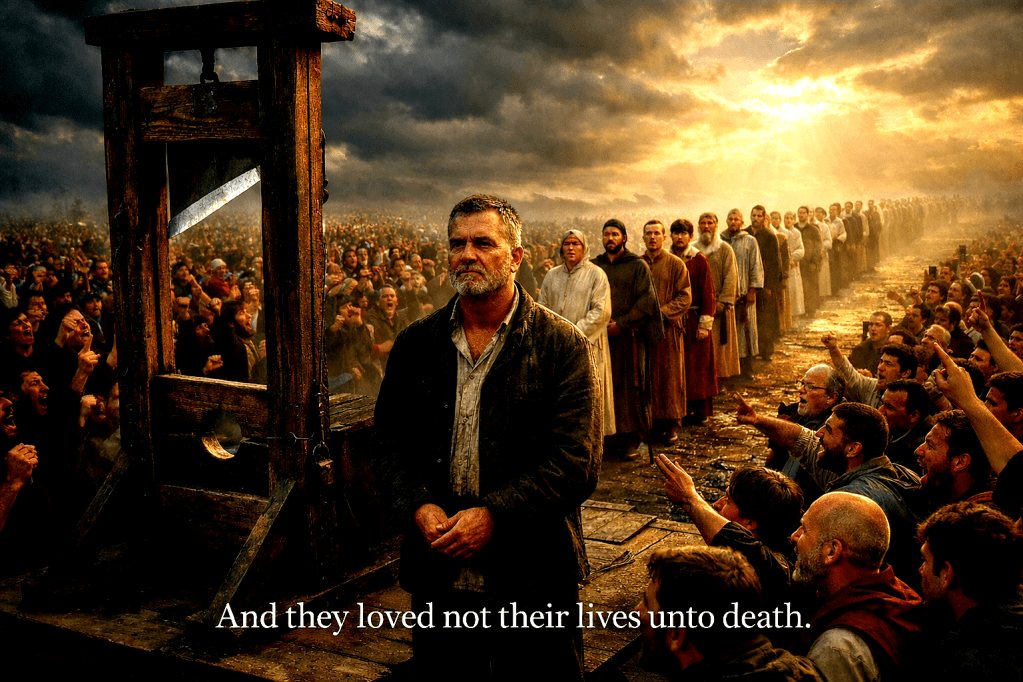
And by the fact that we do not cling to our lives on this earth, even unto death.

This power to wage war agsinst us, along with authority over all nations, is must be remembered has been “granted,” by God for a specific and limited time. It represents a divine allowance for testing, not an independent victory of the beast. As it was with Job. Its reach is measured. Its duration is bound. And even in its fiercest hour, it remains subject to the sovereign limits set by the throne of Heaven.

This is the one thing I do know. As long as He is with us, those of us who remain will pass through the waters and the fires. He knows us. He has redeemed us for this appointed time. He has called us by name. And He declares over us, You are Mine.

We fight not with carnal strength, but with proximity to Jesus. To bask in the glow of His presence is to walk in the beauty of holiness, to move in the overflow of His majesty and His glory. His grace will be sufficient, no matter how fierce the battle becomes.

I was saying to a brother only the other day, as long as I am granted breath enough to make a final speech to the baying crowd, to proclaim to them the glory of the God they have rejected, then I will be satisfied to say, let the blade fall.

And if not even that, then I shall declare that very same thing to the principalities and powers.
For their blade does not end my story.
It only propels me home.

Posted in christian living, Christianity, Daily devotional, Devotions, end times, End Times Eschatology, Eschatology - Study of the 'End Times', Jesus, remnant church, testimony, the crucified life, the deeper life, the persectuted church, The presence of God, the remnant, the state of the church | Tagged: , , , , , , , , | 3 Comments »

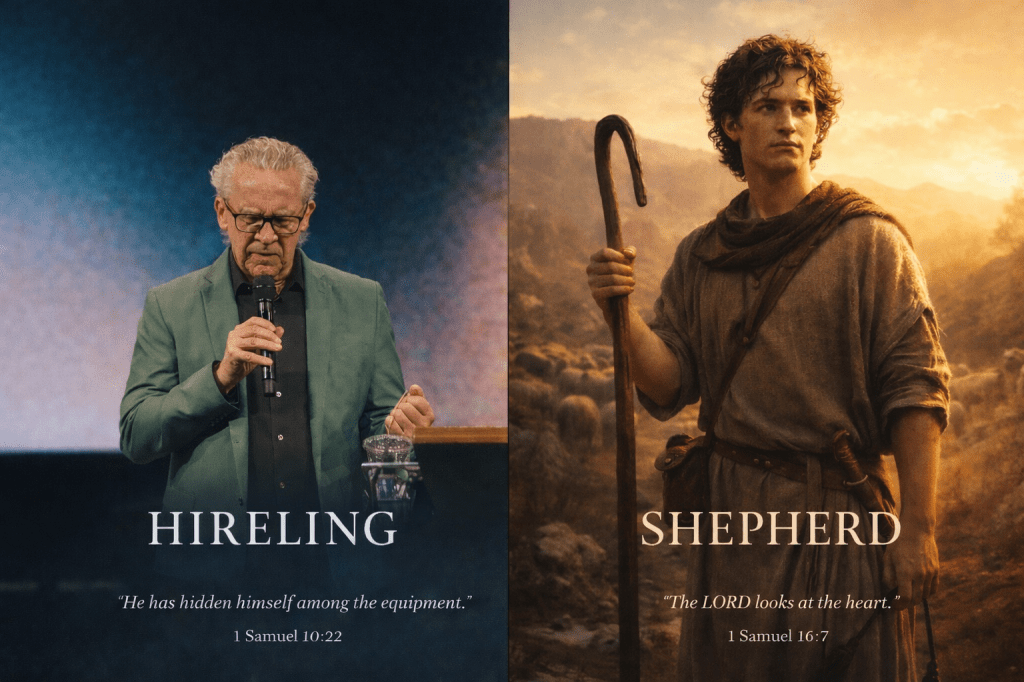
Hireling versus Shepherd

Posted by appolus on February 6, 2026

There is a profound contrast in Scripture between Saul and David, and it is not merely the difference between two kings, but between two kinds of men, two kinds of callings, and two kinds of authority.
Saul is chosen by men. He fits the visible criteria. He is tall, impressive, outwardly commanding. He looks like a king. Yet when the moment comes for him to step into what God has spoken, he is found hiding among the equipment. The one selected to lead is crouched among baggage.

He has already spoken of his small tribe, his insignificant family, and while those words sound humble, they reveal a man measuring himself by human categories and shrinking beneath the weight of them. His humility is not rooted in trust, but in fear. When pressure comes, he preserves himself.

David is altogether different.

David’s story does not begin on a battlefield or in a palace, but in obscurity. He is the youngest. He is forgotten by his own father when Samuel comes to anoint a king. Yet long before any man sees him, the eye of the Lord is already upon him.

Scripture reminds us that God knows His own before they ever draw breath, that He forms them and calls them while they are yet in the womb. David is such a man. The hand of God, the presence of God, and the purpose of God are upon him from the beginning.

This is no man hiding among the equipment.
While Saul hides, David fights. While Saul shrinks from visibility, David embraces responsibility. Alone in the fields, with no audience and no reward, David lays his life on the line for the sheep.

When the lion comes, when the bear comes, David does not calculate his odds. He does not preserve himself. He runs toward danger, because something in him already understands what it means to be a shepherd. The sheep matter more than his own safety.

This is the true shepherd, contrasted with the king men choose.

Men look for height, strength, charisma, and persuasive speech. God looks for the heart. Men crown what impresses them outwardly. God entrusts authority to those who are faithful inwardly. Saul is anointed first, but David is formed first.

David’s courage does not begin after anointing, it precedes it. His confidence is not in himself, but in the Lord who has already delivered him before anyone was watching.

This distinction is not confined to ancient Israel. It is painfully relevant today.

In every generation, men continue to choose leaders who are tall, handsome, articulate, and compelling. They gather crowds, build platforms, and command loyalty. Yet many have never been touched or shaped by the Spirit of God in secret. They are appointed by men, affirmed by numbers, and sustained by applause.

When the crux of the matter comes, when the cost is high and the wolves are near, they preserve themselves. They protect the institution, the reputation, the platform, rather than laying down their lives for the sheep.

David stands as God’s rebuke to this pattern.
God is not impressed by appearance. He is not moved by charisma. He does not entrust His flock to those who hide when the cost becomes personal. He looks for shepherds who have already proven, in hidden places, that they will bleed for what is His. He looks for hearts that run toward danger when others retreat, for men who fear God more than visibility, and obedience more than survival.

The tragedy of Saul is not that he was small.
The glory of David is not that he was strong.
The difference is this: Saul belonged to himself.David belonged to God.

And that difference still determines everything.

Posted in Babylon, Christian, christian blog, christian living, Christianity, consequences of sin, Daily devotional, Devotions, end times, End Times Eschatology, False Prophet, False Prophets, False Prophets and Teachers, false teachers, Greedy Shepherds, heresy, Jesus, Kansas City Prophets, Modern church critique, New Apostolic Reformation, Patricia King, Paul & Jan Crouch, prostitutes, Spiritual warfare, testimony, the crucified life, the deeper life, the gospel, the persectuted church, the remnant, The State of the Chuch and Manifest presence, the state of the church, watchmen | Tagged: , , , , , , , , , , , , , , | Leave a Comment »

Wolves in Sheep’s clothing.

Posted by appolus on January 29, 2026

You get caught, the pressure builds, the crisis reaches critical mass, and suddenly something must be done. So the machinery groans into motion, statements are issued, gestures are made, hands are wrung. Damage control. Optics. Containment. It’s what politicians do, it’s what Hollywood does, it’s what the world does when exposure becomes unavoidable.

But it is not repentance. It is not the brokenness that comes when the Holy Spirit convicts a soul and strips it bare before God. It is theater, not truth. We’ve seen it before, paraded as humility, recycled as reform, trotted out whenever the spotlight burns too hot. But the repentance of the world does not lead to life, it leads to death.

And the system that birthed this spectacle, the swollen engine of charismania, is rotten clear through. It has flooded the earth with slogans instead of Scripture, promises instead of obedience, “name it and claim it” in place of the fear of the Lord.

Health and wealth, prosperity without holiness, gold dust and feathers, signs without substance, every unclean counterfeit dressed up as revival. Its leaders have fattened themselves on the flock and boasted in their excess without shame. This road has only one destination. It does not end in awakening. It ends in judgment.

Posted in Babylon, Benny Hinn, Charisma Magazine, Charismatic, Christian, christian blog, Christianity, consequences of sin, Daily devotional, Devotions, False Doctrine, false prophecy, False Prophet, False Prophets, False Prophets and Teachers, false teachers, heresy, Jesus, New Apostolic Reformation, remnant church, testimony, the crucified life, the deeper life, The State of the Chuch and Manifest presence, watchmen | Tagged: , , , , , , , | 5 Comments »

A follow up to the Yancey post on Grace

Posted by appolus on January 15, 2026

I want to respond to some objections raised against my initial piece on Yancey, though in truth it was never really about Yancey at all. It was about grace, what it is, how Scripture defines it, and why it matters. If the Body of Christ is ever to walk in true holiness and righteousness, so that a dying world can genuinely contrast us with itself, then grace must be taught and held in its proper biblical place. We have not been called to soothe the conscience of the saint, nor to dull the edge of God’s holiness, but to bear faithful witness to a God who is righteous, holy, and not to be treated lightly.

Philip Yancey presents a grace-first theology in which God’s mercy precedes human response, repentance is real but functions relationally rather than judicially, and the fear of God is redefined primarily as reverence and relational grief rather than warning or dread.

In this framework, repentance restores fellowship but does not place salvation genuinely at risk, and passages that warn of falling away are treated pastorally rather than with the full weight that tge words carry.. Yet Scripture speaks of those who were “once enlightened,” who “shared in the Holy Spirit,” and still “fell away,” and of judgment that is described as “a fearful thing to fall into the hands of the living God.” Jesus Himself warned that not everyone who says “Lord, Lord” will enter the kingdom, and that “the one who endures to the end will be saved.” The tension lies in whether these words are allowed to carry their full weight.

“Those once enlightened… who shared in the Holy Spirit… and then fell away.”

Hebrews and the warnings of Jesus present a gospel in which grace and holy fear coexist without contradiction.

Grace initiates salvation, yet believers are repeatedly urged to “hold fast,” to “take care lest there be an evil, unbelieving heart,” and to remember that “our God is a consuming fire.” This fear is not terror for the weak or the repentant, but sober awareness that holiness is real, covenant is serious, and perseverance matters. Scripture never pits love against Godly fear, but assumes they walk together in a proper union.

“Take care… lest there be an evil, unbelieving heart… for our God is a consuming fire.”

This tension is made unmistakable in the account of Ananias and Sapphira.

They were not outsiders but members of the church, and God judged deliberate hypocrisy in such a way that “great fear came upon the whole church.” The text offers no apology and no softening. The early believers learned, in a single moment, that the God who pours out grace also disciplines His people, and that His presence is not merely comforting but holy.

“Great fear came upon the whole church and upon all who heard these things.”

Throughout Scripture, promises are consistently attached to endurance and overcoming.

Life is promised to “the one who overcomes,” rest to those who “do not draw back,” and reigning with Christ to those who “remain faithful.” The other side of that promise is never hidden: hardening the heart, refusing to repent, or presuming upon grace carries consequence. These warnings are not written to frighten the faithful, but to awaken the complacent.

“To the one who overcomes… do not draw back… hold fast.”

This is why a softened, purely pastoral presentation of grace is ultimately dangerous.
Grace was never meant to remove fear altogether, but to place it rightly. When grace is framed mainly to comfort, it risks producing peace without perseverance and assurance without obedience. There has always been a market for teachers who tell people what they want to hear, but Scripture was not written to soothe the unwatchful — it was written to form a people who endure, overcome, and remain faithful to the end.

“They will not endure sound teaching… turning aside to what they want to hear.”

Posted in christian blog, christian living, Christianity, Daily devotional, Jesus, revival, spiritual growth, the crucified life, the deeper life, the gospel, the persectuted church, The presence of God, the remnant, The State of the Chuch and Manifest presence, the state of the church | Tagged: , , , , , , , , , , , , | 12 Comments »

O CHURCH, RETURN FROM THE PIGSTY – A PROPHETIC LAMENT AND CALL

Posted by appolus on August 14, 2025

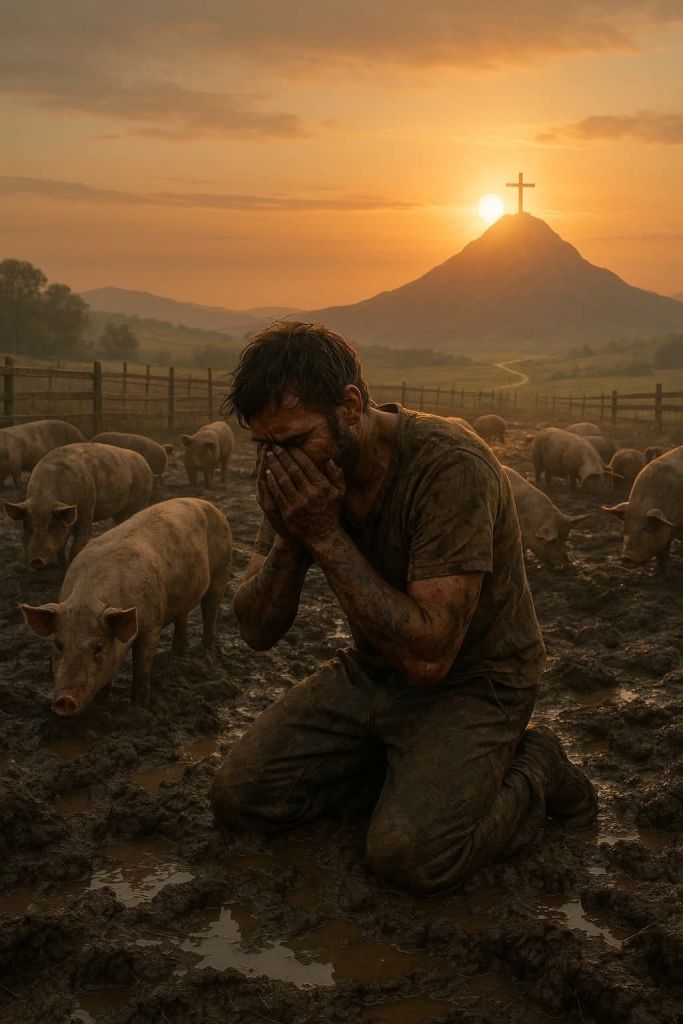
In the parable of the prodigal son (Luke 15:11–32), Jesus gives us a picture we dare not turn away from. A son goes to his father and demands what he believes is his right. The father, with sorrow in his eyes, grants it. The son leaves for a far country, intoxicated by the noise of sin and the wine of the world. For a time the music is loud and the cups are full, yet the sweetness turns bitter and the music fades into the groan of hunger. All is gone, and he is left with nothing. He takes work feeding swine, longing even for their food, and no one gives him anything (v.15–16). The father does not chase him into the darkness. He waits. He longs. But the son must first come to himself before he can come home (v.17).

In the stench of the pigsty the young man finally sees the truth. His condition pierces his heart like an arrow (Lamentations 3:40). His pride is broken and his hope rests only in mercy. He says, I am no longer worthy to be called your son, make me like one of your hired servants (Luke 15:19). He rises, not in strength but in weakness, not in triumph but in repentance (James 4:10). Step by step, through dust and shame, he walks the long road home (Micah 6:8). The father sees him while he is still far off, runs to him, embraces him, and restores him fully (Luke 15:20).

Church, do you not see? We are that son. We have taken the treasures of heaven, the sharp and living Word of God (Hebrews 4:12), the glory of His presence, the power of His Spirit (Acts 1:8), the holy calling to be a set apart people (1 Peter 2:9), and we have squandered them. We have gone into the far country, embraced its ways (Romans 12:2), and lived as it lives. We have traded holiness for popularity (Hebrews 12:14), truth for comfort (2 Timothy 4:3–4), and the fear of God for the applause of men (John 12:43).

Now the banquet is over and the gold has turned to dust in our hands. Our garments are stained and our lamps are dim (Matthew 25:8). This is the state of the modern church. We are in the pigsty (Isaiah 1:4–6), trying to call it blessing while the stench rises to heaven. And yet, even now, the voice of the Lord is heard, saying, Come to Me, all you who labor and are heavy laden, and I will give you rest (Matthew 11:28). Return to Me, and I will return to you (Malachi 3:7). Be zealous and repent (Revelation 3:19).

Leaders, shepherds of the flock (Jeremiah 23:1–2), you will give an account before God. Tear your hearts and not your garments (Joel 2:13). Weep between the porch and the altar (Joel 2:17). Let your tears be rivers upon your cheeks (Psalm 126:5). Let cries of repentance rise like incense before the throne (Psalm 141:2). The hour is late and the call is urgent.

We must come to ourselves. We must take the road of humiliation back to the Father’s house, for His thoughts are not our thoughts, nor are His ways our ways (Isaiah 55:8). If we will humble ourselves under His mighty hand (1 Peter 5:6), He will lift us up. He will heal our wounds (Hosea 6:1–2) and restore the joy of His salvation (Psalm 51:12). But if we refuse, the pigsty will be our dwelling still and the stench will only deepen.

The question is not whether the Father is willing to receive us. The question is whether we will rise from the filth, bow low before Him, and begin the journey home. The door stands open. The Father waits. The time to move is now.

Posted in christian blog, christian living, Christianity, Daily devotional, Devotions | Tagged: , , , , , , , , , , , , , | 4 Comments »

The Rise and Fall of a Movement: From Pentecost to Prosperity

Posted by appolus on August 3, 2025

At the turn of the 20th century, we witnessed the birth of two monumental Pentecostal movements. First, in 1904, came the Welsh Revival in Britain, and then, in 1906, the fires of revival swept through Azusa Street in Los Angeles. These were no ordinary stirrings, they were powerful outpourings of the Holy Spirit that would give rise to entire movements, such as the Elim Pentecostal Church in Britain and the Assemblies of God, which would spread globally and impact hundreds of millions.

From these humble beginnings, in every corner of the land, small Pentecostal churches began to emerge. Their message was simple: salvation through Jesus Christ, the power of the Holy Spirit, and the restoration of spiritual gifts. These fellowships sprang up in the shadow of massive denominational institutions, the Church of England, the Church of Scotland, and others, hige edifices steeped in their own traditions. Yet right beside them, in modest, unassuming buildings, were these Spirit-filled gatherings where lives were being radically transformed, adults were getting saved, and the gifts of the Spirit were active and alive.

This was a profound blow to the kingdom of darkness. The enemy, seeing the explosive growth of this movement, would not sit idly by. His question became clear: How can we bring this down? And so, beginning in the 1940s, we saw the emergence of new “theological,” trends, the Word of Faith movement, the Prosperity Gospel, and of course the Charismatic movement in the 60s, which would swallow up the others and become indistinguishable.

It was a cunning strategy: If you can’t beat them, buy them. The philosophy was simple, promise the very things that human beings everywhere fear to lose: health and wealth. Whether you’re in New York City or a remote village in the jungle, the universal concerns remain the same, our bodies and our bank accounts. The enemy offered a counterfeit gospel, one that shifted the focus from the cross of Christ to the desires of the flesh.

The Charismatic Movement became a Trojan horse. It infiltrated Pentecostal churches across the globe, not with persecution, but with promises. And it worked, brilliantly, tragically. The smoke from the fire of true revival has been replaced by the smoke machines of performance and entertainment. The altars were replaced by stages, the message by motivational speaking, and the Spirit by self-help and “self,” seeking

What followed was the tearing down of the very pillars upon which the early Pentecostal movement had stood. The purity of the Gospel was traded for a gospel of gain. Faith, once the precious link to Christ Himself, was twisted into a tool to manipulate blessings. Prosperity or tge lack of it, once counted as rubbish in comparison to knowing Christ, became the goal.Christ had become but a means to a materialistic end.

It was a disaster for the Church, and a stunning success for the enemy. The people rose up and played, just as they did before the golden calf in the wilderness. Think of “holy laughter,” and roaring like animals. And today, we stand in the shadow of that fall, in the ruins of what once was a mighty move of God.

These false ideologies, health and wealth, Name It and Claim It, the separation of faith from Christ Himself, have infected almost every corner of the modern Pentecostal and non-denominational world. Rare is the church untouched. Subtle or blatant, this taint remains, and it must be recognized for what it is.

Now, in this late hour, a remnant is rising, a people who are returning to the simplicity and the power of the cross, who walk not in the counsel of the world but in the fear of the Lord. Let us not be seduced by the glitter of gain or the lure of comfort. Let us remember the foundation laid in tears and prayer and holy fire. It is time to leave the circus behind, with all its many forms of entertainment, and “come out from among her.”

Posted in Babylon, bible, Charisma Magazine, Charismatic, Christian, christian blog, christian living, Christianity, Church history, church mafia, churches, consequences of sin, Counterfeit Jesus, Daily devotional, Devotions, end times, End Times Eschatology, False Prophets and Teachers, false teachers, Greedy Shepherds, Jesus, remnant church, revival, the crucified life, the deeper life, the gospel, the persectuted church, The presence of God, the remnant, The State of the Chuch and Manifest presence, the state of the church | Tagged: , , , , , , , , | 4 Comments »

The remnant that loves.

Posted by appolus on May 19, 2025

One of the most tragic realities of the contemporary church, most glaringly within the American context, yet by no means confined to it, is the widespread absence of the new birth among professing Christians. This foundational deficiency renders it utterly impossible for such individuals to love as the early church loved, for the very source and sustainer of that love is Christ Himself. It is He who binds believers together in divine unity.

The church, properly understood, is not a building, a denomination, or an institution, it is the living body of Christ. And unless one has been joined to that body through regeneration, one simply does not belong to the Church in the true, biblical sense, the ekklesia, the “called-out ones.”

It is spiritual folly to expect those outside of Christ, unregenerate and untouched by the Spirit of God, to manifest the supernatural love that defined the earliest believers. This love flows not from religious duty or communal sentiment, but from the indwelling presence of the Holy Spirit.

Oswald Chambers, in his meditations on the Sermon on the Mount, rightly observed that any attempt to live out Christ’s teachings apart from the new birth results in a miserable experience. For the unregenerate, the Sermon is not a light but a crushing burden, a lofty ideal that exposes the impossibility of genuine righteousness without divine transformation.

Religion, absent the life of Christ, becomes little more than a philosophy, a system of ethics, or a cultural form. It may produce momentary acts of kindness, but it cannot sustain the sacrificial, Spirit-wrought love of the saints. This love, that bears all things, believes all things, hopes all things, endures all things, does not arise from human effort but from the supernatural work of God in the soul.

Thus, what many interpret as disunity in the church is, in truth, the presence of multitudes who are members of religious organizations, but not members of Christ’s body. They are, at best, moralists striving in their own strength, at worst, deceived souls clinging to the form of godliness while denying its power.

The Scriptures are not silent on this. “Many are called, but few are chosen” (Matthew 22:14). The remnant, the few, are the truly born again, those who love with a love not their own, who recognize one another not by label or denomination, but by the Spirit of Christ within. When these encounter one another, there is immediate fellowship, unfeigned and deeply rooted in shared life.

To expect widespread spiritual unity in a landscape dominated by nominalism is to set oneself up for continual disillusionment. Indeed, the gap between our expectations and the reality of the religious world around us is often the precise measure of our grief.

But if we understand this reality, that true unity and true love exist only among the regenerate few, we will cease to be disheartened by the failures of the masses and instead rejoice to find, here and there, a brother or sister truly alive in Christ. For these are the Church. These are the Body. These are the beloved of God.


Posted in christian blog, christian living, Christianity, Daily devotional, God's love, Jesus, Oswald Chambers, remnant church, revival, testimony, the crucified life, the deeper life, the gospel, the persectuted church, The presence of God, the remnant, The State of the Chuch and Manifest presence, the state of the church | Tagged: , , , , , , , , , , , , , , | 4 Comments »

Church attendance is not Discipleship.

Posted by appolus on August 25, 2024

Some poor deluded folks think that by attending a church they are being disciples. Very sad. I’ve known disciples who attend a church, I’ve known disciples who gather together in small groups, I’ve even known disciples who meet just “where two or three are gathered,” but I’ve known very few disciples. They are the few. They are the remnant. Just as the Lord said it would be. The vast majority I’ve known are church goers, which is a world apart from disciples……bro Frank.

Charles Simeon 1759-1836 wrote…………

Isaiah 29:13, “The Lord says: These people come near to Me with their mouth and honor Me with their lips, but their hearts are far from Me!”

In our church services, we go through all the external bodily motions; but as to the prostration of the soul, we are for the most part oblivious and unconcerned. We think that we have done our duty to God, if we have gone through the appointed external rituals, though our heart has not accorded with the body in any part of the service. In truth, our services have been hypocritical throughout.

Had a stranger come into one of our church services, and overheard our glowing praises, and our solemn confessions, petitions, and thanksgivings–he would have supposed that we were the most humble, spiritual, and devout people in the universe!

But had he been privy to the real state of our hearts–then how little would he have seen:
of earnest ardor in our praises,
or of honest humiliation in our confessions,
or of sincere fervor in our petitions,
or of genuine gratitude in our thanksgivings!

He would see that the state of our hearts indicated that we felt nothing, and meant nothing–at the very time that we professed to mean so much and feel so much!

For the most part, he would have seen that the whole of our service was only a solemn mockery; that instead of being genuine worshipers of our majestic and holy God–for the most part, we were but insincere hypocrites!

Let me ask, in the name of God Himself: What reason you can have to think that God would accept such services as these?

If, indeed, God were like ourselves, and could see only the outward appearance, then we might hope that, being deceived by us–He would be pleased with us.

But when we bear in mind, that the omniscient God knows . . .
our every secret thought,
our every secret desire,
our every secret motive,
and that He perfectly searches our heart, and knows our thoughts–then we must be sure that our very services are an abomination in His sight!

“Isaiah was right when he prophesied about you hypocrites; as it is written: These people honor me with their lips, but their hearts are far from me! They worship Me in vain.” Mark 7:6, 7

J.C. Ryle: In all our Christian duties, whether giving or praying, the great thing to be kept in mind, is that we have a heart-searching and all-knowing God! Everything like mere formal worship, is abominable and worthless in God’s sight. The one thing which His all-seeing eye looks at, is the nature of our motives, and the state of our hearts!

“Serve Him with a whole heart and a willing mind; for the Lord searches all hearts, and understands every intent of the thoughts!” 1 Chronicles 28:9

Posted in Christian, christian blog, christian living, Christianity, Church history, churches, controlling churches | Tagged: , , , , , , , , , , | 6 Comments »

The narrow gate ( final part) Martin J Collison

Posted by appolus on September 28, 2013

YEARNINGS FOR THE VERY HEART OF CHRIST – SAUL’S ARMOUR IS NOT THE AIM

At this point I turn to King Saul. The apostate church is a type of Saul in my eyes. Eventually it will fall on its own sword. The sword which it has so meticulously crafted for itself. Saul represents the dangers of the flesh. Trusting in the flesh and not God. Though he started off with some good intentions and he gave Almighty God credit for his early victories in warfare, soon the form dipped. The devotion waned. The flesh arose again. As a man, he never allowed himself to be conquered by God. And this is factor is central issue. Those that desire to be true believers will allow whatever it takes for God to conquer them. God is cutting the blood lines to Saul within His church. King Saul has led the church too long.

The Almighty is searching out His very own group of David’s. Those after His very own heart. Nothing but His heart will do. David too made grave mistakes and errors of judgement of the deepest sort. He too veered into the flesh, took his eyes off the Lord. He too counted his fighting men, hedging on the resources of the flesh rather than God. Yet, he is still counted as a man after the very heart of God, the life of the Spirit. And despite all his failures God was still pleased to call His very own beloved son “The Son of David”. God sees the sincere heart. He never gives up on the sincere heart. And in Jesus, His very own precious son, God found a man that He could entrust to see through all that the very plan of salvation and redemption entailed. The utter loneliness, solitude and rejection of the Cross. To be despised, broken, spat on, kicked and beaten. To have all the sin and wrongdoing of all the ages placed on Him. To be so marred and afflicted by that sin that God Himself could not look on Him. But glorious day. He went through the Cross. Now He desperately seeks a people that will reciprocate. He seeks a Bride that will make herself ready out of a heart of utter devotion and love of Jesus Himself. Not for what He gives. Those that will lay everything down in order to be found only in Him.

Read the rest of this entry »

Posted in Christian, christian living, Christianity, church of scotland, end times, Jesus, pentecostal, revival, the remnant, the state of the church, theology | Tagged: , , , | 7 Comments »