


Archive for February, 2026
A Word of Encouragement to the Remnant.
Posted by appolus on February 22, 2026
Posted in Uncategorized | 4 Comments »
THE DEVIL IS IN THE DETAILS
Posted by appolus on February 20, 2026

There’s a phrase we use in the world: “The devil is in the details.”
It’s usually applied to negotiations or contracts, a warning to examine how things will actually work out. But there is another application to that phrase.
When you are in a trial, in a tribulation, and you allow your mind to go over and over and over every aspect of the circumstance, something begins to happen. You surrender control of your mind.
We are told to take every thought captive to the obedience of Christ (2 Corinthians 10:5).
Yet when we rake over every detail of what has happened, rehearsing it, replaying it, analyzing it, and then telling one person, and then another, and another, adding to it each time, we are not walking in that obedience. We are multiplying our sorrows.
The Scripture says, “You will keep him in perfect peace, whose mind is stayed on You, because he trusts in You” (Isaiah 26:3).
Notice, peace is connected to where the mind stays.
Think about this.
How does a bird feed its young? It regurgitates food from its stomach back into the mouths of its chicks. That is how nature works.
But when we regurgitate, and let’s use the plain word, vomit, our circumstances to five other people, and then they begin to add their own details to our story, we are not seeking peace. We are reliving it. We are feeding on it again.
The apostle Paul instructs us clearly: “Be anxious for nothing, but in everything by prayer and supplication, with thanksgiving, let your requests be made known to God; and the peace of God, which surpasses all understanding, will guard your hearts and minds through Christ Jesus” (Philippians 4:6–7).
The guarding of the heart and mind comes after we bring it to God, not after we rehearse it before men.
Instead, when we continually retell and relive the circumstance, we rake over the ashes and coals of what has happened. We fan embers back into flame. We reset the fire of the circumstance rather than bringing it to the Lord and finding peace in Him.
We forget that the Lord was not in the wind, nor in the earthquake, nor in the fire, but in the still small voice (1 Kings 19:11–12).
And that stillness cannot be heard in a mind that is constantly agitated.
So remember this, brothers and sisters:
Unless you are in a place of peace, unless you have quieted your mind enough to hear the still, small voice of God, do not regurgitate the story. Do not relive it again and again.
“For where your treasure is, there your heart will be also” (Matthew 6:21).
If the treasure becomes the injury, the offense, the trial, then the heart will remain there.But if the treasure is Christ, then the mind will return to Him.
You are not glorifying the Lord by rehearsing the wound.You are not edifying your brothers and sisters by spreading the ashes.
And you are not strengthening yourself by reliving the fire.
You are adding to your sorrows (Psalm 16:4).
Posted in bible, Christian, christian blog, christian living, Christianity, Daily devotional, intimacy, Jesus, revival, Spirituality, testimony, the crucified life, the deeper life, the gospel, the persectuted church, The presence of God, the remnant, The State of the Chuch and Manifest presence | Tagged: A call to the remnant, alive in christ jesus, attributes of god, beauty of holiness, Christendom, christian living, Christianity, circumstances, daily devotions, deeper life, devotional, eyes of your heart, fellowship, fellowship with God, fiery furnace, Frank McEleny, genuine fellowship, hearing god, Jesus | Leave a Comment »
Separation of the wheat from the tares.
Posted by appolus on February 19, 2026

We stand in a time when the Lord’s description of the harvest is no longer theoretical, but increasingly observable, to the point that what once lay hidden within the field can now be discerned as the age moves toward its consummation.
The Lord did not frame the close of the age as a single moment, but as a harvest season, as He Himself declared when opening the parable of the field [Matthew 13:24].
A closing span in which what has long grown together can no longer conceal its nature, for the harvest, He said, is the end of the age [Matthew 13:39].
When the grain reaches fullness, weight comes upon the head of the true wheat. It bows, heavy with formed life, while the tare, light and fruitless, remains upright, exposed by its own barrenness.
This is why there must be a period of unveiling. The distinction, once hidden in the green blade, becomes undeniable in the ripened field, just as He taught that both must grow together until the harvest [Matthew 13:30].
What could not safely be touched in the early growth can now be handled without harm to the wheat, because maturity has made separation just, visible, and irreversible.
So within the synteleia tou aiōnos (Matthew 13:39), the consummation of the age, there unfolds a measured work of exposure and removal.
It is not haste, but precision. Not impulse, but ripeness that governs the reaping.
The tares are taken from among the wheat because their habitation was never separate, reflecting His own words that the enemy sowed them among the wheat while men slept [Matthew 13:25].
They shared the same soil, the same rain, the same sun, yet bore no grain.
And when the reapers move, they do so in a window of divine timing, for He said the reapers are the angels sent forth at the close of the age [Matthew 13:39–41].
In that solemn interval, the uprightness of the tare becomes its own testimony, and the harvest, long foretold, proceeds without injury to the wheat, fulfilling His declaration that all things that offend would be gathered out of His kingdom [Matthew 13:41].
And in an actual field, as the season turns and the wind moves across the ripened grain, another distinction appears.
The wheat does not only bow from weight, it moves differently.
When the gusts come, the true wheat sways in unified rhythm, heavy heads yielding, bending without breaking, the whole field rolling like waves of gold.
But the tares, stiffer and lighter, resist the movement. They jut upward, visually discordant, unable to flow with the humbled harvest around them, a living contrast between fruitfulness and barrenness.
Farmers have long known that near reaping time, the mixed field reveals itself not merely by fruit, but by motion, posture, and response to pressure.
And so too in the closing span of this age, when the winds of testing, exposure, and judgment begin to blow across the house of God, ministries once indistinguishable from the surrounding wheat find themselves revealed by how they stand, echoing the apostolic warning that judgment must begin at the house of God [1 Peter 4:17].
The recent unravelings surrounding International House of Prayer Kansas City and controversies touching streams connected to Bethel Church have, for many, felt like that late season wind moving across the field.
Not creating what was hidden, but revealing what maturity and pressure made visible.
For the first labor of the harvest is not the gentle gathering of the wheat, but the careful and deliberate removal of the tares from among it.
Separation is the primary work.
For they did not grow in distant fields, but intertwined in the same soil, their roots wrapped together beneath the surface, their blades indistinguishable in the early season.
And so when the harvest begins, the more exacting task comes first, just as the Lord instructed, gather the tares first and bind them [Matthew 13:30].
The tares must be identified, drawn out, and gathered away with precision, lest the wheat be harmed in the process.
It is a judicial work before it is a restorative one, a clearing of the field before the securing of the grain.
Only when that difficult labor has been sufficiently accomplished does the harvest of the wheat proceed with swiftness and clarity.
For once the choking growth has been removed, the bowed heads stand unobstructed, ready for the reaper’s hand.
Then the work becomes one of gathering rather than separating, of bringing in rather than casting out, fulfilling His promise that the righteous would be gathered into His barn [Matthew 13:30].
The barn awaits what the field has produced, and the weight of the wheat, once hidden among the tares, is now brought safely home.
The paradigm shift has taken place in the world.
Thus the parable and the apostolic warning converge, revealing that the exposure of the tares is not reserved for a distant day, but is taking place even now.
What was planted in secrecy is being uncovered in the present hour.
The likeness that once concealed is breaking down, and the field itself is bearing witness to the difference.
For the harvest is advancing, the separation is underway, and the righteous stand on the threshold of that moment when they will shine forth as the sun in the kingdom of their Father [Matthew 13:43].
Posted in Christian, christian blog, christian living, Christianity, Church history, Counterfeit Jesus, Daily devotional, Devotions, discernment, faith, false prophecy, False Prophets, false teachers, Greedy Shepherds, Jesus, leaving the church, New Apostolic Reformation, new wineskins, prophetic movement, prosperity gospel, remnant church, revival, Spiritual warfare, testimony, the crucified life, the deeper life, the gospel, the persectuted church, The presence of God, the remnant, The State of the Chuch and Manifest presence, the state of the church | Tagged: A call to the remnant, apostate church, Apostolic Christianity, Bill Johnson, birth pangs, Christendom, Christianity, church institutions, counterfeit god, daily devotions, doctrine, end time prophecy, established church, false teachers, first judgement, foolish virgins, glorious harvest, God's children | 5 Comments »
A Serious Word To the Remnant-A Paradigm Shift
Posted by appolus on February 17, 2026
Posted in Uncategorized | 10 Comments »
How Shall We Prevail In The Coming Tribulation?
Posted by appolus on February 12, 2026
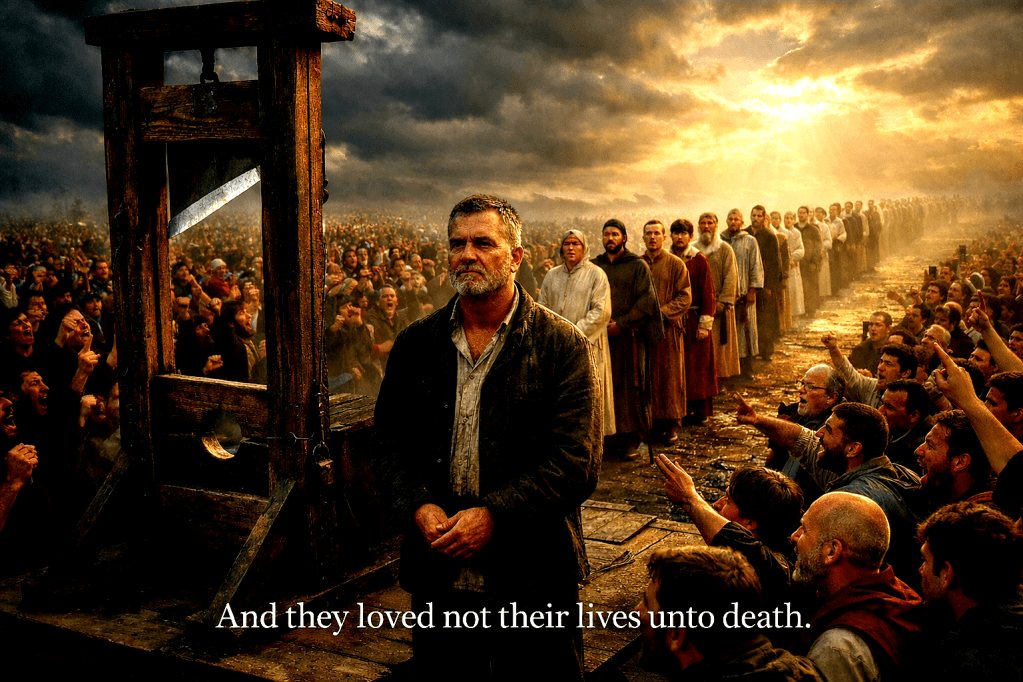
This is the primary role of God’s remnant here on earth, to be His witness. In every age His remnant have suffered. They were and are a living witness to the underlying truth that suffering is a major part of our walk with Christ. Scripture does not say if we pass through the waters, but when. The passage assumes the trial. It establishes it as certain.
Job, of course, stands as the perfect example of a mere man. It is no surprise that his account is widely regarded as the earliest book of the Bible, written before Genesis itself. God was laying down markers from the very beginning. He was clearly showing that there is no vital connection between worldly blessing and relationship to Him. Job’s friends, like most modern day Christians, and certainly almost all within Charismatic circles, trying to “live their best lives now” could not and would not understand this mystery.
Yet when Job shaved his head and tore his robe over the loss of everything, and then fell to his knees in worship and blessed the name of God, we are given the model. There it is unveiled in raw humanity and holy reverence.
Suffering, and our reaction to it, becomes the great separator. It separates the legitimate from the illegitimate. The many from the few. And it has been this way down through the ages, right up to and including this present day.
When the great tribulation comes, when trials grow fierce beyond anything previously known, God will already have trained a remnant over the many decades of their lives in the ways of suffering, enduring, and overcoming. They will not be novices in the furnace. They will have fought many battles long before the great battle arrives.
They will know the Scripture well from Revelation 13 where the great enemy of our souls wages war against the saints and, in human terms, prevails.
And yet the question stands. How do we overcome when that time comes? The same way we overcome now.
By the Blood of the Lamb.
By the word of our testimony.
And by the fact that we do not cling to our lives on this earth, even unto death.
This power to wage war agsinst us, along with authority over all nations, is must be remembered has been “granted,” by God for a specific and limited time. It represents a divine allowance for testing, not an independent victory of the beast. As it was with Job. Its reach is measured. Its duration is bound. And even in its fiercest hour, it remains subject to the sovereign limits set by the throne of Heaven.
This is the one thing I do know. As long as He is with us, those of us who remain will pass through the waters and the fires. He knows us. He has redeemed us for this appointed time. He has called us by name. And He declares over us, You are Mine.
We fight not with carnal strength, but with proximity to Jesus. To bask in the glow of His presence is to walk in the beauty of holiness, to move in the overflow of His majesty and His glory. His grace will be sufficient, no matter how fierce the battle becomes.
I was saying to a brother only the other day, as long as I am granted breath enough to make a final speech to the baying crowd, to proclaim to them the glory of the God they have rejected, then I will be satisfied to say, let the blade fall.
And if not even that, then I shall declare that very same thing to the principalities and powers.
For their blade does not end my story.
It only propels me home.
Posted in christian living, Christianity, Daily devotional, Devotions, end times, End Times Eschatology, Eschatology - Study of the 'End Times', Jesus, remnant church, testimony, the crucified life, the deeper life, the persectuted church, The presence of God, the remnant, the state of the church | Tagged: A call to the remnant, apostate church, Apostolic Christianity, Christianity, death-to-self, end time prophecy, end times, endtimes, Frank McEleny | 3 Comments »
Hireling versus Shepherd
Posted by appolus on February 6, 2026
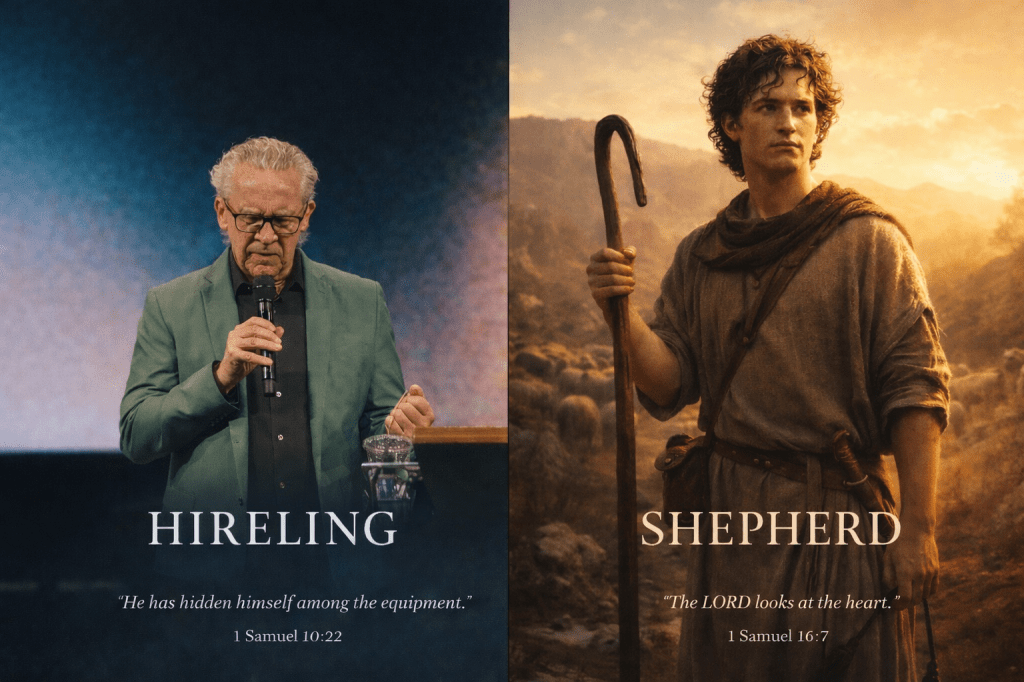
There is a profound contrast in Scripture between Saul and David, and it is not merely the difference between two kings, but between two kinds of men, two kinds of callings, and two kinds of authority.
Saul is chosen by men. He fits the visible criteria. He is tall, impressive, outwardly commanding. He looks like a king. Yet when the moment comes for him to step into what God has spoken, he is found hiding among the equipment. The one selected to lead is crouched among baggage.
He has already spoken of his small tribe, his insignificant family, and while those words sound humble, they reveal a man measuring himself by human categories and shrinking beneath the weight of them. His humility is not rooted in trust, but in fear. When pressure comes, he preserves himself.
David is altogether different.
David’s story does not begin on a battlefield or in a palace, but in obscurity. He is the youngest. He is forgotten by his own father when Samuel comes to anoint a king. Yet long before any man sees him, the eye of the Lord is already upon him.
Scripture reminds us that God knows His own before they ever draw breath, that He forms them and calls them while they are yet in the womb. David is such a man. The hand of God, the presence of God, and the purpose of God are upon him from the beginning.
This is no man hiding among the equipment.
While Saul hides, David fights. While Saul shrinks from visibility, David embraces responsibility. Alone in the fields, with no audience and no reward, David lays his life on the line for the sheep.
When the lion comes, when the bear comes, David does not calculate his odds. He does not preserve himself. He runs toward danger, because something in him already understands what it means to be a shepherd. The sheep matter more than his own safety.
This is the true shepherd, contrasted with the king men choose.
Men look for height, strength, charisma, and persuasive speech. God looks for the heart. Men crown what impresses them outwardly. God entrusts authority to those who are faithful inwardly. Saul is anointed first, but David is formed first.
David’s courage does not begin after anointing, it precedes it. His confidence is not in himself, but in the Lord who has already delivered him before anyone was watching.
This distinction is not confined to ancient Israel. It is painfully relevant today.
In every generation, men continue to choose leaders who are tall, handsome, articulate, and compelling. They gather crowds, build platforms, and command loyalty. Yet many have never been touched or shaped by the Spirit of God in secret. They are appointed by men, affirmed by numbers, and sustained by applause.
When the crux of the matter comes, when the cost is high and the wolves are near, they preserve themselves. They protect the institution, the reputation, the platform, rather than laying down their lives for the sheep.
David stands as God’s rebuke to this pattern.
God is not impressed by appearance. He is not moved by charisma. He does not entrust His flock to those who hide when the cost becomes personal. He looks for shepherds who have already proven, in hidden places, that they will bleed for what is His. He looks for hearts that run toward danger when others retreat, for men who fear God more than visibility, and obedience more than survival.
The tragedy of Saul is not that he was small.
The glory of David is not that he was strong.
The difference is this: Saul belonged to himself.David belonged to God.
And that difference still determines everything.
Posted in Babylon, Christian, christian blog, christian living, Christianity, consequences of sin, Daily devotional, Devotions, end times, End Times Eschatology, False Prophet, False Prophets, False Prophets and Teachers, false teachers, Greedy Shepherds, heresy, Jesus, Kansas City Prophets, Modern church critique, New Apostolic Reformation, Patricia King, Paul & Jan Crouch, prostitutes, Spiritual warfare, testimony, the crucified life, the deeper life, the gospel, the persectuted church, the remnant, The State of the Chuch and Manifest presence, the state of the church, watchmen | Tagged: A call to the remnant, apostate church, Babylon, beauty from the ashes, Bill Johnson, Charismatics, Christianity, consuming fire, end times, endtimes, Frank McEleny, god is a consuming fire, Holiness, Jannes and Jambres, Jesus | 2 Comments »
The ground upon which the Lord works, is Holy Ground.
Posted by appolus on February 4, 2026
I was speaking with a brother the other day, a man seasoned by many years. He has been a pastor for more than three decades and also served for many years as a police officer. Before all of that, he once drove a concrete truck.
He told me about a day in Texas when the truck broke down while carrying ten yards of concrete. The drum stopped turning. Time passed, and before the load could be poured, the concrete had set solid inside the bowl. It took him nearly a week with a jackhammer to break it free. Concrete must keep moving until it is ready to be laid, otherwise it hardens without mercy and becomes unusable.
So it is with our hearts. When the Spirit’s work is resisted, delayed, or neglected, what was meant to be formed and poured out becomes hardened instead. What should have been usable for God’s purpose becomes difficult to break and costly to restore.
He spoke about the slump. Concrete must meet a precise measure. If it does not rise to the required standard, the entire load is rejected and discarded. There is no partial acceptance. If it does not meet the specification, it cannot be used.
So it is with the work God is doing in us. God does not measure by appearance or intention, but by what meets His standard. What does not rise to the measure of obedience and faith cannot be blended in or excused, it must be dealt with before the work can continue.
I shared with him what I had learned in construction. Samples are taken from the pour, allowed to harden, and weeks later crushed beneath great pressure. Only then is its strength revealed. Only then is it known whether it can bear the load for which it was made.
So it is with our faith. What God has formed in us is not proven in comfort, but under pressure. The crushing does not create the strength, it reveals whether the strength is truly there to bear the weight God has assigned.
There is also the matter of composition. Water, sand, aggregate, and cement must all be present, and each must be measured carefully. Too much or too little of any one part weakens the whole. The mixture determines the endurance.
So it is with the life God forms in us. Truth, obedience, suffering, grace, and patience each have their place, and none can be removed without consequence. When we favor one at the expense of the others, the strength of the whole is compromised, and what remains cannot endure the load it was meant to bear.
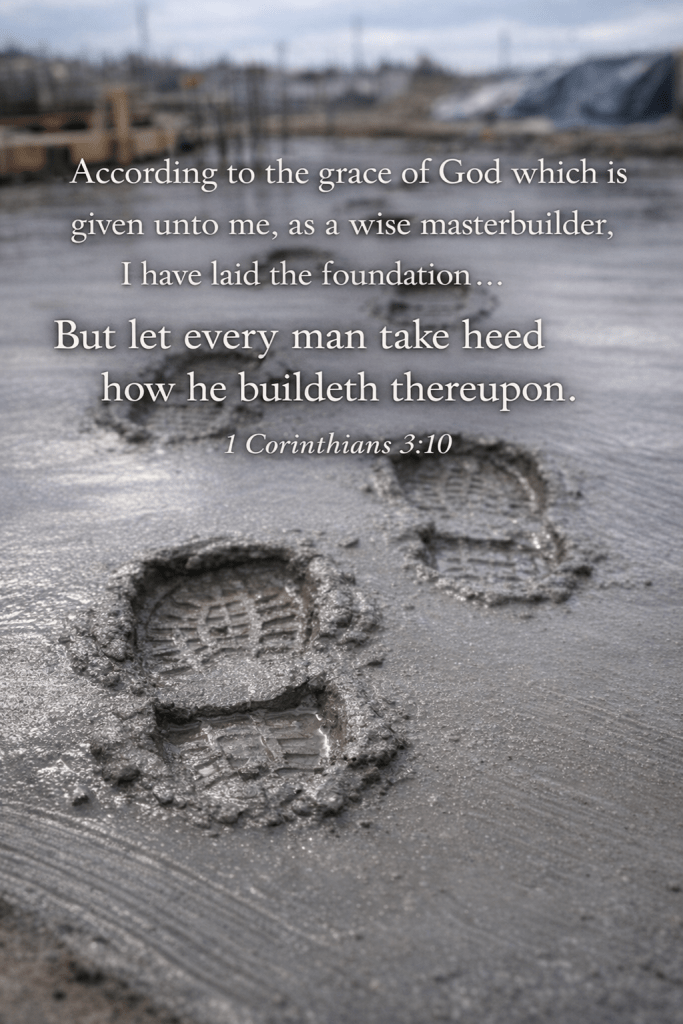
He then spoke of the freshly poured surface, smooth and carefully troweled. Sometimes someone comes walking toward it. You can see it happening and men shout warnings, but at times the person keeps going and walks straight through the concrete.
When that happens, the work is ruined. Either it must be torn up and done again, or the footprints remain forever, a permanent mark where none was meant to be.
Here the lesson becomes clear. When the Lord is doing a work, it is holy ground. When He is forming, shaping, and strengthening something, it is not to be trampled by careless feet.
God determines the mixture of our lives. He measures joy and sorrow, strength and weakness. He allows the testing and the crushing, not to destroy us, but to reveal whether we can bear the load appointed to us.
The strength that grows in us is not accidental, and the endurance is not self-made. It is the result of a careful and deliberate work of God. And even then, He does not leave us to carry the load alone. He bears it with us.
Posted in Christian, christian blog, christian living, Christianity, Daily devotional, Devotions, Jesus, remnant church, revival, testimony, the crucified life, the deeper life, the gospel, the remnant, The State of the Chuch and Manifest presence | Tagged: A call to the remnant, absolute surrender, Apostolic Christianity, attributes of god, beauty from the ashes, beauty of holiness, Body of Christ, Calvary, Christianity | 1 Comment »
 A Call To The Remnant