At the turn of the 20th century, we witnessed the birth of two monumental Pentecostal movements. First, in 1904, came the Welsh Revival in Britain, and then, in 1906, the fires of revival swept through Azusa Street in Los Angeles. These were no ordinary stirrings, they were powerful outpourings of the Holy Spirit that would give rise to entire movements, such as the Elim Pentecostal Church in Britain and the Assemblies of God, which would spread globally and impact hundreds of millions.
From these humble beginnings, in every corner of the land, small Pentecostal churches began to emerge. Their message was simple: salvation through Jesus Christ, the power of the Holy Spirit, and the restoration of spiritual gifts. These fellowships sprang up in the shadow of massive denominational institutions, the Church of England, the Church of Scotland, and others, hige edifices steeped in their own traditions. Yet right beside them, in modest, unassuming buildings, were these Spirit-filled gatherings where lives were being radically transformed, adults were getting saved, and the gifts of the Spirit were active and alive.
This was a profound blow to the kingdom of darkness. The enemy, seeing the explosive growth of this movement, would not sit idly by. His question became clear: How can we bring this down? And so, beginning in the 1940s, we saw the emergence of new “theological,” trends, the Word of Faith movement, the Prosperity Gospel, and of course the Charismatic movement in the 60s, which would swallow up the others and become indistinguishable.
It was a cunning strategy: If you can’t beat them, buy them. The philosophy was simple, promise the very things that human beings everywhere fear to lose: health and wealth. Whether you’re in New York City or a remote village in the jungle, the universal concerns remain the same, our bodies and our bank accounts. The enemy offered a counterfeit gospel, one that shifted the focus from the cross of Christ to the desires of the flesh.
The Charismatic Movement became a Trojan horse. It infiltrated Pentecostal churches across the globe, not with persecution, but with promises. And it worked, brilliantly, tragically. The smoke from the fire of true revival has been replaced by the smoke machines of performance and entertainment. The altars were replaced by stages, the message by motivational speaking, and the Spirit by self-help and “self,” seeking
What followed was the tearing down of the very pillars upon which the early Pentecostal movement had stood. The purity of the Gospel was traded for a gospel of gain. Faith, once the precious link to Christ Himself, was twisted into a tool to manipulate blessings. Prosperity or tge lack of it, once counted as rubbish in comparison to knowing Christ, became the goal.Christ had become but a means to a materialistic end.
It was a disaster for the Church, and a stunning success for the enemy. The people rose up and played, just as they did before the golden calf in the wilderness. Think of “holy laughter,” and roaring like animals. And today, we stand in the shadow of that fall, in the ruins of what once was a mighty move of God.
These false ideologies, health and wealth, Name It and Claim It, the separation of faith from Christ Himself, have infected almost every corner of the modern Pentecostal and non-denominational world. Rare is the church untouched. Subtle or blatant, this taint remains, and it must be recognized for what it is.
Now, in this late hour, a remnant is rising, a people who are returning to the simplicity and the power of the cross, who walk not in the counsel of the world but in the fear of the Lord. Let us not be seduced by the glitter of gain or the lure of comfort. Let us remember the foundation laid in tears and prayer and holy fire. It is time to leave the circus behind, with all its many forms of entertainment, and “come out from among her.”
The Herd Mentality and the Call to Swim Against the Current
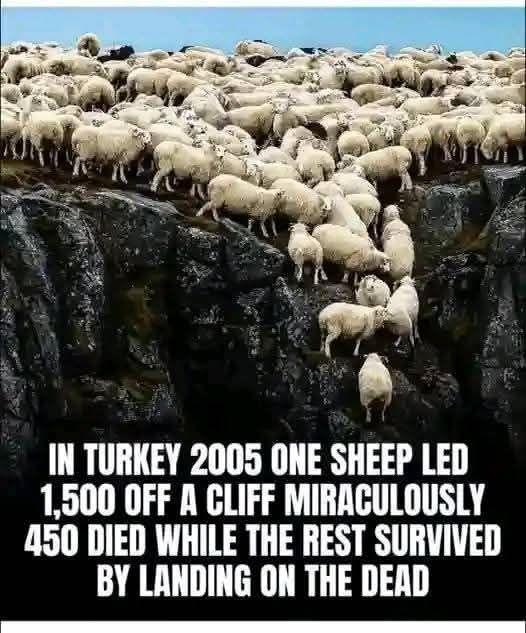
In July 2005, in Eastern Turkey near the village of Gevas in Van province, something astonishing happened. A group of shepherds had left their flock of about 1,500 sheep to have breakfast. During that time, one sheep wandered off a cliff, and every single one of the others followed. It’s a chilling picture of herd mentality , not just among sheep, but a profound metaphor for humanity.
We see this throughout history and even in our own day. People instinctively believe there’s safety in numbers, but the crowd can and mostly are terribly wrong.
One story from 9/11 that has always stayed with me is of two men who were above the impact zone of one of the towers. Very few people survived from above the crash site. These two did, and their story speaks volumes.
As they made their way down a heavily damaged stairwell, they came upon a group of 14 to 20 people heading upward. The men pleaded with them, “Don’t go up, there’s no rescue coming from the roof.”
But some in that group were being swayed by charismatic voices insisting that helicopters would come, that rescue was possible if they just went higher. But they were wrong. Helicopters couldn’t reach the roof because of the intense smoke and heat, and the rooftop doors were locked. Everyone who followed that advice died.
The two men who chose the hard way down , they lived.
That’s the herd mentality again. A subtle, collective pull toward what seems right, especially when others are doing it. But real awareness, real wisdom, often means resisting the flow.
Nazi Germany is another sobering example. A woman in a documentary from the 1960s was asked why she attended Hitler rallies. Her answer has never left me: “There was something in the atmosphere, and we all breathed it in.”
That’s the crowd again. That’s the spirit of the age, the zeitgeist, and it’s often strong enough to sweep entire nations away. Not everyone agreed with the Nazis, but most went along. They gave the salute, kept their heads down, and refused to stand out.
I remember once the Lord said to me, “Frank, if you’re running with the crowd, you’re running in the wrong direction.”
There are two rivers in this life.
The river of God, the river of life, where we are called to be immersed, not just ankle-deep or knee-deep, but swept up and carried by the Spirit of the Lord.
“And he measured one thousand cubits, and brought me through the waters, the water came up to my ankles. Again he measured one thousand and brought me through the waters, the water came up to my knees. Again he measured one thousand and brought me through, the water came up to my waist. Again he measured one thousand, and it was a river that I could not cross, for the water was too deep, water in which one must swim, a river that could not be crossed.” — Ezekiel 47:3–5, NKJV
And then there’s the river of this world, strong, dark, and swift, and we are called to swim upstream, against its flow.
We are not meant to follow the crowd off a cliff. We are called to be a peculiar people, a royal priesthood, a chosen generation. We are pilgrims and strangers in this land, never quite fitting in.
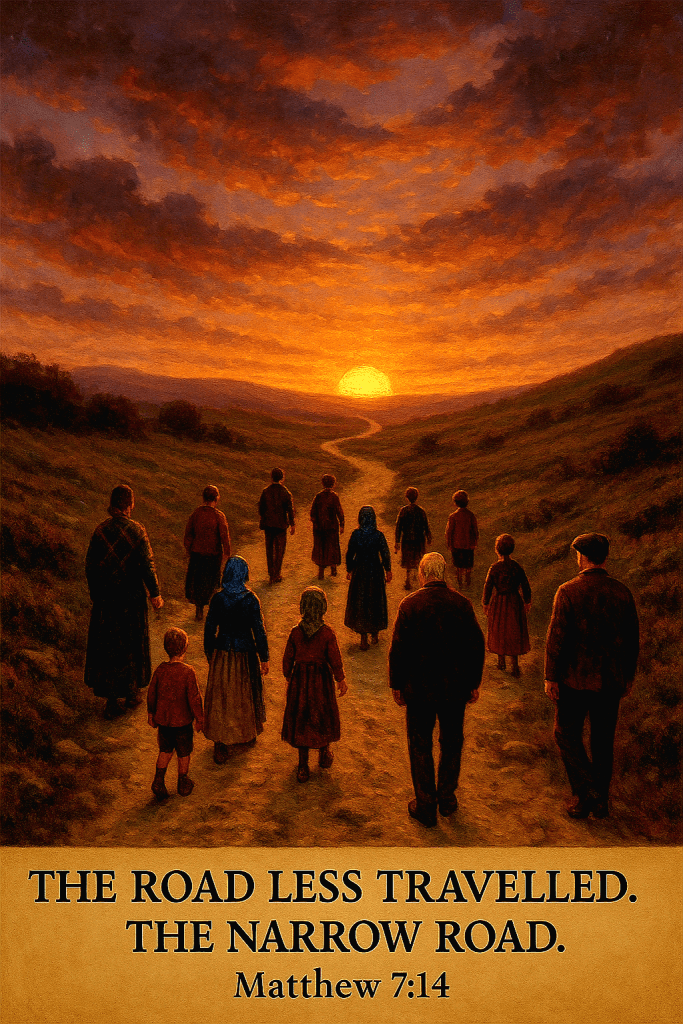
There are two overarching paths that lie before us, as stated by Jesus. One is the broad road that leads to destruction, and many will go in by it — the crowd. The other is the narrow gate and the difficult way that leads to life, and few will find it — the remnant.
“Enter by the narrow gate, for wide is the gate and broad is the way that leads to destruction, and there are many who go in by it. Because narrow is the gate and difficult is the way which leads to life, and there are few who find it.” — Matthew 7:13–14, NKJV
We are those who hear the voice of the Spirit through the Word of God, who see and understand and stand, even if we stand alone.
Let us be voices that warn. And more than that, let our walk be our light and a lamp of direction to others. The word of God is a lamp to our feet, it leads us and guides us in the way that we should go.The Kingdom of God is found along the narrow path that runs counter to the world.
We encourage one another, it is a beautiful thing, a sacred rhythm in the Body of Christ. It has been the highest privilege of my life to minister to the few, those precious souls who once believed they were utterly alone. They are the ones who, at great personal cost, have come out from the organized church, misunderstood, maligned, and often mistrusted. They have been accused of elitism, of arrogance, even of falling away, when in truth, they could no longer endure the weight of a system that quenched the very Spirit they were called to walk in.
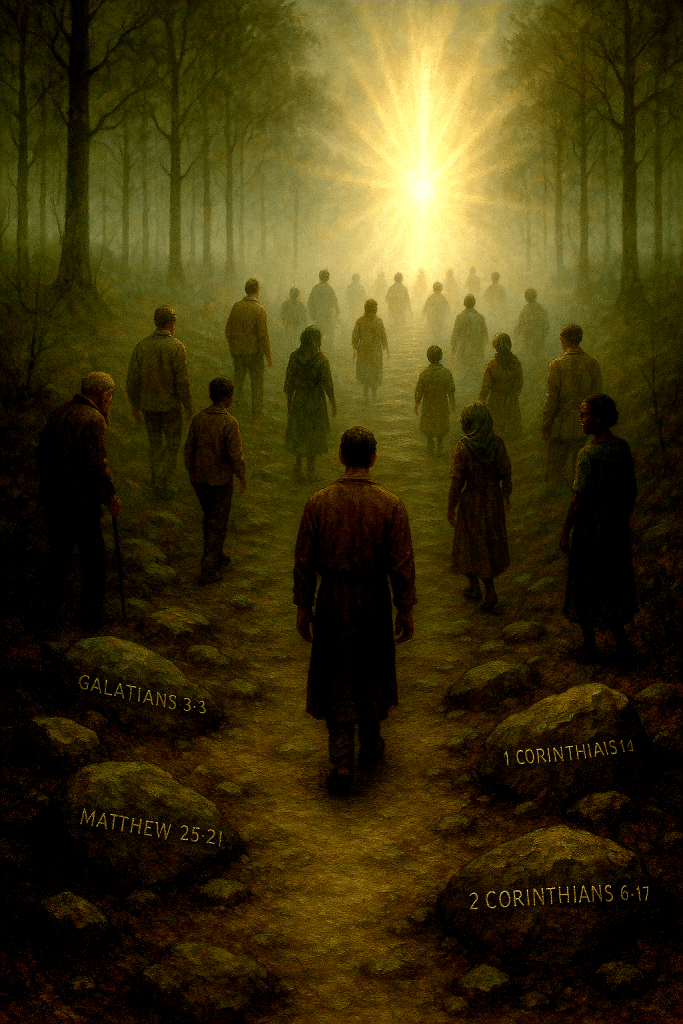
These are they who began in the Spirit, and, like Paul’s plea to the Galatians, refused to be perfected by the flesh (Galatians 3:3). They yearn to hear not the rebuke, “O foolish Galatians,” but rather the commendation, “Well done, good and faithful servant” (Matthew 25:21). They seek to gather where the Spirit is free to move, where the saints may truly fulfill the exhortation of 1 Corinthians 14, that all may speak, all may learn, all may be encouraged, and the gifts be exercised for the edification of the whole.
They long to walk simply, with humility before God and sincerity before men (Micah 6:8). In their gatherings, Christ alone is exalted, Jesus, the Lord of glory, lifted up as the only Head, the only Shepherd, the only One who is preeminent (Colossians 1:18). There are no stars, no stages, only saints, broken and burning, desiring nothing but Him.
Yet to walk this way, there has been a call, an unrelenting summons from the Lord, “Come out from among them and be separate, says the Lord. Do not touch what is unclean, and I will receive you” (2 Corinthians 6:17). This is the remnant road, walked not in bitterness but in obedience, not in pride but in pursuit of the living God, Christ in us, the hope of glory.
In the fierce heart of every storm, there lies a sacred stillness , a place untouched by the chaos that rages all around. That stillness is Christ. He is not on the edge, not watching from afar , He is at the very center, the calm within the tempest, the anchor of our souls.
When we run to Him, we do not escape reality , we enter into a deeper one. We step into perfect peace, not because the storm ceases, but because the Prince of Peace reigns within it. But if we flee, if we try to outrun the storm in our own strength, we hurl ourselves into its fiercest winds. The resistance grows, the fear swells, and we are battered by every gust.
Brothers and sisters, run to the center. Run to Jesus. For in Him, the storm loses its power, and the winds fall silent in the shadow of His presence. He prepares a table for us in the heart of every storm. He causes us to lie down in green pastures , beside still waters. He anoints us with oil and restores us. This goodness and mercy shall follow us all the days of our lives.
It was a cost that had to be counted. It was a road that had to be walked alone. More than eighteen years ago, I began the web-sight of “A Call to the Remnant,” knowing full well that such a path would not be popular. Yet the Lord impressed upon me to speak to the remnant, encourage them that they are not alone, and do not concern yourself with those who are drawn to personalities or positions of influence. To speak of suffering and endurance. To focus on taking up one’s cross daily. None of these subjects were or are popular.
In every sphere of life, even within the realms of revival and now the so-called “remnant movement,” there is the ever-present temptation to be seen as a leader. This must be resisted at all costs. For the call of Christ is not to innovate or to gather followers, but to return. To return to the old paths, to rediscover what has been forsaken, not to reimagine or redesign it.
“Thus says the Lord, ‘Stand in the ways and see, and ask for the old paths, where the good way is, and walk in it, then you will find rest for your souls'” (Jeremiah 6:16).
Ours is the ancient path. It is the road of the cross, the way of dying daily, of fellowshipping in His sufferings. It is not the road of crowds and applause, but of quiet obedience and sacred obscurity. It is not about drawing attention to ourselves, but rather retreating to the mountains where only the Father sees.
“Then Jesus went out to the mountain to pray, and continued all night in prayer to God” (Luke 6:12).
Jesus did not seek the multitude. In fact, when the crowds pressed in, He often withdrew. He did not entrust Himself to men, for He knew what was in them. He was not flattered by popularity, nor swayed by numbers.
“But Jesus did not commit Himself to them, because He knew all men, and had no need that anyone should testify of man, for He knew what was in man” (John 2:24–25).
To take up the cross is to refuse the limelight. It is to prefer the valley of humility to the heights of acclaim. It is to labor for an unseen Kingdom, to speak to the few who are willing to walk the narrow way.
“If anyone desires to come after Me, let him deny himself, and take up his cross daily, and follow Me” (Luke 9:23).
“Enter by the narrow gate, for wide is the gate and broad is the way that leads to destruction, and there are many who go in by it. Because narrow is the gate and difficult is the way which leads to life, and there are few who find it” (Matthew 7:13–14).
To be unknown in this world, and yet known in heaven, this is our portion. We abide under the shadow of His wing. The world may not understand us, but the Spirit bears witness that we are His.
“He who dwells in the secret place of the Most High shall abide under the shadow of the Almighty” (Psalm 91:1).
We are not called to build movements. We are not called to replicate the machinery of men. We are called to bear witness. We are called to walk in truth and in love, to speak to the few, the weary, the broken, the ones who hunger and thirst for righteousness.
“Let us go forth to Him, outside the camp, bearing His reproach” (Hebrews 13:13). “For your fellowship in the gospel from the first day until now, being confident of this very thing, that He who has begun a good work in you will complete it until the day of Jesus Christ” (Philippians 1:5–6).
This is the way of the wilderness. This is the way of the cross. It is not the world’s way, the path of influence and comfort, but the Lord’s way,the narrow way. It is the road that leads to life.
The Pentecostal and Charismatic world has been shaped by movements such as “name it and claim it” and the so-called “word of faith” message. Add to that the prosperity gospel, and what remains is a witches brew, a kind of spiritual confusion brewed in our own theological cauldron. These movements have often shifted the focus of faith from trusting in God to demanding from God, turning faith into a formula for material gain rather than a pathway to spiritual depth. What was once a holy dependence on the sovereignty of God has, in many circles, become a technique for manipulating outcomes.
Yet Scripture offers a deeper, more sobering view. Depending on the translation, the word “faith,” appears around 270 times in the Bible. The vast majority of these references are not about miracles or breakthrough, but about trust, trust in God’s character, His promises, and His sovereign will.
Hebrews 11:6 says, “But without faith it is impossible to please Him, for he who comes to God must believe that He is, and that He is a rewarder of those who diligently seek Him.”
The kind of faith that pleases God is not transactional, but relational. It is the quiet, unwavering confidence in who God is, even when heaven is silent and the way is dark.
Romans 8:8 reinforces this truth: “So then, those who are in the flesh cannot please God.” Faith and flesh are incompatible. One walks by sight, the other by belief. To walk in the flesh is, functionally, to walk without faith.
Romans 8:5 explains, “For those who live according to the flesh set their minds on the things of the flesh.” The word mind here, phroneó, speaks of setting one’s affections, fixing one’s thoughts and desires. To “mind” the things of the flesh is to be consumed with the visible, temporal world. The Greek word for flesh, sarx, in this context means “the symbol of what is external.”
What does that look like in practical terms? It means being consumed with our careers, our possessions, our reputations, our politics, our social standing, our image, gaining our miracles, our health, rather than being absorbed in the things of God. A mind dominated by these mostly earthly concerns is incompatible with the Spirit-led life. Such a person is not walking in the Spirit, and therefore cannot please God. Being obsessed with miracles often flows, not from the heart of God, rather , it flows from the depths of our flesh.
“For to be carnally minded is death, but to be spiritually minded is life and peace.” (Romans 8:6)
The spiritual mind is one that seeks first the Kingdom of God and His righteousness (Matthew 6:33). It is a life oriented toward the eternal, not the temporary.
Hebrews 11, that great chapter of faith, gives us a dual picture. We rejoice in the stories of deliverance:
“By faith the walls of Jericho fell” (v.30), “Through faith they subdued kingdoms, worked righteousness, obtained promises, stopped the mouths of lions” (v.33). These are victories worth celebrating.
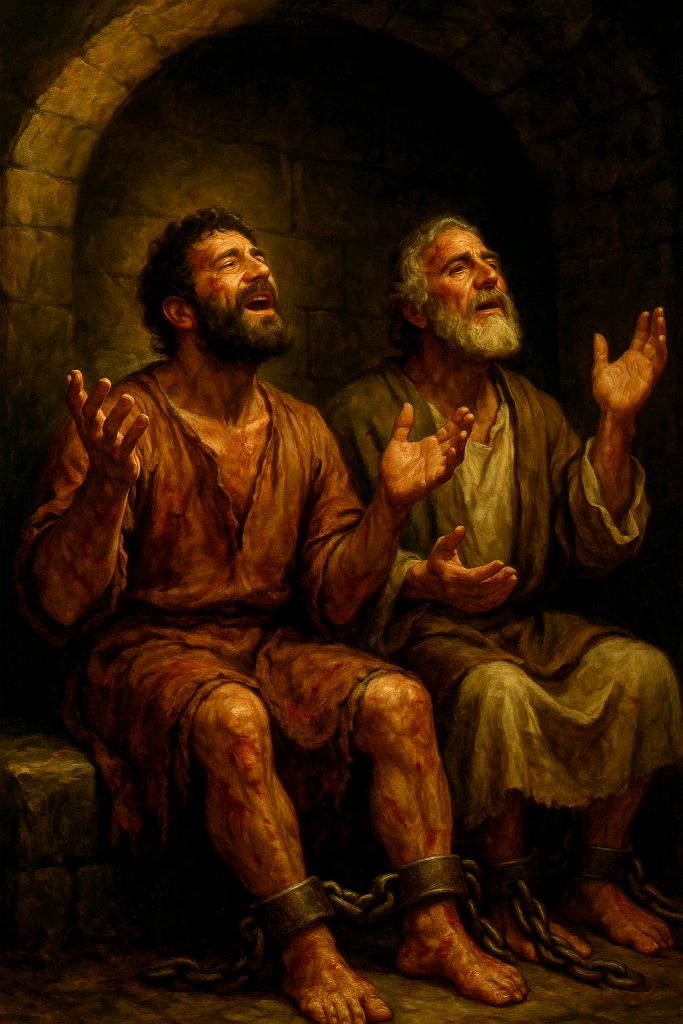
Yet the chapter shifts abruptly. “Others were tortured, not accepting deliverance, that they might obtain a better resurrection. Still others had trial of mockings and scourgings, yes, and of chains and imprisonment. They were stoned, they were sawn in two… being destitute, afflicted, tormented, of whom the world was not worthy.” (vv.35–38)
The common thread?
“And all these, having obtained a good testimony through faith, did not receive the promise.” (v.39)
Their faith was not measured by immediate reward, but by enduring trust in the unseen. Job expressed it best:
“Though He slay me, yet will I trust Him.” (Job 13:15)
Habakkuk echoes the same heart: “Though the fig tree may not blossom… yet I will rejoice in the Lord.” (Habakkuk 3:17–18)
This kind of faith is not swayed by trials or silence. It is rooted in relationship, not reward. Psalm 23 reminds us that God does not remove the enemies, but prepares a table in their midst.
“You anoint my head with oil, my cup runs over.” (Psalm 23:5) The oil flows not in times of ease, but in times of pressure. The true reward of faith is not what we receive, but who we receive—His presence.
“In Your presence is fullness of joy.” (Psalm 16:11)
The last 2,000 years of Church history bear witness to this truth. Millions have suffered for Christ, not because their faith failed, but because their faith endured. They possessed a spiritual mind and a heart anchored in another world. Their lives pleased God. Their testimonies still speak.
So the question is this: will you walk in the Spirit today? Will you cast aside the fleeting things of this world and set your affections on things above (Colossians 3:2)? Will you walk by faith and not by sight (2 Corinthians 5:7)? Will you trust God even when there is no sign of deliverance?
This is the faith that pleases God. And without it, we cannot.
A few years ago, my wife and I visited Bar Harbor, Maine, a picturesque town along the rugged coast of northern Maine. On the surface it was charming, but beneath that charm I sensed something deeply troubling. There were pride flags in abundance, drag performers openly parading down the street, but it was not the mere presence of these things — it was the spiritual atmosphere. It was oppressive, heavy, dark. A spirit hovered there that grieved my soul, and I knew it. The Spirit of God within me bore witness, and I felt led to walk through that town early one morning, praying in the Spirit.
With each step I called on the name of the Lord, walking the streets as one who carries the presence of God. Eventually, I came to the Village Green, and felt impressed to sit and worship. I reached for my earphones, but realized I had left them in the hotel. Yet the call to worship remained. So I turned up the volume on my phone and let the songs of praise rise into the morning air. I sat there quietly at first, hoping not to disturb, but then the Holy Spirit spoke gently to my heart.
He said, “There are pride signs everywhere. These people are proud of who they are. Are you proud of who you are?” It was not harsh, not condemning, but firm and loving. The answer welled up in me, not just as a thought, but as a fire—yes Lord, I am not ashamed of You. I am not ashamed of the Lord Jesus Christ. And then the Spirit said, “Raise your hands here, in the middle of this park, and worship Me.”
I hesitated for a moment. The flesh wrestled with the spirit. What will people think? What will they say? But the Spirit whispered, Who cares what they think? Galatians 1:10 says, “For do I now persuade men, or God? Or do I seek to please men? For if I still pleased men, I would not be a bondservant of Christ.” So I surrendered, I raised my hands, and worshiped. In the open. In the daylight. Among strangers.
And when I did, something broke. The chains of fear and intimidation snapped. Freedom swept over me like a wave. For ten, maybe fifteen minutes, I sat there, hands lifted to heaven, praising the King of glory. People walked by, some stared, but I no longer cared. I had entered the sanctuary of His presence in the open square. And when it was done, the oppression that had pressed upon me was gone. Lifted. Dispersed like a mist under the rising sun.
You see, brothers and sisters, there is power in being unashamed. There is liberty in declaring with your whole life that Jesus is Lord. As it is written in Romans 1:16, “For I am not ashamed of the gospel of Christ, for it is the power of God to salvation for everyone who believes.” There is a direct connection between boldness and power, between confession and anointing.
Jesus said in Luke 9:26, “For whoever is ashamed of Me and My words, of him the Son of Man will be ashamed when He comes in His own glory, and in His Father’s, and of the holy angels.” Let it not be so with us. Let us be those who glorify our God not just with words, but with surrendered lives, with uplifted hands, with fearless obedience.
The world is growing darker, more hostile to Christ and His people. But the light shines in the darkness, and the darkness cannot overcome it.
Stand firm. Be unashamed. And in doing so, walk in the power of His gospel — the only power that saves, the only power that delivers. His way, His truth, His life.
You know, tomorrow is Pentecost (I wrote this a few weeks ago) And like many sacred things in the church, we have made a symbol of it. We have reduced it to a ritual, a religious observance marked by a date on the calendar. Pentecost, like Christmas or Easter, has become a ceremony. But, brothers and sisters, let me tell you plainly, that is not what it was meant to be.
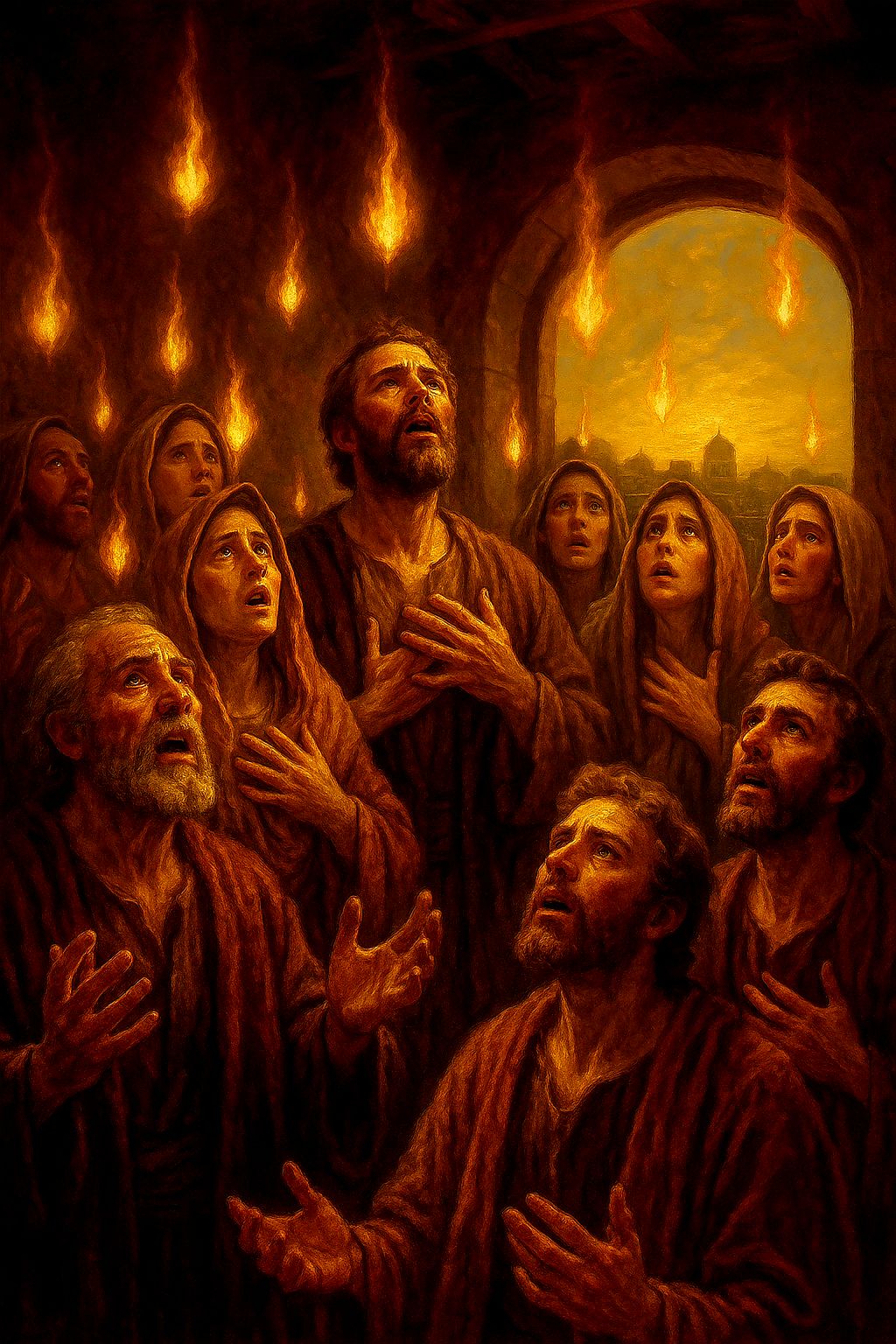
Pentecost was not a celebration of a day. It was the arrival of a Person. The Holy Spirit descended like fire from heaven. As the Word declares, “Then there appeared to them divided tongues, as of fire, and one sat upon each of them. And they were all filled with the Holy Spirit” (Acts 2:3–4, NKJV).
That moment was not meant to be memorialized once a year, it was meant to revolutionize every day. One encounter with the baptism of the Holy Spirit transforms a life utterly. It sets the heart ablaze and loosens the tongue with boldness. It becomes the source of power that causes the devil to flee. It strengthens our feet for the narrow way, “Because narrow is the gate and difficult is the way which leads to life, and there are few who find it” (Matthew 7:14, NKJV).
The Spirit enables us to pass through valleys, to climb spiritual mountains, to face the enemy of our souls. Not with trembling but with power. For “greater is He who is in you than he who is in the world” (1 John 4:4, NKJV). Pentecost is not a date, it is a way of living, it is heaven’s breath within us, propelling us forward in divine strength.
Jesus Himself declared, “I came to send fire on the earth, and how I wish it were already kindled” (Luke 12:49, NKJV). And John the Baptist testified of Christ, saying, “He will baptize you with the Holy Spirit and fire” (Luke 3:16, NKJV). This fire, I believe, was taken from the coals of the heavenly altar, the very presence of God, and placed upon frail men.
And what happened? Those few, filled with that fire, “turned the world upside down” (Acts 17:6, NKJV). They did not wait for a Sunday. They did not look to feast days. They carried Pentecost in their bones, in their breath, and in their speech. They were pierced by power and spoke so that “when they heard this, they were cut to the heart” (Acts 2:37, NKJV).
You must be born again. You must be baptized in the Holy Spirit. You must have the fire of God within. Without Him, Christianity becomes religion, an empty shell. But with Him, it becomes life and that more abundantly (John 10:10, NKJV).
For it is the God who commanded light to shine out of darkness, who has shone in our hearts to give the light of the knowledge of the glory of God in the face of Jesus Christ (2 Corinthians 4:6, NKJV).This divine command, “Let there be light,” echoes not only through the void of creation, but through the depths of the human soul, awakening the dead and igniting the flame of divine revelation within frail vessels of clay.
And these vessels, earthen, vulnerable and mortal, contain within them a treasure beyond comprehension, so that the surpassing greatness of the power may be shown to be of God and not of us (2 Corinthians 4:7, NKJV).It is in this paradox, this sacred tension, that the furnace of affliction becomes the forge of transformation. We are summoned into the crucible, not to be consumed, but to be refined, not to be broken, but to be remade in the image of the Son.
Pressed on every side, yet not crushed, perplexed, but never abandoned to despair, persecuted, yet never forsaken, struck down, but not destroyed (2 Corinthians 4:8–9, NKJV). This is the holy pattern, the bearing of the dying of the Lord Jesus in our bodies, that His life, resurrected and victorious, might also be manifest in us (2 Corinthians 4:10, NKJV).
The flesh suffers and is scourged that the Spirit might rise, the outward man perishes so that the inward man may be renewed day by day (2 Corinthians 4:16, NKJV).This, indeed, is the Christian mystery, that the path to life is through death, and the ascent to glory begins with the descent into suffering.
For our light affliction, which is but for a moment, is working for us a far more exceeding and eternal weight of glory (2 Corinthians 4:17, NKJV).We do not fix our eyes upon what is seen, for what is seen is fleeting, mortal dust swept along by the winds of time. No, we set our eyes upon the eternal, upon the unseen, where Christ is seated at the right hand of God.
It is there, in the realm of eternity, that power is born, the power to endure, to overcome, to rise from the ashes with beauty unspeakable.Peter walked upon the waters while his eyes were locked upon the gaze of his Master. And he began to sink the moment he turned his attention to the storm (Matthew 14:29–30, NKJV).
So it is with us, brothers and sisters. When we look to Christ, we walk in divine power, power to break chains, to still the storm, to raise the dead things to life.Even in the fire, He is with us.“Look!” he answered, “I see four men loose, walking in the midst of the fire, and they are not hurt, and the form of the fourth is like the Son of God” (Daniel 3:25, NKJV).
As with the three Hebrew children, the world may peer into the furnace and behold One like the Son of God walking amidst the flames in the midst of our circumstances.And the testimony shall rise, not only from our lips, but from our lives, that this, indeed, is the God of heaven (Daniel 3:28–29, NKJV).
Shall our lives not speak of such glory, saints? Shall our lives not bear testimony of the majesty that resides in us, the Lord Jesus? In the crucible, which is our lives, may our heavenly treasure pour forth as we are poured out for His sake.
The apostolic revelation given to Paul, as recorded in Colossians 1:26, presents one of the most profound disclosures in redemptive history—a mystery once concealed from ages and generations, now gloriously revealed to the saints. This mystery, long hidden in the counsels of God, was not perceived by the prophets nor comprehended by the wise of this world. It is the astounding truth that in Christ Jesus, Jew and Gentile are no longer divided, but made one—a new humanity, a single body in the Messiah. This is the long-anticipated fulfillment of the promise to Abraham, that in his seed all the nations of the earth would be blessed. No merely ethnic boundary remains, for in Christ there is neither Jew nor Greek. This is a revelation of cosmic consequence and divine ingenuity, wholly unforeseen in its breadth and intimacy.
Yet, astonishingly, the mystery deepens. As Paul continues in Colossians 2:2–3, he reveals that the purpose of this unity is not an end in itself, but a divine conduit by which the saints are brought into the very heart of God. He prays that their hearts might be encouraged, being knit together in love, and that they may attain to all the riches of the full assurance of understanding—to the knowledge of the mystery of God, both of the Father and of Christ.
Herein lies the surpassing dimension of the mystery: not merely reconciliation between former enemies, but an invitation into divine communion. In Christ are hidden all the treasures of wisdom and knowledge. Through union with Him, the veil is lifted and the Father—once unknowable and inscrutable—is made known. The mystery begins with the joining of the divided, but it climaxes in the revelation of the Divine. It is not only that Jew and Gentile are made one in Christ, but that in being made one, they are ushered into the very life of God.
This is the formation of the true Israel of God—a people sanctified, a royal priesthood, whose minds are being renewed and whose hearts are being enlarged by the Spirit. The saints are not left with mere doctrine, but are drawn into the riches of divine intimacy, discovering the boundless wisdom and knowledge hidden in Christ. This is the full arc of the mystery: reconciliation leading to revelation, unity giving way to glory, and the Church—Christ’s body—growing in grace as it beholds the face of God in the person of Jesus Christ.
One of the most tragic realities of the contemporary church, most glaringly within the American context, yet by no means confined to it, is the widespread absence of the new birth among professing Christians. This foundational deficiency renders it utterly impossible for such individuals to love as the early church loved, for the very source and sustainer of that love is Christ Himself. It is He who binds believers together in divine unity.
The church, properly understood, is not a building, a denomination, or an institution, it is the living body of Christ. And unless one has been joined to that body through regeneration, one simply does not belong to the Church in the true, biblical sense, the ekklesia, the “called-out ones.”
It is spiritual folly to expect those outside of Christ, unregenerate and untouched by the Spirit of God, to manifest the supernatural love that defined the earliest believers. This love flows not from religious duty or communal sentiment, but from the indwelling presence of the Holy Spirit.
Oswald Chambers, in his meditations on the Sermon on the Mount, rightly observed that any attempt to live out Christ’s teachings apart from the new birth results in a miserable experience. For the unregenerate, the Sermon is not a light but a crushing burden, a lofty ideal that exposes the impossibility of genuine righteousness without divine transformation.
Religion, absent the life of Christ, becomes little more than a philosophy, a system of ethics, or a cultural form. It may produce momentary acts of kindness, but it cannot sustain the sacrificial, Spirit-wrought love of the saints. This love, that bears all things, believes all things, hopes all things, endures all things, does not arise from human effort but from the supernatural work of God in the soul.
Thus, what many interpret as disunity in the church is, in truth, the presence of multitudes who are members of religious organizations, but not members of Christ’s body. They are, at best, moralists striving in their own strength, at worst, deceived souls clinging to the form of godliness while denying its power.
The Scriptures are not silent on this. “Many are called, but few are chosen” (Matthew 22:14). The remnant, the few, are the truly born again, those who love with a love not their own, who recognize one another not by label or denomination, but by the Spirit of Christ within. When these encounter one another, there is immediate fellowship, unfeigned and deeply rooted in shared life.
To expect widespread spiritual unity in a landscape dominated by nominalism is to set oneself up for continual disillusionment. Indeed, the gap between our expectations and the reality of the religious world around us is often the precise measure of our grief.
But if we understand this reality, that true unity and true love exist only among the regenerate few, we will cease to be disheartened by the failures of the masses and instead rejoice to find, here and there, a brother or sister truly alive in Christ. For these are the Church. These are the Body. These are the beloved of God.
Our small house church, though modest in number, stands as a precious testimony to a deeper reality, a reality that transcends the glittering edifices and booming stages of modern Christendom.
Over a decade ago I made the conscious, Spirit-led shift, joining countless others across the globe who have heard the still small voice calling them out of spiritual Babylon. For in every generation, God reserves for Himself a remnant, a people who will not bow the knee to Baal, no matter how cunningly he reinvents himself through culture, compromise, or counterfeit religion.
Before our very eyes unfolds the tragic convergence of the harlot church, a synthesis of worldliness and religion, dressed in finery but inwardly defiled. Its heartbeat is not the cross, but the stage; not the Spirit, but spectacle. As it was in Rome, so it is today. The Coliseum, once the epicenter of Roman life, rose from the gold and silver plundered by Titus during the destruction of the Temple in Jerusalem. One temple fell, another was built. Worship of the Holy was replaced by worship of self, veiled in the opiate of entertainment. Bread and circuses—tools of distraction, tools of dominion.
Yet the martyr Stephen, in his final breath, echoed the words of our Lord: “The Most High does not dwell in temples made by human hands.” Jesus, speaking to the Samaritan woman, dismantled the geography of worship and pointed to its essence—Spirit and truth. When asked, “Where should we worship?” Christ responded not with a location, but with a mandate: how we are to worship.
It is vital—indeed, imperative—that the true saints gather not around programs, performances, or personalities, but around the presence of God. In Spirit. In truth. And as the great Day of the Lord draws ever nearer, this calling becomes all the more urgent. For history has shown: men gather to entertain themselves. But few gather to worship God as He has ordained.
Let us, then, be counted among the few—those walking the narrow path that leads to life. Let us not be swept away by the many, whose feet tread the broad road of destruction. Let our assemblies be small, but pure; hidden, but radiant. May our worship rise not from stages, but from sanctified hearts. For the time is short, and the Bride must make herself ready.
A couple of days ago, I found myself praying through the pain. The weight of chronic suffering pressed hard against my body, sleepless nights, relentless aches, and then came the news: my mother, already fragile, had fallen again, twice in three days. Now she lies in a hospital bed back in Scotland, and I feel the ache of distance more deeply than the pain in my bones.
But in the middle of this storm, our little fellowship had just been walking through Colossians 1, and Paul’s words struck deep: “Strengthened with all might, according to His glorious power, for all patience and longsuffering with joy.” Oh, what a mystery! That in our weakness, we are strengthened, not by our own feeble will, not by grit or determination, but by all might, according to His glorious power. It is Christ. It is all Christ. His strength, His might, His glory. He initiates, He enables, and in Him, we become more than conquerors. And as this truth ignited my spirit, a prayer rose from the depths, a cry not of despair but of victory, and it thrilled my soul and lifted me high, far above the valley, to a place where joy and power meet on the mountaintop of faith. Glory to God!
……………………This was my prayer……….
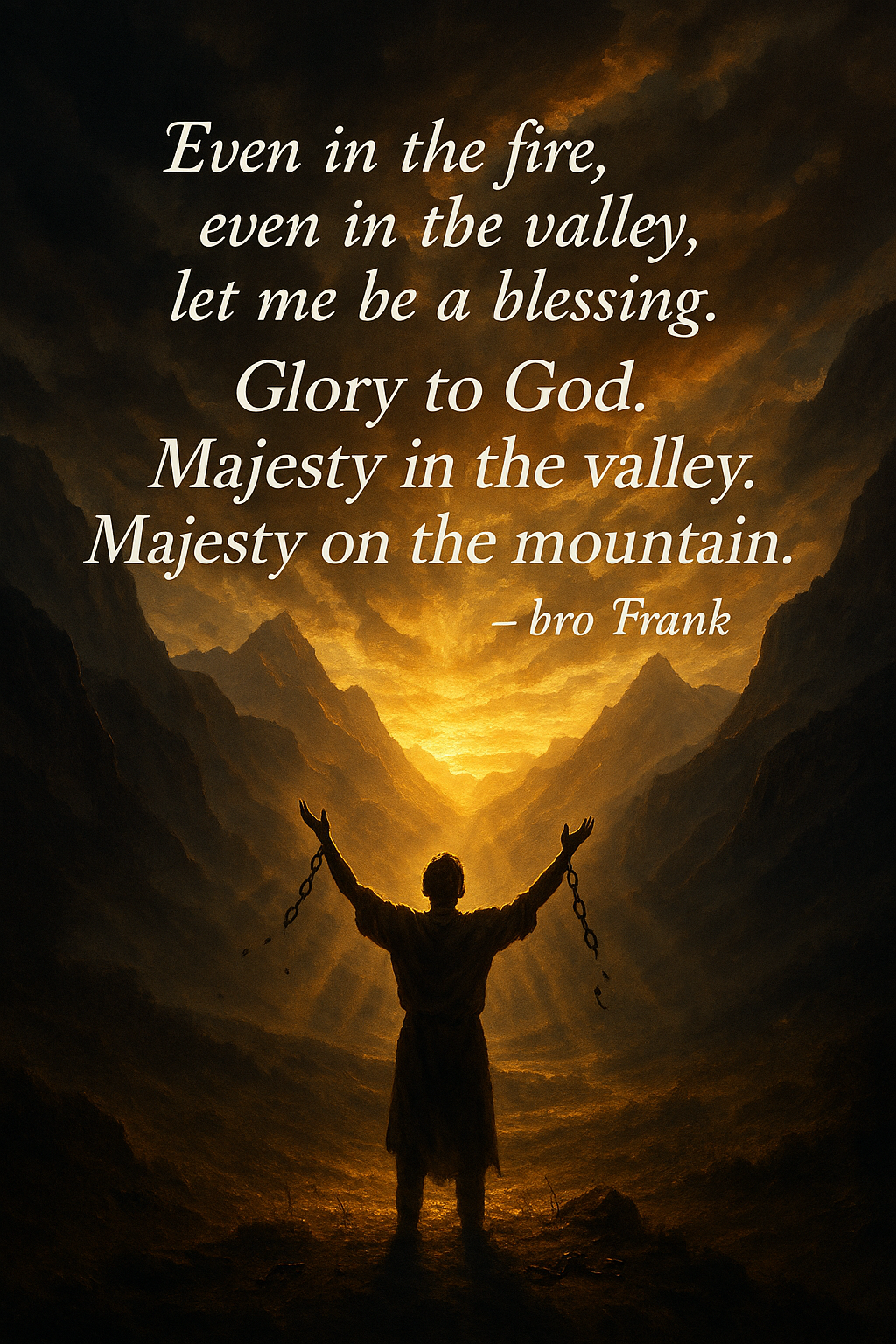
When every last breath is torn from my lungs, still, I will give You the kiss of life. When I have tasted no food for many days, my soul shall yet feed the hungry. When the sun has hidden its face and the heavens remain cloaked in silence, I will lift my face to You, and You, O Radiant One, will shine through me. And when my heart is heavy with sorrow and anguish drowns my soul, I will break the alabaster jar of joy and pour it out upon the weary. O Lord of Heaven and Earth! Even in the testing, even in the fire and the fury, even in the shadow of death and in the long-suffering of my pain, let me be a blessing. Let me bless them from the prison of that pain. Let me lift them from the depths of my own valley. If they are halfway up the mountain and I am still far below, let them hear my song rise from the depths:Glory to God. Glory to God!
And may the valley blaze with the light of that glory. Let the darkness tremble. Let chains be shattered. Let the echo of praise thunder through every cavern, For You, O King, are worthy in fire and flood, in feast and famine. Majesty in the valley. Majesty on the mountain.
If I can rejoice in the midst of suffering, then I stand at the threshold of a sacred mystery, that place where I, in my own frail flesh, “fill up what is lacking in the afflictions of Christ… for the sake of His Body.” Only the soul saturated and drenched in the Spirit of the Living God, can rise in the midst of wreckage of loss and cry out with trembling lips, “The Lord gives, and the Lord takes away, blessed be the name of the Lord!” This is no mere endurance, no stoic stance, it is a sacred participation in the sorrow and the splendor of Christ. It is the fellowship of His suffering. A communion few will dare to enter, too costly for most, and yet it is the very ground where heaven bows down and kisses the wounded earth
When heaven collides with earth, then it enters into sorrow. How could it be otherwise? One is perfect, the other a ruin of its original. And we, we who have been born from above, have been invaded by that very heaven. It fills our bones. It saturates our hearts. And in that collision we begin to drink from the same bitter cup our Lord once drank. We are not spectators. We are not distant. We are His Body, and so we must enter into that same sorrow, that way of suffering, and there we must rejoice in the midst of it all. And the joy we share, as we tarry there, begins to tear down the kingdom of darkness.
Our joy is the indelible, supernatural fingerprint of heavens glory that lies within us. Our brokenness, shattered by a dying world, becomes the sacred fissures through which the glory of God bursts forth. And as that glory pours forth, it kisses the wounded earth, and it becomes a balm of Gilead. It is the fellowship of His suffering. It is the communion of the afflicted. It is the royal priesthood of the scarred and the sanctified. A holy nation, set apart, bearing upon our very bodies the marks of our King. Not in shame, but in triumph. Not in defeat, but in everlasting victory.
I find myself increasingly dismayed by the widespread lack of discernment concerning not only the papacy but the Catholic Church as a whole. Speaking as a former Catholic, one who departed from the Church upon experiencing a genuine conversion, a born-again encounter with Christ. I am particularly troubled by the growing acceptance of Catholicism among Protestant and Evangelical circles that, only a few decades ago, would have maintained a clear separation. The shift over the past 25 to 30 years is both significant and concerning.
Research indicates that there are at least 20 million former Catholics in the United States alone. Of these, studies suggest that approximately 80–90% departed after undergoing a born-again experience. If we extend these figures to South America, the number nearly doubles, approaching 50 million individuals across the Americas who have left Catholicism for similar reasons. When extrapolated globally, the figure could be closer to 100 million. There is, therefore, a profound and deliberate reason why so many now identify as “ex-Catholics,” myself included, and I do not hesitate to affirm that designation.
The widespread failure to recognize these realities, in my view, correlates closely with the phenomenon commonly referred to as the “Great Falling Away” a time marked by diminishing spiritual discernment, widespread biblical illiteracy, and the dilution of Protestant witness, which has become but a shadow of its former vitality. This erosion continues largely unabated.
The idea that the head of the Catholic Church, the Pope, could be regarded as a born-again believer is, in my estimation, theologically untenable and historically absurd. This is to say nothing of the longstanding doctrinal errors promulgated by the Catholic Church, foremost among them the dogma of transubstantiation. The claim that a priest has the authority to transform a piece of bread into the literal body of Christ not only defies plain scriptural teaching but also strains credulity to the utmost. Such a claim, divorced from biblical foundations, highlights the extent of the doctrinal chasm.
Given these concerns, I have deliberately refrained from engagement with recent papal funerals, elections, and public commentary surrounding the pontificate. I am personally persuaded that the figure of the Pope, whether the present or a soon-coming successor, will fulfill the prophetic role of the False Prophet, one who will direct the world to the Antichrist, declaring him to be the true Christ. In a world that increasingly regards the Pope as the de facto figurehead of Christianity, reverently referring to him as the “Holy Father” and the “Vicar of Christ,” such developments seem to me to be falling into place with alarming predictability.
Then Moses stood, trembling before the living God and cried, “If Your Presence does not go with us, do not bring us up from here!” What use is a promised land without the presence of the Lord? What use victory without the Victor? Better to die in the wilderness with His presence than to live in palaces void of His presence. Moses didn’t crave gold or glory—only God. “How will they know we have found grace in Your sight unless You are with us? For it is Your Presence that sets us apart from all the peoples of the earth!”
This plea came after the shame of the golden calf. God had said, “I will not go in your midst, lest I consume you on the way, for you are a stiff-necked people.” Judgment hung heavy. But the people responded with brokenness, they stripped themselves of their ornaments, the very gold they once used to craft an idol. What was once an object of rebellion would now be set apart for worship, given for the building of the tabernacle. Out of ashes, something holy would rise.
God, moved by the bold and broken cry of His servant, said to Moses, “I will do this thing that you have spoken, for you have found grace in My sight, and I know you by name.”
Oh, the wonder of being known by God, not just as a face in the crowd, but as a beloved child. Your name, spoken from His lips. The same voice that formed the stars knows your name.
But Moses was not satisfied. He wanted more. “Show me Your glory!” he cried. The cloud wasn’t enough. The fire wasn’t enough. The voice on Sinai wasn’t enough. He longed to see God Himself. Do we? Do you long for His presence with such desperation? Is this one desire the fire that burns in your bones?
David knew that longing. “I have set the Lord always before me; because He is at my right hand, I shall not be moved… for in Your Presence there is fullness of joy.” Not a taste, not a whisper, not a portion-fullness. The very life of the soul. Like a deer pants for the water, so our souls should pant for Him. We cannot go forward unless He goes with us. We need the cloud by day, the fire by night, and the glory that changes everything.
David cried again in Psalm 27, “One thing I have desired of the Lord, that will I seek: that I may dwell in the house of the Lord all the days of my life, to behold the beauty of the Lord, and to inquire in His temple.” His heart was not set on fame or fortune, but on this one thing—to dwell with God, to see His beauty, to be near Him. In the time of trouble, God would hide him, lift him high upon the Rock.
To Moses, God replied, “I will make all My goodness pass before you… but no one can see My face and live. Still, there is a place by Me. Stand on the rock. I will hide you in the cleft of the rock and cover you with My hand. Then you shall see My back.” What a mercy. What a gift. Moses stood on the Rock, hidden in the cleft, shielded by God’s hand, and he saw the glory of the Lord.
Dear brothers and sisters, do you stand upon the Rock? Are you hidden in the cleft? Has the hand of God covered you, and have you glimpsed His glory? Has it changed you from the inside out? Like Isaiah, who saw the Lord and was undone. Like Jeremiah, who burned with His word. Like Ezekiel, who fell before the wheels of glory. Has His fire touched your lips?
This is no ordinary walk. This is the baptism of fire. For Jesus said, “I have come to cast fire upon the earth, oh, how I wish it were already kindled!” Our God is a consuming fire. He burns away the flesh, the pride, the idols, and reveals His glory in the soul that longs for Him. Let that fire fall.
There is power, brothers and sisters, real power. In Christ. It resides within us and we have been called to exercise it in the name of the Lord Jesus. Just because the Word of Faith movement and the Charismatics have so abused this notion, this should not dissuade us from moving in the power of God,He gives power to the weak, not just comfort, not just words, but power, power from heaven
poured into fragile clay. To those who have no might, He increases strength. This is not human resolve. This is not willpower. This is divine empowerment. Those who wait on the Lord? They don’t just survive, they rise. They mount up with wings like eagles. They run and do not grow weary. They walk, and they do not faint.
Why? Because it is God, yes, God, who commanded light to shine forth from darkness, who said “Let there be!” and there was, who has now shone into our hearts the light of the knowledge of the glory of God in the face of Jesus Christ. There is power in the light, there is power in the “knowledge of glory.” Not the head knowledge, the mental assent to an abstract truth, but the glory itself and your experience of it and in it.
And this treasure, what a treasure! This power lives in earthen vessels, in us, so that the excellence of the power may be of God and not of us. And Jesus said: “You shall receive power when the Holy Spirit has come upon you…” (Acts 1:8). Power to live. Power to stand. Power to speak. Power to shine like lights in a darkened world. Power to be His witnesses in Jerusalem, Judea, Samaria, and to the ends of the earth.
Paul declared, “I can do all things through Christ who strengthens me.” He prayed that we would be strengthened with might through His Spirit in the inner man. And Jesus Himself said, “My grace is sufficient for you, for My strength is made perfect in weakness.” So Paul says, “Therefore I will boast in my infirmities, that the power of Christ may rest upon me.” Do you believe that today, saints? Do you believe there is a power alive in you? Christ in you, the hope of glory? Is there life in you? Is there light in you? Then let it burn. Let it blaze. Let the world see Jesus alive in you.
Let me give you a small example of Gods glory and power. I sat in the vet’s office many years ago as my beloved dog was old and sick and dying. I asked them how long the injection would take and they said a minute, maybe two. But after five minutes passed—she was still breathing. Confusion crossed their faces. The young women looked a little panicked. Something unspoken hung in the air. My hand was resting on her head. And then, in that moment, the Lord whispered to me: “Take your hand off her head.” I obeyed. As I did, her head slowly lowered and she rested on my foot and passed away.
There is power, my friends. Power in the touch. Power in obedience. Power in surrender. Power in the flow of Christ’s Spirit through yielded vessels. Will you let Him flow through you today? The world is starving, starving for an expression of Christ. Not religion. Not performance. But the raw, radiant reality of Jesus alive in us.
Let Him rise in you. Let Him shine through you. Let the power of Christ rest upon you today. The resurrection power of the Holy Spirit, the same power that caused Christ to rise from the dead, dwells with us earthen vessels.
Who, I ask you, who can separate us from the love of Christ? Shall trial? Shall agony? Shall persecution or hunger or nakedness or danger or the edge of the sword? It is written—For Your sake we are killed all the day long. We are accounted as sheep for the slaughter.
And yet—yet! In all these things, not outside of them, not after them, but in the very midst of them, we are more than conquerors through Him who loved us.
I am fully persuaded—utterly convinced—anchored with a faith that will not be shaken, That neither death, nor life, Nor angels nor demons, Nor rulers nor tyrants, Nor the present agony nor the looming shadow of the future, Nor the height of ecstasy nor the depths of despair, Nor anything that has ever been created in heaven or on earth or beneath the earth —none of it, nothing— shall be able to sever us, to tear us, to pry us loose from the love of God which is ours in Christ Jesus our Lord.
Oh, do you see it, saints? We are more than conquerors—not just survivors, not merely enduring, but victorious with eternal weight—in every circumstance.
Whether clothed in splendor or stripped bare in affliction, Whether seated in honor or cast into the pit of shame, Whether celebrated or scorned, Whether fed at a banquet or starved in a wasteland, Whether on the mountaintop or in the furnace—we overcome.
And we do not boast in our own strength. No! We walk humbly before men when they praise us. And we fall humbly before God when they revile us. For in the kingdom of God, victory and defeat are not what the world claims they are.
The cross proves this.
For at the hour when Jesus hung stripped, beaten, nailed to a tree—when the world saw only ruin, He was in fact winning the greatest victory ever known in heaven or on earth. He triumphed over sin. He broke the power of death. He shamed the powers of darkness and bore the full weight of the wrath of God. And He did it not by avoiding the humiliation—but by embracing it, enduring it for the joy set before Him.
And now, because He conquered, we too conquer.
Because He stood, we stand.
Because He rose, we rise.
So let the sword come. Let famine rage. Let persecution howl. Let all hell be loosed against us. We will not be moved. For we are more than conquerors—not in ourselves, but in Christ Jesus, by the power of the Holy Spirit.
And nothing—nothing—shall separate us from His love.
This is a song I wrote about about the valleys of brokenness to the mountaintops of divine encounter.It declares the eternal power of the Lord’s sacrifice and the unshakeable glory of God’s presence. It can be for personal worship or gatherings and I pray that it will draw you close to Jesus. The valleys spoken of in this song are very real, as is the mountaintops. We are called to worship in both places!…..bro Frank









 A Call To The Remnant