We stand in a time when the Lord’s description of the harvest is no longer theoretical, but increasingly observable, to the point that what once lay hidden within the field can now be discerned as the age moves toward its consummation.
The Lord did not frame the close of the age as a single moment, but as a harvest season, as He Himself declared when opening the parable of the field [Matthew 13:24].
A closing span in which what has long grown together can no longer conceal its nature, for the harvest, He said, is the end of the age [Matthew 13:39].
When the grain reaches fullness, weight comes upon the head of the true wheat. It bows, heavy with formed life, while the tare, light and fruitless, remains upright, exposed by its own barrenness.
This is why there must be a period of unveiling. The distinction, once hidden in the green blade, becomes undeniable in the ripened field, just as He taught that both must grow together until the harvest [Matthew 13:30].
What could not safely be touched in the early growth can now be handled without harm to the wheat, because maturity has made separation just, visible, and irreversible. So within the synteleia tou aiōnos (Matthew 13:39), the consummation of the age, there unfolds a measured work of exposure and removal.
It is not haste, but precision. Not impulse, but ripeness that governs the reaping. The tares are taken from among the wheat because their habitation was never separate, reflecting His own words that the enemy sowed them among the wheat while men slept [Matthew 13:25].
They shared the same soil, the same rain, the same sun, yet bore no grain. And when the reapers move, they do so in a window of divine timing, for He said the reapers are the angels sent forth at the close of the age [Matthew 13:39–41].
In that solemn interval, the uprightness of the tare becomes its own testimony, and the harvest, long foretold, proceeds without injury to the wheat, fulfilling His declaration that all things that offend would be gathered out of His kingdom [Matthew 13:41].
And in an actual field, as the season turns and the wind moves across the ripened grain, another distinction appears.
The wheat does not only bow from weight, it moves differently.
When the gusts come, the true wheat sways in unified rhythm, heavy heads yielding, bending without breaking, the whole field rolling like waves of gold.
But the tares, stiffer and lighter, resist the movement. They jut upward, visually discordant, unable to flow with the humbled harvest around them, a living contrast between fruitfulness and barrenness. Farmers have long known that near reaping time, the mixed field reveals itself not merely by fruit, but by motion, posture, and response to pressure.
And so too in the closing span of this age, when the winds of testing, exposure, and judgment begin to blow across the house of God, ministries once indistinguishable from the surrounding wheat find themselves revealed by how they stand, echoing the apostolic warning that judgment must begin at the house of God [1 Peter 4:17].
The recent unravelings surrounding International House of Prayer Kansas City and controversies touching streams connected to Bethel Church have, for many, felt like that late season wind moving across the field.
Not creating what was hidden, but revealing what maturity and pressure made visible. For the first labor of the harvest is not the gentle gathering of the wheat, but the careful and deliberate removal of the tares from among it.
Separation is the primary work. For they did not grow in distant fields, but intertwined in the same soil, their roots wrapped together beneath the surface, their blades indistinguishable in the early season. And so when the harvest begins, the more exacting task comes first, just as the Lord instructed, gather the tares first and bind them [Matthew 13:30].
The tares must be identified, drawn out, and gathered away with precision, lest the wheat be harmed in the process. It is a judicial work before it is a restorative one, a clearing of the field before the securing of the grain.
Only when that difficult labor has been sufficiently accomplished does the harvest of the wheat proceed with swiftness and clarity. For once the choking growth has been removed, the bowed heads stand unobstructed, ready for the reaper’s hand.
Then the work becomes one of gathering rather than separating, of bringing in rather than casting out, fulfilling His promise that the righteous would be gathered into His barn [Matthew 13:30].
The barn awaits what the field has produced, and the weight of the wheat, once hidden among the tares, is now brought safely home. The paradigm shift has taken place in the world.
Thus the parable and the apostolic warning converge, revealing that the exposure of the tares is not reserved for a distant day, but is taking place even now.
What was planted in secrecy is being uncovered in the present hour. The likeness that once concealed is breaking down, and the field itself is bearing witness to the difference.
For the harvest is advancing, the separation is underway, and the righteous stand on the threshold of that moment when they will shine forth as the sun in the kingdom of their Father [Matthew 13:43].
This is the primary role of God’s remnant here on earth, to be His witness. In every age His remnant have suffered. They were and are a living witness to the underlying truth that suffering is a major part of our walk with Christ. Scripture does not say if we pass through the waters, but when. The passage assumes the trial. It establishes it as certain.
Job, of course, stands as the perfect example of a mere man. It is no surprise that his account is widely regarded as the earliest book of the Bible, written before Genesis itself. God was laying down markers from the very beginning. He was clearly showing that there is no vital connection between worldly blessing and relationship to Him. Job’s friends, like most modern day Christians, and certainly almost all within Charismatic circles, trying to “live their best lives now” could not and would not understand this mystery.
Yet when Job shaved his head and tore his robe over the loss of everything, and then fell to his knees in worship and blessed the name of God, we are given the model. There it is unveiled in raw humanity and holy reverence.
Suffering, and our reaction to it, becomes the great separator. It separates the legitimate from the illegitimate. The many from the few. And it has been this way down through the ages, right up to and including this present day.
When the great tribulation comes, when trials grow fierce beyond anything previously known, God will already have trained a remnant over the many decades of their lives in the ways of suffering, enduring, and overcoming. They will not be novices in the furnace. They will have fought many battles long before the great battle arrives.
They will know the Scripture well from Revelation 13 where the great enemy of our souls wages war against the saints and, in human terms, prevails. And yet the question stands. How do we overcome when that time comes? The same way we overcome now.
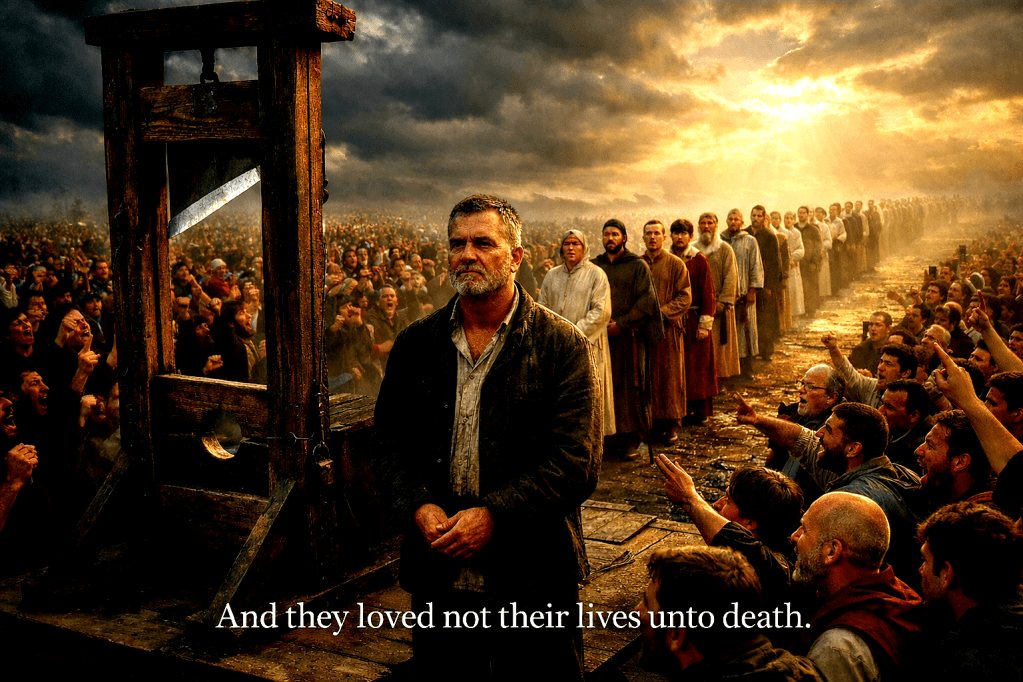
By the Blood of the Lamb. By the word of our testimony. And by the fact that we do not cling to our lives on this earth, even unto death.
This power to wage war agsinst us, along with authority over all nations, is must be remembered has been “granted,” by God for a specific and limited time. It represents a divine allowance for testing, not an independent victory of the beast. As it was with Job. Its reach is measured. Its duration is bound. And even in its fiercest hour, it remains subject to the sovereign limits set by the throne of Heaven.
This is the one thing I do know. As long as He is with us, those of us who remain will pass through the waters and the fires. He knows us. He has redeemed us for this appointed time. He has called us by name. And He declares over us, You are Mine.
We fight not with carnal strength, but with proximity to Jesus. To bask in the glow of His presence is to walk in the beauty of holiness, to move in the overflow of His majesty and His glory. His grace will be sufficient, no matter how fierce the battle becomes.
I was saying to a brother only the other day, as long as I am granted breath enough to make a final speech to the baying crowd, to proclaim to them the glory of the God they have rejected, then I will be satisfied to say, let the blade fall.
And if not even that, then I shall declare that very same thing to the principalities and powers. For their blade does not end my story. It only propels me home.
I was speaking with a brother the other day, a man seasoned by many years. He has been a pastor for more than three decades and also served for many years as a police officer. Before all of that, he once drove a concrete truck.
He told me about a day in Texas when the truck broke down while carrying ten yards of concrete. The drum stopped turning. Time passed, and before the load could be poured, the concrete had set solid inside the bowl. It took him nearly a week with a jackhammer to break it free. Concrete must keep moving until it is ready to be laid, otherwise it hardens without mercy and becomes unusable.
So it is with our hearts. When the Spirit’s work is resisted, delayed, or neglected, what was meant to be formed and poured out becomes hardened instead. What should have been usable for God’s purpose becomes difficult to break and costly to restore.
He spoke about the slump. Concrete must meet a precise measure. If it does not rise to the required standard, the entire load is rejected and discarded. There is no partial acceptance. If it does not meet the specification, it cannot be used.
So it is with the work God is doing in us. God does not measure by appearance or intention, but by what meets His standard. What does not rise to the measure of obedience and faith cannot be blended in or excused, it must be dealt with before the work can continue.
I shared with him what I had learned in construction. Samples are taken from the pour, allowed to harden, and weeks later crushed beneath great pressure. Only then is its strength revealed. Only then is it known whether it can bear the load for which it was made.
So it is with our faith. What God has formed in us is not proven in comfort, but under pressure. The crushing does not create the strength, it reveals whether the strength is truly there to bear the weight God has assigned.
There is also the matter of composition. Water, sand, aggregate, and cement must all be present, and each must be measured carefully. Too much or too little of any one part weakens the whole. The mixture determines the endurance.
So it is with the life God forms in us. Truth, obedience, suffering, grace, and patience each have their place, and none can be removed without consequence. When we favor one at the expense of the others, the strength of the whole is compromised, and what remains cannot endure the load it was meant to bear.
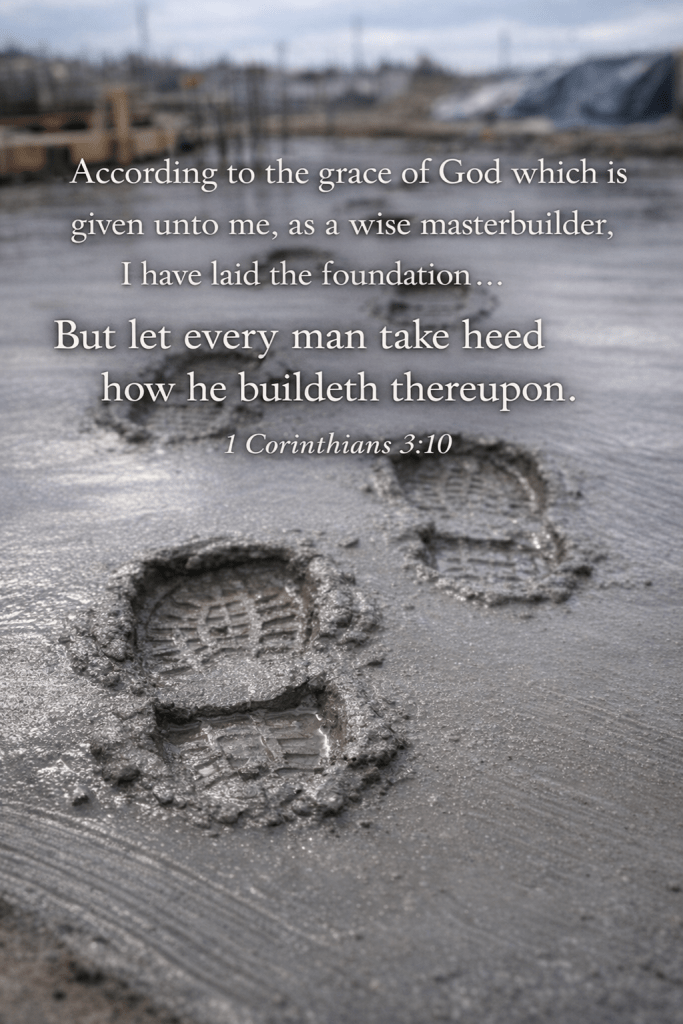
He then spoke of the freshly poured surface, smooth and carefully troweled. Sometimes someone comes walking toward it. You can see it happening and men shout warnings, but at times the person keeps going and walks straight through the concrete.
When that happens, the work is ruined. Either it must be torn up and done again, or the footprints remain forever, a permanent mark where none was meant to be.
Here the lesson becomes clear. When the Lord is doing a work, it is holy ground. When He is forming, shaping, and strengthening something, it is not to be trampled by careless feet.
God determines the mixture of our lives. He measures joy and sorrow, strength and weakness. He allows the testing and the crushing, not to destroy us, but to reveal whether we can bear the load appointed to us.
The strength that grows in us is not accidental, and the endurance is not self-made. It is the result of a careful and deliberate work of God. And even then, He does not leave us to carry the load alone. He bears it with us.
You get caught, the pressure builds, the crisis reaches critical mass, and suddenly something must be done. So the machinery groans into motion, statements are issued, gestures are made, hands are wrung. Damage control. Optics. Containment. It’s what politicians do, it’s what Hollywood does, it’s what the world does when exposure becomes unavoidable.
But it is not repentance. It is not the brokenness that comes when the Holy Spirit convicts a soul and strips it bare before God. It is theater, not truth. We’ve seen it before, paraded as humility, recycled as reform, trotted out whenever the spotlight burns too hot. But the repentance of the world does not lead to life, it leads to death.
And the system that birthed this spectacle, the swollen engine of charismania, is rotten clear through. It has flooded the earth with slogans instead of Scripture, promises instead of obedience, “name it and claim it” in place of the fear of the Lord.
Health and wealth, prosperity without holiness, gold dust and feathers, signs without substance, every unclean counterfeit dressed up as revival. Its leaders have fattened themselves on the flock and boasted in their excess without shame. This road has only one destination. It does not end in awakening. It ends in judgment.
In Corinth, Paul lifts the veil and speaks of glory.
In Corinth, Paul lifts the veil and speaks of glory. Even the law, etched upon tablets of stone, a ministry of death, bore a splendor from God. Yet if such a ministry shone, how much more shall the ministry of the Spirit blaze. If condemnation itself arrived clothed in glory, then righteousness must surely outshine it all. Praise be to God. (2 cor 3:7,9)
Now see the glorious transition Paul teaches in Romans.
For when we enter Romans 7, the apostle stands exposed, a man laid bare beneath the weight of his own inability.
“O wretched man that I am, who shall deliver me from this body of death?”
No pause, no philosophy, no remedy of self. Only the one solution.
“I thank God, through Jesus Christ our Lord.”
This is like dawn breaking upon a battlefield, the cry of despair yields to the trumpet of triumph.
“There is therefore now no condemnation to those who are in Christ Jesus, who walk not after the flesh, but after the Spirit.”
What wonder is this. What glory unimagined.
The ministry of condemnation dissolves into the proclamation of no condemnation at all. The Old Covenant had passed, and the new one was born in Christ Jesus, and Him crucified and resurrected!
Let none suppose that Moses trafficked in darkness. Far from it. The Law was holy, its purpose sure, its season appointed. It revealed the blazing holiness of God, gave sin a name and a measure, set boundaries against the flood of evil, and pointed every soul toward Christ.
The fault lay not in the Law, for the Law was perfect. The fault lay in us. Flesh, frail, rebellious, unyielding.
So Christ came in flesh, and that flesh was lifted upon the cross. There it was nailed, restrained, undone. The cross was no swift end. It was a long and gasping death. The flesh struggled. It fought for breath. Yet dying it was, all the same.
We wrestle still, not with flesh and blood, but with principalities and powers. And yes, the flesh wars against the Spirit. But the war is already decided.
The sentence has been overturned. The gavel has fallen. The court stands adjourned.
There is therefore now no condemnation. Saints, this is what victory looks like. For the law of the Spirit of life in Christ Jesus “HAS,” set me free from the law of sin and death. (Rom 8:2)
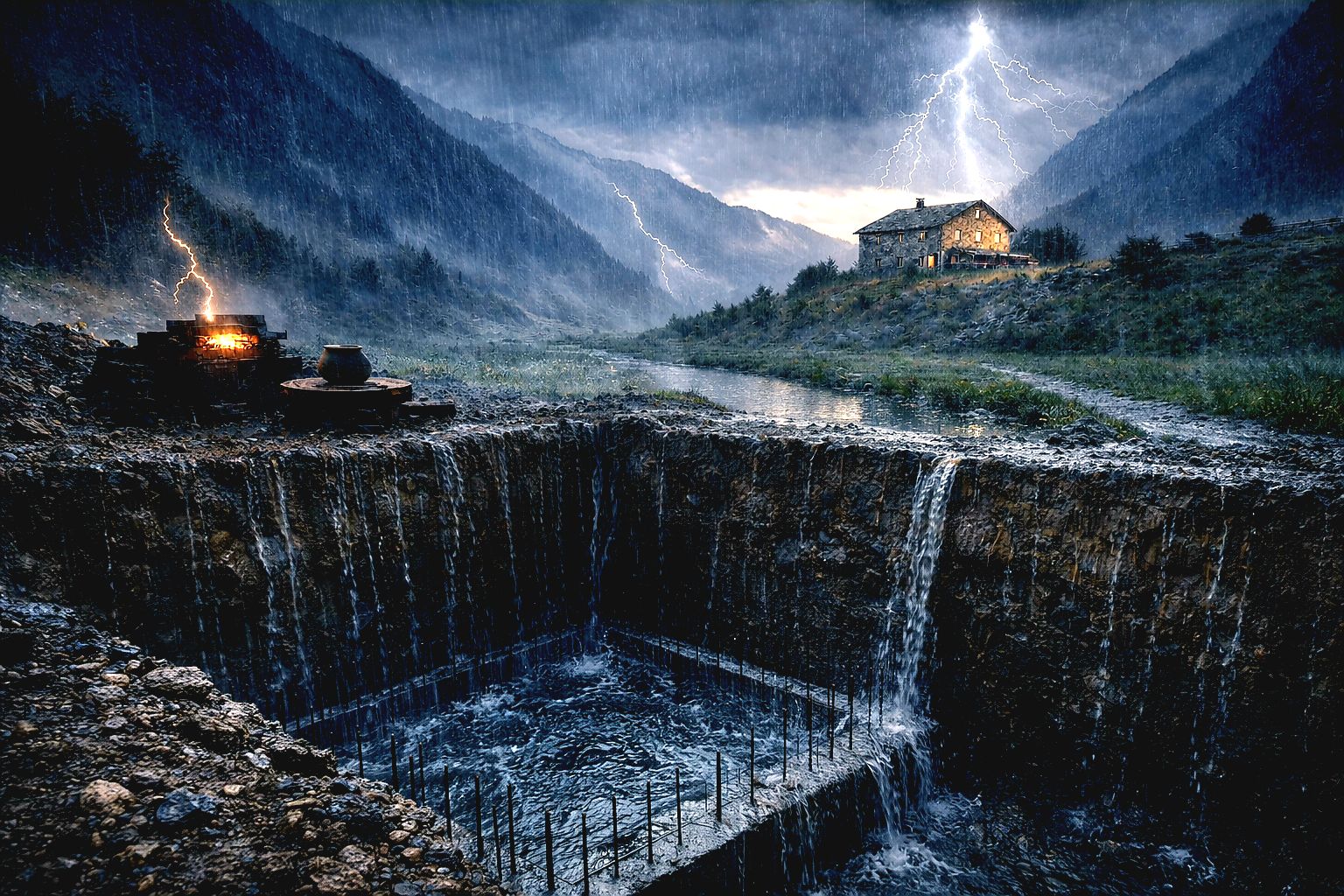
As a builder, I know the most critical part of any structure is the foundation. Everything depends on it. It is hidden from view, slow to complete, costly, and difficult. It requires going deep, sometimes all the way to bedrock, contending with water, unstable soil, resistance, and delay. Yet whatever rises later stands or falls on what is laid first.
When Christ speaks of many mansions in His Father’s house, I do not hear a promise of size or luxury. I hear a description of lives shaped and capacities formed. The mansion is not constructed after death. What awaits us in eternity rests upon what has been forged here. Heaven does not replace the foundation. It fulfills it.
This is why Psalm 23 speaks so deeply to the human condition. “Yea, though I walk through the valley of the shadow of death.”
I no longer read this as a passing season. This life itself is the valley. We walk through it from our first breath to our last. And yet, even here, God makes us lie down in green pastures. Even here, He leads us beside still waters.
Joy is not reserved for the mountaintop. The mountaintop comes down into the valley. We are not blessed by the absence of enemies, but in their presence. Not by the removal of hardship, but by the transformation of the heart that walks through it. We have been equipped for joy now, not later.
Paul and Silas understood this when they sang in the dungeon. Job understood it when devastation stripped him bare and he fell to his knees in worship. “The Lord gives, and the Lord takes away.” Even, “Though He slay me, yet will I trust Him.” These were not men spared from suffering. They were men formed by it.
This life in Christ is the furnace. It is the fire. It is the forging.
Here, courage is shaped. Patience is learned. Humility is refined. Gratitude is born. Unshakable joy is formed, not in the absence of pain, but through faithful endurance within it. Heaven is not the place where these virtues are forged. Heaven is where they are revealed, filled, and brought to completion.
When the furnace is finished, the shaping is complete. When we take our final breath, what has been formed has been formed. What is lost in that transition is not the work God has done in us, but only the corruptible flesh, the weakness, decay, and limitation bound to mortality. Eternity does not re-forge the soul through suffering. It unveils and fulfills what time has already shaped.
We have gone down to the potter’s wheel. We have yielded to its turning. We have surrendered to the hands of God as circumstances pressed, shaped, and refined us.
This life is the valley. This life is the foundation. This life is the wheel.
And heaven is the home that rests upon what has been made.
Many years ago I was asked to write a piece for the ministry “Persecution Watch,” founded in part by my dear brother Blaine, now gone on into glory. I believe that every genuine saint will soon enough face bars and chains. This is to encourage the saints. Please share if you are led by the Spirit.
There is a holy pattern woven through every life the Lord redeems: our brokenness, or the lack of it, always reveals how much of our nature we have allowed Him to transform. Wherever the self remains unyielded, untouched, unbroken, pain gathers there like a storm waiting to burst forth. For the measure of our troubles is so often the measure of the self we have held on to. We hold onto much of the the old nature, and the pieces of our old self becomes the sharp edges that wound us. The keeping of self becomes the birthplace of our sorrow, and the refusal to be broken becomes the soil where so much of our pain takes root.
There is a mystery here, one the Spirit teaches slowly: wherever the self is protected, trouble multiplies. Wherever the flesh remains alive, unmortified, unchallenged, it rises with its old strength and lays claim to the inner life. And from that unyielded ground springs turmoil, not random, not surprising, but the predictable fruit of a nature not yet surrendered. Look closely at the landscape of any life, and you will see it: the unbroken places are the breeding ground of unrest and much pain.
But where the Spirit is welcomed, where the self bends low, where the inner man yields to the hand of God, there the breaking becomes a kindness. In the surrendered places, the Lord breathes His life. What once was hard ground cracks open beneath His touch, and from those very fractures new life emerges. For the Spirit does not revive what is meant to die; He resurrects only what has been laid down.
And so the breaking is not destruction, it is invitation. It is the mercy of God pulling us away from the life we keep trying to preserve. In every part of us surrendered, transformation takes root. And the soul learns, slowly and deeply, that what we lose in yielding becomes the very ground where His life begins to grow.
True peace is found, not when temptations and trials cease, for surely He prepares a table before us in their presence? But when the heart is surrendered, hushed, and anchored in Christ. Temptations reveal our weaknesses and trials expose our need; and both become our teachers, if we will allow them.
The flesh is diminished when the spirit yields to God moment by moment, refusing to complain, trusting that Christ Himself is the victory. Suffering becomes the school of faith, because our flesh is never louder when it is seeking relief. Yet these trials are teaching us to rely wholly on God, and brings the heart into a deeper, quieter union with Him. Our life, in its entirety, is the valley. How then shall we walk through it? He has to make us lie down in green pastures. He causes us to sit beside the still waters.
And in these places we would never go by ourselves, He restores our soul.
What does it mean to have faith? What does it mean to exercise faith? And what does it truly mean to trust in the Lord? The words faith and trust are often used interchangeably, yet Scripture distinguishes their shades of meaning. The Greek word for faith, πίστις (pistis), carries the sense of conviction, fidelity, and steadfast belief , a firm persuasion of the truth and character of God. It is not vague optimism but anchored certainty rooted in who He is. The Greek term for trust, πεποίθησις (pepoithēsis), flows from pistis and means confident reliance, settled assurance, and inward persuasion. It is faith extended through endurance, faith that has matured under testing. Thus, pistis believes what God has spoken, and pepoithēsis continues to rest in that promise when sight fails and the storm gathers. Both are born of the same root: confidence in the unchanging nature of God. This is the foundation upon which all true preparedness stands, the faith that acts and the trust that endures.
Faith, then, is the spiritual substance of what is unseen, the invisible made certain in the heart of the believer. “Now faith is the substance of things hoped for, the evidence of things not seen” (Hebrews 11:1). It is not mere belief that God exists, but confidence in His goodness, His promises, and His Word. Faith does not rest upon sight or circumstance; it rests upon the immutable character of God. It looks into the unseen and says, “Thou art faithful.” It is the anchor of the soul, both sure and steadfast, which enters within the veil where Christ Himself has gone before (Hebrews 6:19–20). Pistis is not a feeling to be maintained but a conviction to be lived by, it sees the eternal in the midst of the temporal and moves the heart to obedience.
To exercise faith is to act upon that conviction. Faith untested remains theory; exercised faith becomes testimony. The one who believes that winter is near cuts his firewood before the frost. His pistis (faith) moves his hands; his belief produces action. But the frail widow, who has no strength to lift the axe, exercises faith in another form. She cannot labor, but she trusts , her pepoithēsis (trust) clings to God’s faithfulness, believing He will make provision where she cannot. In both, faith lives and breathes. The strong man acts upon what he believes; the widow rests upon what she cannot see. Faith is not idleness. It is obedience moving in harmony with the will of God , for “faith without works is dead” (James 2:17). Yet these works are not self-reliant striving; they are the fruit of divine persuasion , the evidence that pistis (faith) is alive within the heart.
To trust in the Lord , to walk in pepoithēsis (trust) , is to place one’s full confidence in His sovereign care when reason falters and outcomes remain hidden. “Trust in the Lord with all thine heart; and lean not unto thine own understanding. In all thy ways acknowledge Him, and He shall direct thy paths” (Proverbs 3:5–6). Trust is faith stretched through time; it is the steady endurance of the soul that refuses to doubt the character of God though all outward things collapse. Job, sitting among the ashes, spoke this divine paradox: “Though He slay me, yet will I trust in Him” (Job 13:15). That is trust refined in the fire , pepoithēsis (trust) at its highest expression. Faith says, “God can.” Trust declares, “God will.” Love adds, “Even if He does not, He is still my God.”
What, then, is our part in this divine partnership? Scripture tells us to “put on the whole armor of God” (Ephesians 6:11), to take up the shield of faith, to gird our loins with truth, and to shod our feet with the preparation of the gospel of peace. These are commands of readiness. The armor is given by grace, but it must be worn by choice. The believer must take up what God has provided. Preparation is not unbelief — it is the living demonstration of faith’s reality. The man who sharpens his sword before battle is not denying God’s help; he is aligning himself with it. Our pistis (faith) equips us; our pepoithēsis (trust) steadies us. The one is the conviction that moves; the other is the confidence that endures.
And did not our Lord Himself prepare? The supreme pattern of readiness is found in Gethsemane. Beneath the olive trees, Christ waged the invisible war before the visible cross. “And being in agony He prayed more earnestly: and His sweat was as it were great drops of blood falling down to the ground” (Luke 22:44). The disciples slept, but the Captain of our salvation fought alone. The struggle was not with men but within His own humanity , the surrender of His human will to the divine. And when the moment came — “Not my will, but Thine be done” , the victory was secured. From that garden He rose, His face set like flint (Isaiah 50:7), and for the joy set before Him He endured the cross, despising the shame (Hebrews 12:2). The battle of Calvary was the outworking of the triumph of Gethsemane. Pistis (faith) led Him into prayer; pepoithēsis (trust) carried Him through obedience.
What, then, does it mean for us to be prepared? It means to cultivate a heart steadfast in pistis (faith) and anchored in pepoithēsis(trust). The prepared soul is not caught unaware when the storm descends. It has stored the Word in its heart, for the Word is the sword of the Spirit (Ephesians 6:17). It has guarded its thoughts with the helmet of salvation and girded its life with truth (Ephesians 6:14). It prays without ceasing, for prayer is the breath of faith (1 Thessalonians 5:17). It stands ready with the gospel of peace, for readiness itself is part of the armor. Such a soul walks neither in fear nor presumption, but in quiet confidence. The unprepared are like those who wait for winter with no firewood; but those who live by faith have already kindled the flame within their hearts.
The battle, as the Lord showed us, is won not first in the field but in the heart’s preparation. “The preparations of the heart in man, and the answer of the tongue, is from the Lord” (Proverbs 16:1). Victory begins in surrender. When a believer bows in the secret place and whispers, “Not my will, but Thine be done,” the triumph is already assured. From that hidden Gethsemane he rises clothed in divine strength, able to endure the cross set before him, whatever form it takes. Faith has believed; trust has endured; preparation has secured the victory.
To have faith is to believe. To exercise faith is to act. To trust is to endure. To prepare is to triumph before the battle begins. And when the soul, through pistis (faith) and pepoithēsis( trust), comes to that holy place of surrender, it finds, as Christ did, that peace flows where agony once reigned. For the Lord who prepared Himself in Gethsemane now prepares His saints likewise , that they may stand in the evil day, and having done all, to stand (Ephesians 6:13). Praise be to the Lord, for the battle is His , yet He trains our hands for war and girds us with strength for the fight (Psalm 18:34, 39).
Scripture Appendix
I. Πίστις (Pistis) — Faith, Conviction, Persuasion
Hebrews 11:1 – Faith as substance and evidence of the unseen.
Romans 1:17 – ‘The just shall live by faith.’
Ephesians 2:8 – Faith as the gift of God in salvation.
Romans 10:17 – Faith comes by hearing the Word of God.
Galatians 2:20 – Living by the faith of the Son of God.
James 2:17 – Faith without works is dead.
Hebrews 11:6 – Without faith it is impossible to please God.
2 Timothy 4:7 – ‘I have kept the faith.’
II. Πεποίθησις (Pepoithēsis) — Trust, Confidence, Assurance
2 Corinthians 3:4 – ‘Such trust have we through Christ to Godward.’
Philippians 1:6 – Being confident that He who began a good work will perform it.
Philippians 3:3–4 – Having no confidence in the flesh.
Hebrews 3:14 – Holding the beginning of our confidence steadfast to the end.
2 Corinthians 1:9–10 – Trusting in God who raises the dead.
Ephesians 3:12 – Boldness and access with confidence by the faith of Him.
Faith (pistis) is the seed; trust (pepoithēsis) is its fruit. One believes God’s word; the other continues in that belief when all else fails. Together, they form the unshakable posture of the prepared soul , believing, enduring, and standing firm until the end.
The final reproach of the saints, when truth itself is branded as hate.
From the earliest days of the church, the saints of God have endured the reproach of being called what they are not. To stand for truth has always been to invite slander, and to speak the Word of God faithfully has never been received without hostility. As Jesus Himself said, “Blessed are you when they revile and persecute you, and say all kinds of evil against you falsely for My sake” (Matthew 5:11). History testifies that the righteous have consistently been accused of hatred, malice, and cruelty when, in reality, they were bearing witness to the love and holiness of God.
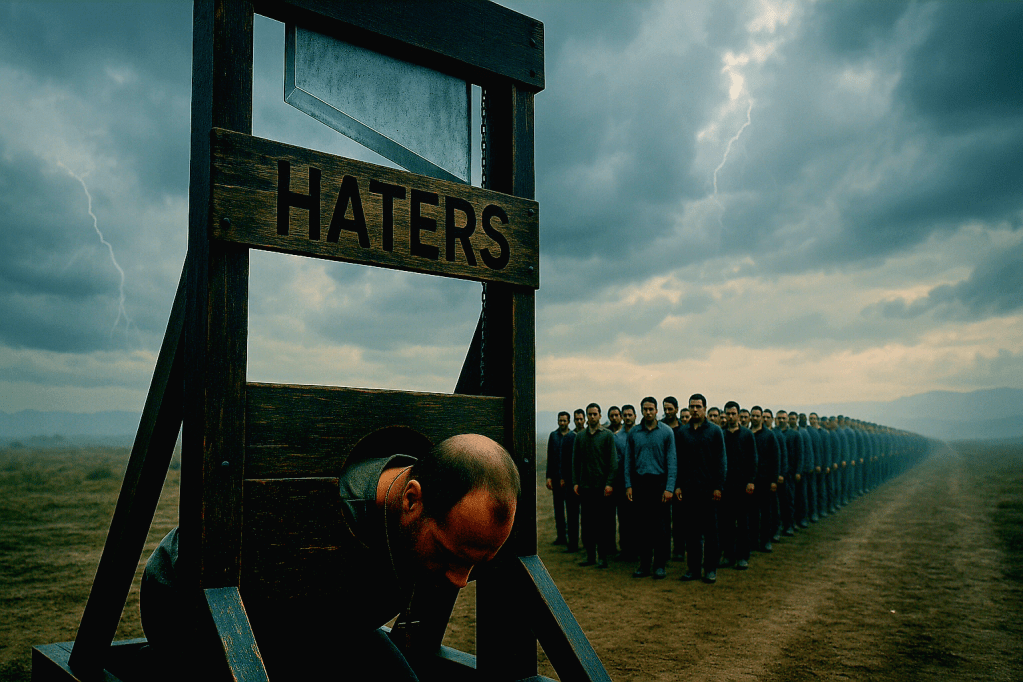
In our present age, particularly since the cultural shifts of the early twenty-first century, a new distortion has arisen. It is no longer permissible in much of society to disagree with the prevailing moral fashions without being branded a hater. A deliberate conflation has been made between disagreement and hatred, as if to question the legitimacy of homosexual practice or transgender ideology were to harbor malice against those who embrace it. But disagreement is not hatred. To call sin what Scripture calls sin is not to despise the sinner, but to speak truth in love (Ephesians 4:15), the truth that alone can set men free (John 8:32).
This inversion of meaning is no accident. It is the inevitable fruit of a culture that prefers sentimentality over truth, appearance over substance, and human approval over divine authority. The saints of God must see it for what it is: an attempt by the spirit of the age to silence the proclamation of the gospel by weaponizing false accusation. For if every Christian who holds to biblical teaching is deemed a “hater,” then every genuine believer is, by that definition, worthy of scorn and—according to some—even worthy of destruction.
And make no mistake, saint: the false accusers of the brethren have almost always come from within the ranks of what calls itself Christendom. Nearly all the martyrs of the last two thousand years were condemned at the insistence of religious institutions, who sought to preserve their own influence and protect their own power. Secular authorities and atheists may join in, but the fiercest opposition is often religious. Those who speak the truth boldly are always a danger to the religious establishment, because they expose its corruption, its hypocrisy, and its lifeless form. And so the institutions respond either by silencing themselves in cowardice or by attacking the voices of truth with fury—denouncing, separating, and historically, even putting to death those who dared to stand in the light of God’s Word.
This is the way of religion versus relationship. It has always been so, and it will always be so until the end of the age. Jesus reserved His harshest words not for pagans or atheists, but for the Pharisees, the Sadducees, and the scribes—the religious authorities of His day (Matthew 23). Though divided among themselves, Pharisees and Sadducees, Herodians and Zealots, even Rome itself, found common cause in their hatred of Christ. In an unholy alliance, they conspired to destroy Him because His very presence threatened every institution and every system of control. And kill Him they did.
That same religious spirit has not died. It has persisted through the centuries, raising its hand against prophets, apostles, reformers, and martyrs. And it remains strong today. As the end draws nearer, that spirit will only intensify, aligning with worldly powers to silence, discredit, and ultimately destroy those who walk in genuine relationship with the Lord Jesus Christ. For “the time is coming when whoever kills you will think he offers God service” (John 16:2).
Therefore, the genuine saint must not shrink back. He or she must understand that as the darkness increases, so too will the accusations, the betrayals, and the persecutions. Yet none of this is strange, for our Lord told us beforehand: “If the world hates you, you know that it hated Me before it hated you” (John 15:18). The darkness hates the light and will always seek to extinguish it (John 3:19–20).
But take heart. The slanders of men are but passing shadows. The record of heaven is clear, and the Judge of all the earth will vindicate His people. To be falsely accused is grievous, yes, but it is also glorious—it means we are walking in the footsteps of prophets, apostles, martyrs, and of Christ Himself, who “was despised and rejected by men, a Man of sorrows and acquainted with grief” (Isaiah 53:3).
So let the saints stand firm. Let them embrace the reproach of Christ as greater riches than the treasures of Egypt (Hebrews 11:26). For though the world brands them as haters, heaven knows them as beloved, faithful witnesses of the Light. And as the night grows darker, their testimony will shine all the more brightly until the Day dawns and the Morning Star arises in their hearts (2 Peter 1:19).
More than a decade ago, I wrote The Fall of Christendom—And the Separation of the Remnant. Since its publication, I have been humbled by the many messages from readers who shared how it opened their eyes to the larger story, the sweeping overview of how Christendom arrived at its present state. That “big picture” view has always been the burden of my spirit.
Today, I return to those themes, not to rehash old arguments, but to press them further—deeper, into the marrow of our collective conscience. The question remains as urgent as ever, perhaps even more so in our time of great religious confusion:
How did we get here?
Apostolic Warnings
The New Testament contains not only proclamations of grace but also sobering warnings. Three texts stand out as particularly vital:
Hebrews warns against retreating into Judaism.
Galatians cautions against beginning in the Spirit but seeking perfection through the law.
Revelation presents Christ’s own admonitions to the churches, declaring that their lampstand would be removed if they refused to repent.
And here lies the burning question: What would it look like if they did not repent?
What if the Galatians persisted in finishing in the flesh what began in the Spirit?
What if the Hebrews clung to the forms and ceremonies of a passing covenant?
What if the churches ignored Christ’s rebuke and carried on with cold orthodoxy, lukewarm faith, or lifeless ritual?
History itself gives us the answer: Christianity, once ablaze with apostolic fire, slowly morphed into a religion of priests, altars, incense, and empire. A living faith became an institution. The Spirit was quenched. The lampstand removed.
And yet—even in the darkest chapters—God preserved a remnant. A people who chose Spirit over ceremony, truth over tradition, Christ Himself over the systems that claimed His name.
A Prophetic Call
This post is not merely history, nor is it theory. It is a call. A prophetic summons to look unflinchingly at where we are, to trace how we got here, and to reckon with what it means that the lampstand has already been removed from much of Christendom.
The only hope lies where it always has:
In returning to the Word of God and the Spirit of Truth.
In joining the remnant outside the gates.
In embracing Christ as the living Head of His people.
1. Hebrews: Warning Against Returning to Judaism
The Epistle to the Hebrews insists the old covenant is obsolete:
“Now what is becoming obsolete and growing old is ready to vanish away.” (Heb. 8:13 NKJV)
To return to temple and priesthood was to crucify Christ afresh (Heb. 6:6).
History confirms the warning was ignored. By the late 2nd century, the Eucharist was increasingly described as a sacrifice, bishops as priests. Cyprian of Carthage argued the bishop stood in the place of Christ in offering the Eucharist. Thus, shadows of Judaism crept back under Christian names.
2. Galatians: Warning Against Finishing in the Flesh
Paul’s rebuke was stark:
“Having begun in the Spirit, are you now being made perfect by the flesh?” (Gal. 3:3 NKJV)
By the 3rd century, salvation was widely understood as mediated through sacraments. Baptism, Eucharist, and penance became a system where grace was dispensed mechanically. The life of the Spirit was overshadowed by ritual performance.
3. Revelation: Warning to the Churches
Christ warned the churches: Ephesus had lost first love, Sardis had a name but was dead, Laodicea was lukewarm.
By the 4th century, Christianity outwardly triumphed with basilicas and liturgies, but inwardly the flame dimmed. Nominal Christianity flourished while true discipleship waned.
4. Historical Development: From Apostles to Constantine
a. Second and Third Centuries
The monarchical bishop system arose. Ignatius urged obedience to bishops as if to Christ.
The Montanists resisted, emphasizing the Spirit, prophecy, and holiness. Tertullian joined them. They were condemned as heretics, proof that institutional Christianity preferred order over Spirit.
b. Constantine and Imperial Christianity
The 4th century marked a dramatic shift. Constantine favored Christianity, making it the religion of empire. Bishops gained power, councils met under imperial patronage.
Christianity outwardly triumphed but inwardly conformed to worldly structures.
5. The Hollowing of Christianity
By the medieval period, the warnings were ignored:
Hebrews ignored: a priesthood and continual sacrifices (the Mass).
Galatians ignored: salvation by works and sacraments.
Anabaptists (16th c.) – Radical discipleship, voluntary faith, often martyred by both Catholics and Protestants.
7. The Reformers: A Partial Recovery
The Reformers restored key truths—justification by faith, authority of Scripture, priesthood of believers.
But much of the medieval framework remained:
Luther retained infant baptism and the state church.
Calvin enforced conformity and sanctioned persecution.
The Reformation was real, but incomplete.
8. Theological Reflections
Warnings are Perennial – Drift to ritual, reliance on flesh, loss of first love appear in every age.
Apostasy as Substitution – Replacing Christ with religion, law, or cultural Christianity.
The Remnant Principle – God preserves a faithful witness in every generation.
Conclusion: A Prophetic Word for Today
History demonstrates the accuracy of the apostolic warnings. Christendom became ritual without reality, tradition without truth, form without fire.
The prophetic word today is urgent:
The lampstand has already been extinguished in much of what calls itself church.
God’s people must leave man-made religion and come into the light of Christ.
They must go outside the camp, bearing His reproach but gaining His glory (Heb. 13:13).
The hope does not lie in the institutions of Christendom, but in Christ Himself, the same yesterday, today, and forever.
The choice is clear: remain in the darkness of religion where the lampstand has been removed, or come into His marvelous light where His Spirit gives life.
At the turn of the 20th century, we witnessed the birth of two monumental Pentecostal movements. First, in 1904, came the Welsh Revival in Britain, and then, in 1906, the fires of revival swept through Azusa Street in Los Angeles. These were no ordinary stirrings, they were powerful outpourings of the Holy Spirit that would give rise to entire movements, such as the Elim Pentecostal Church in Britain and the Assemblies of God, which would spread globally and impact hundreds of millions.
From these humble beginnings, in every corner of the land, small Pentecostal churches began to emerge. Their message was simple: salvation through Jesus Christ, the power of the Holy Spirit, and the restoration of spiritual gifts. These fellowships sprang up in the shadow of massive denominational institutions, the Church of England, the Church of Scotland, and others, hige edifices steeped in their own traditions. Yet right beside them, in modest, unassuming buildings, were these Spirit-filled gatherings where lives were being radically transformed, adults were getting saved, and the gifts of the Spirit were active and alive.
This was a profound blow to the kingdom of darkness. The enemy, seeing the explosive growth of this movement, would not sit idly by. His question became clear: How can we bring this down? And so, beginning in the 1940s, we saw the emergence of new “theological,” trends, the Word of Faith movement, the Prosperity Gospel, and of course the Charismatic movement in the 60s, which would swallow up the others and become indistinguishable.
It was a cunning strategy: If you can’t beat them, buy them. The philosophy was simple, promise the very things that human beings everywhere fear to lose: health and wealth. Whether you’re in New York City or a remote village in the jungle, the universal concerns remain the same, our bodies and our bank accounts. The enemy offered a counterfeit gospel, one that shifted the focus from the cross of Christ to the desires of the flesh.
The Charismatic Movement became a Trojan horse. It infiltrated Pentecostal churches across the globe, not with persecution, but with promises. And it worked, brilliantly, tragically. The smoke from the fire of true revival has been replaced by the smoke machines of performance and entertainment. The altars were replaced by stages, the message by motivational speaking, and the Spirit by self-help and “self,” seeking
What followed was the tearing down of the very pillars upon which the early Pentecostal movement had stood. The purity of the Gospel was traded for a gospel of gain. Faith, once the precious link to Christ Himself, was twisted into a tool to manipulate blessings. Prosperity or tge lack of it, once counted as rubbish in comparison to knowing Christ, became the goal.Christ had become but a means to a materialistic end.
It was a disaster for the Church, and a stunning success for the enemy. The people rose up and played, just as they did before the golden calf in the wilderness. Think of “holy laughter,” and roaring like animals. And today, we stand in the shadow of that fall, in the ruins of what once was a mighty move of God.
These false ideologies, health and wealth, Name It and Claim It, the separation of faith from Christ Himself, have infected almost every corner of the modern Pentecostal and non-denominational world. Rare is the church untouched. Subtle or blatant, this taint remains, and it must be recognized for what it is.
Now, in this late hour, a remnant is rising, a people who are returning to the simplicity and the power of the cross, who walk not in the counsel of the world but in the fear of the Lord. Let us not be seduced by the glitter of gain or the lure of comfort. Let us remember the foundation laid in tears and prayer and holy fire. It is time to leave the circus behind, with all its many forms of entertainment, and “come out from among her.”
We encourage one another, it is a beautiful thing, a sacred rhythm in the Body of Christ. It has been the highest privilege of my life to minister to the few, those precious souls who once believed they were utterly alone. They are the ones who, at great personal cost, have come out from the organized church, misunderstood, maligned, and often mistrusted. They have been accused of elitism, of arrogance, even of falling away, when in truth, they could no longer endure the weight of a system that quenched the very Spirit they were called to walk in.
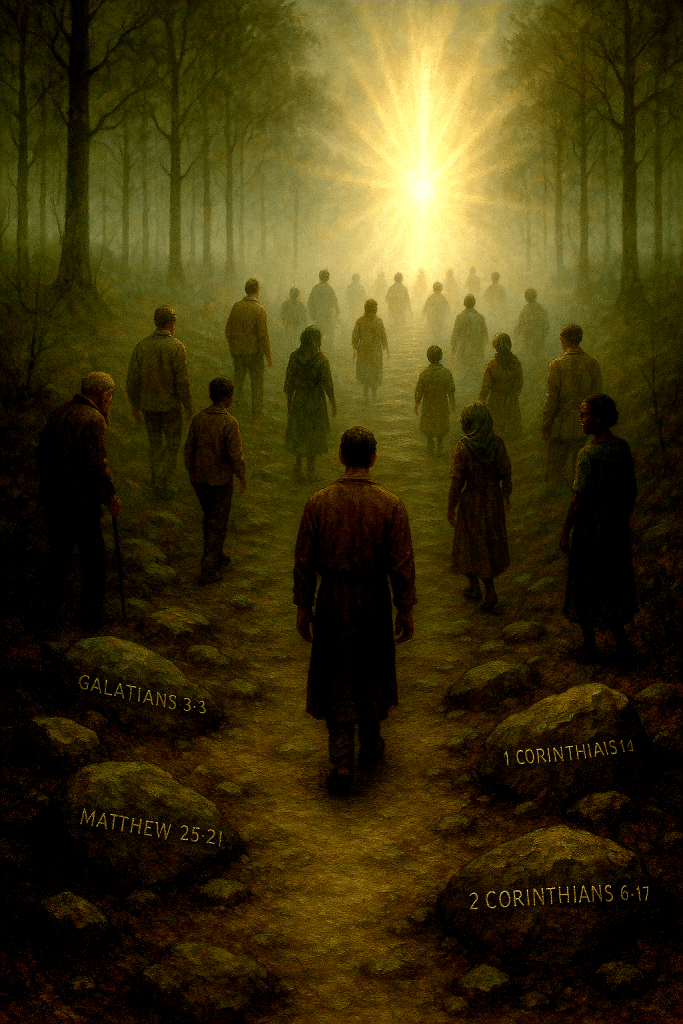
These are they who began in the Spirit, and, like Paul’s plea to the Galatians, refused to be perfected by the flesh (Galatians 3:3). They yearn to hear not the rebuke, “O foolish Galatians,” but rather the commendation, “Well done, good and faithful servant” (Matthew 25:21). They seek to gather where the Spirit is free to move, where the saints may truly fulfill the exhortation of 1 Corinthians 14, that all may speak, all may learn, all may be encouraged, and the gifts be exercised for the edification of the whole.
They long to walk simply, with humility before God and sincerity before men (Micah 6:8). In their gatherings, Christ alone is exalted, Jesus, the Lord of glory, lifted up as the only Head, the only Shepherd, the only One who is preeminent (Colossians 1:18). There are no stars, no stages, only saints, broken and burning, desiring nothing but Him.
Yet to walk this way, there has been a call, an unrelenting summons from the Lord, “Come out from among them and be separate, says the Lord. Do not touch what is unclean, and I will receive you” (2 Corinthians 6:17). This is the remnant road, walked not in bitterness but in obedience, not in pride but in pursuit of the living God, Christ in us, the hope of glory.
One of the most tragic realities of the contemporary church, most glaringly within the American context, yet by no means confined to it, is the widespread absence of the new birth among professing Christians. This foundational deficiency renders it utterly impossible for such individuals to love as the early church loved, for the very source and sustainer of that love is Christ Himself. It is He who binds believers together in divine unity.
The church, properly understood, is not a building, a denomination, or an institution, it is the living body of Christ. And unless one has been joined to that body through regeneration, one simply does not belong to the Church in the true, biblical sense, the ekklesia, the “called-out ones.”
It is spiritual folly to expect those outside of Christ, unregenerate and untouched by the Spirit of God, to manifest the supernatural love that defined the earliest believers. This love flows not from religious duty or communal sentiment, but from the indwelling presence of the Holy Spirit.
Oswald Chambers, in his meditations on the Sermon on the Mount, rightly observed that any attempt to live out Christ’s teachings apart from the new birth results in a miserable experience. For the unregenerate, the Sermon is not a light but a crushing burden, a lofty ideal that exposes the impossibility of genuine righteousness without divine transformation.
Religion, absent the life of Christ, becomes little more than a philosophy, a system of ethics, or a cultural form. It may produce momentary acts of kindness, but it cannot sustain the sacrificial, Spirit-wrought love of the saints. This love, that bears all things, believes all things, hopes all things, endures all things, does not arise from human effort but from the supernatural work of God in the soul.
Thus, what many interpret as disunity in the church is, in truth, the presence of multitudes who are members of religious organizations, but not members of Christ’s body. They are, at best, moralists striving in their own strength, at worst, deceived souls clinging to the form of godliness while denying its power.
The Scriptures are not silent on this. “Many are called, but few are chosen” (Matthew 22:14). The remnant, the few, are the truly born again, those who love with a love not their own, who recognize one another not by label or denomination, but by the Spirit of Christ within. When these encounter one another, there is immediate fellowship, unfeigned and deeply rooted in shared life.
To expect widespread spiritual unity in a landscape dominated by nominalism is to set oneself up for continual disillusionment. Indeed, the gap between our expectations and the reality of the religious world around us is often the precise measure of our grief.
But if we understand this reality, that true unity and true love exist only among the regenerate few, we will cease to be disheartened by the failures of the masses and instead rejoice to find, here and there, a brother or sister truly alive in Christ. For these are the Church. These are the Body. These are the beloved of God.
Our small house church, though modest in number, stands as a precious testimony to a deeper reality, a reality that transcends the glittering edifices and booming stages of modern Christendom.
Over a decade ago I made the conscious, Spirit-led shift, joining countless others across the globe who have heard the still small voice calling them out of spiritual Babylon. For in every generation, God reserves for Himself a remnant, a people who will not bow the knee to Baal, no matter how cunningly he reinvents himself through culture, compromise, or counterfeit religion.
Before our very eyes unfolds the tragic convergence of the harlot church, a synthesis of worldliness and religion, dressed in finery but inwardly defiled. Its heartbeat is not the cross, but the stage; not the Spirit, but spectacle. As it was in Rome, so it is today. The Coliseum, once the epicenter of Roman life, rose from the gold and silver plundered by Titus during the destruction of the Temple in Jerusalem. One temple fell, another was built. Worship of the Holy was replaced by worship of self, veiled in the opiate of entertainment. Bread and circuses—tools of distraction, tools of dominion.
Yet the martyr Stephen, in his final breath, echoed the words of our Lord: “The Most High does not dwell in temples made by human hands.” Jesus, speaking to the Samaritan woman, dismantled the geography of worship and pointed to its essence—Spirit and truth. When asked, “Where should we worship?” Christ responded not with a location, but with a mandate: how we are to worship.
It is vital—indeed, imperative—that the true saints gather not around programs, performances, or personalities, but around the presence of God. In Spirit. In truth. And as the great Day of the Lord draws ever nearer, this calling becomes all the more urgent. For history has shown: men gather to entertain themselves. But few gather to worship God as He has ordained.
Let us, then, be counted among the few—those walking the narrow path that leads to life. Let us not be swept away by the many, whose feet tread the broad road of destruction. Let our assemblies be small, but pure; hidden, but radiant. May our worship rise not from stages, but from sanctified hearts. For the time is short, and the Bride must make herself ready.







 A Call To The Remnant