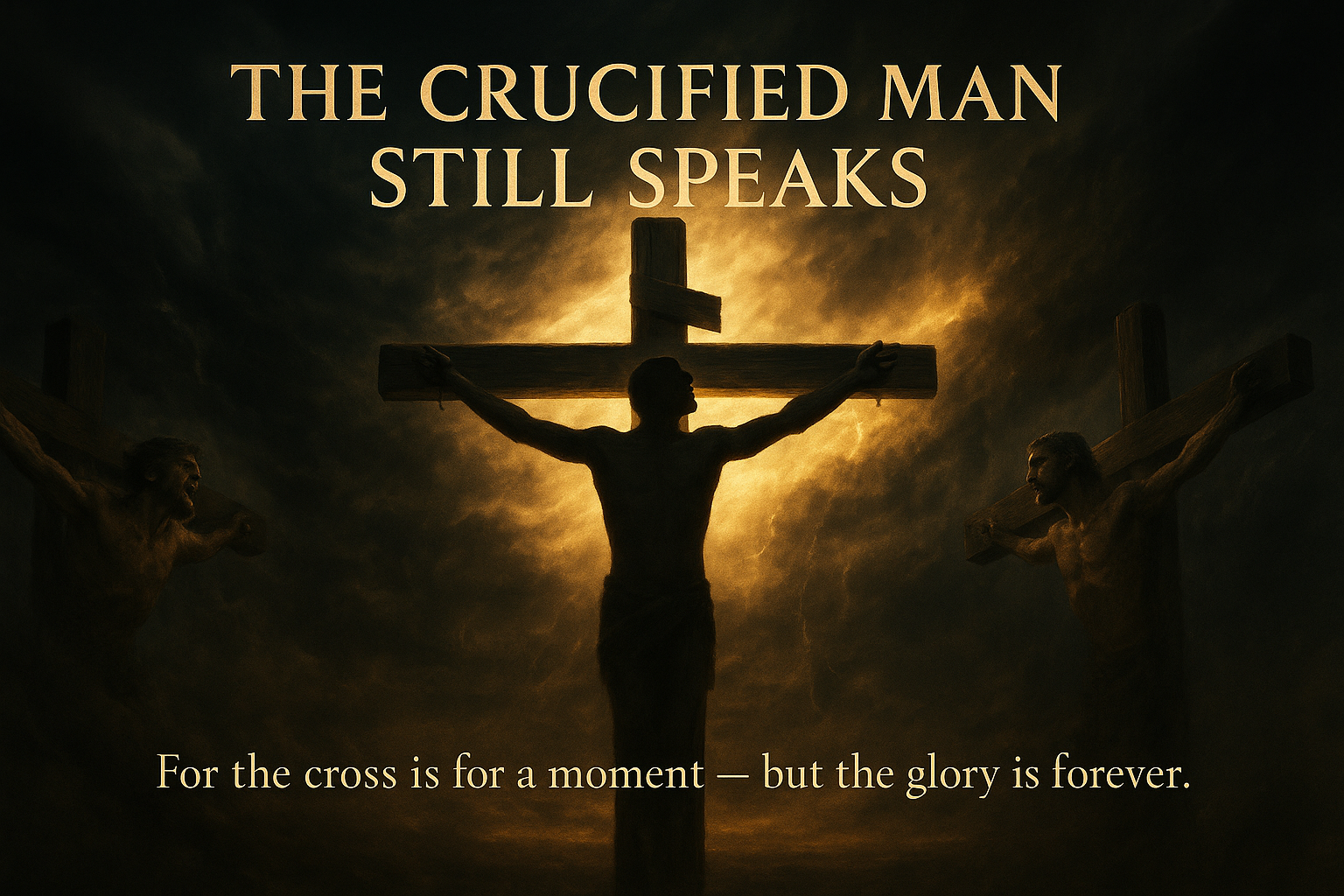
Then “He delivered Him to them to be crucified. So they took Jesus and led Him away. And He, bearing His cross, went out to a place called the Place of a Skull… where they crucified Him” (John 19:16–18). And as He hung between two criminals—with Jesus in the center—the crucified Lord spoke: “When Jesus therefore saw His mother, and the disciple whom He loved standing by, He said…” (John 19:26–27).
The crucified man speaks.
This is not merely a historical moment—it is a spiritual revelation. When I say “the crucified man,” I am not referring only to men, but to all mankind—male and female. In Scripture, “man” refers to the old nature we inherited from Adam, the fleshly soul-life within us. This old man was judicially crucified with Christ at the moment of salvation. Yet crucifixion is not instant death. It is a lingering, agonizing process. The flesh is on the cross, but it still speaks.
The apostle Paul declared: “Knowing this, that our old man was crucified with Him…” (Romans 6:6). “Those who are Christ’s have crucified the flesh with its passions and desires” (Galatians 5:24). “I have been crucified with Christ…” (Galatians 2:20). “I die daily” (1 Corinthians 15:31).
All of these verses reveal a spiritual truth: our flesh has been crucified. Yet our experience testifies that it still cries out. It still resists death. It still seeks to exert control. This is why Jesus commands us to take up our cross daily. If the flesh were silent, there would be no need to deny it daily.
Many can “take up” the cross for a moment. They can lift it onto their shoulder in a burst of zeal. But to bear the cross—to carry it through deep valleys, across raging rivers, and up steep mountains—is another matter. To bear is to endure when every natural instinct cries out for relief. To bear is to persevere when the flesh screams, “Lay this burden down!” To bear is not to escape the cross, but to remain upon it until the flesh is silenced.
The day will come when we lay our burdens down—but that day is not today. It is not tomorrow. It is the day when we take our final breath, and like our Lord, we shall say, “It is finished” (John 19:30).
Consider the two thieves crucified beside Jesus. Both were nailed to their crosses. Both were dying. Both were suffering. Yet one railed against Christ, while the other surrendered and was saved. This is a prophetic picture for every believer: the crucified flesh still speaks, but only the surrendered soul will see Paradise.
The voice of the flesh cries, “Save yourself! Come down from the cross!” But the voice of the spirit says, “Not my will, but Yours be done.”
So I appeal to you, saints of the Living God: Surrender quickly. Obey immediately. Glorify Christ even in your pain. Do not give the flesh any place. Deny its arguments. Silence its cries. Let your spirit ascend with Christ, fixing your gaze on the glory that awaits you.
For what awaits is beyond imagination. “For I consider that the sufferings of this present time are not worthy to be compared with the glory which shall be revealed in us” (Romans 8:18).
There is a day coming when you will be redeemed from this corruptible body, delivered from this sin-sick world, and welcomed into a heaven where there is no more striving, no more sorrow, no more temptation, and no more voice of the flesh. There, the crucifixion gives way to resurrection, and every tear is wiped away by the hand of God Himself.
Our cross is but for a moment—but the glory is forever.
The Latter Rain, Sinless Perfection, and the Crucified Flesh (part of our small home-group study)
The Latter Rain and Sinless Perfection The idea of a “latter rain” greater than Pentecost has no footing in Scripture. Joel’s prophecy was fulfilled at Pentecost — Peter said, “This is that which was spoken by the prophet Joel” (Acts 2:16).
There is no promise of another outpouring that will eclipse it. To claim the Spirit withdrew for 1900 years and will return only at the end denies Christ’s own words: “I will build My church, and the gates of Hades shall not prevail against it” (Matt. 16:18).
Likewise, Scripture never promises sinless perfection in this life. Paul said, “Not that I have already attained, or am already perfected; but I press on” (Phil. 3:12). John warns: “If we say that we have no sin, we deceive ourselves, and the truth is not in us” (1 John 1:8). Victory is real, but it is lived daily in dependence on Christ — not by declaring the battle finished.
The Spirit Wars Against the Flesh Paul wrote: “The flesh lusts against the Spirit, and the Spirit against the flesh” (Gal. 5:17). If the flesh were already silenced, Paul’s warnings would be pointless. Why command us, “Walk in the Spirit, and you shall not fulfill the lust of the flesh” (Gal. 5:16), if there were no struggle?
Romans 6 shows our union with Christ. Romans 7 shows Paul wrestling still: “I find then a law, that evil is present with me, the one who wills to do good” (Rom. 7:21). Deliverance comes not by denying the conflict, but through Christ: “Thanks be to God through Jesus Christ our Lord!” (Rom. 7:25).
The Crucified Flesh: Decisive, Yet Lingering Paul declared: “Those who are Christ’s have crucified the flesh” (Gal. 5:24). Crucifixion was decisive — but it was not instant death. It was slow, agonizing.
A crucified man’s fate was sealed once nailed, yet he still lingered in pain until death. Spiritually, our flesh has been nailed to the cross, its fate sealed — but it still struggles.
This is why Paul said, “I die daily” (1 Cor. 15:31), and urged believers, “Put to death therefore what is earthly in you” (Col. 3:5). The cross was applied once, but its execution unfolds daily until glory.
Jesus said: “If anyone desires to come after Me, let him deny himself, and take up his cross daily” (Luke 9:23). If the flesh were fully dead, why would He command us to do this?
Walking According to the Spirit “There is therefore now no condemnation to those who are in Christ Jesus, who do not walk according to the flesh, but according to the Spirit” (Rom. 8:1).
To be in the Spirit is our position (Rom. 8:9). To walk according to the Spirit is our practice.
The flesh condemns: “You are weak, defeated, guilty.”
The Spirit builds up: “You are sons and daughters, more than conquerors.”
Gideon heard two reports: his flesh said he was the least (Judg. 6:15). God’s Spirit called him a mighty man of valor (Judg. 6:12). The question was: whose report would he believe?
Conclusion The Bible does not teach sinless perfection now, nor that the flesh has vanished, nor that a greater “latter rain” revival is coming. It teaches this:
The flesh has been crucified with Christ.
Its death is certain, though it lingers.
We must deny ourselves, take up the cross daily, and walk according to the Spirit.
To collapse this tension is to miss the biblical balance. Christ’s cross guarantees victory — but discipleship requires daily cross-bearing until the war is over.
Let the Word close the matter: “If we say that we have no sin, we deceive ourselves, and the truth is not in us” (1 John 1:8).
The Doctrine That Christ Hates: The Rise and Return of the Nicolaitans (Did They Ever Leave?)
Christ’s Piercing Words
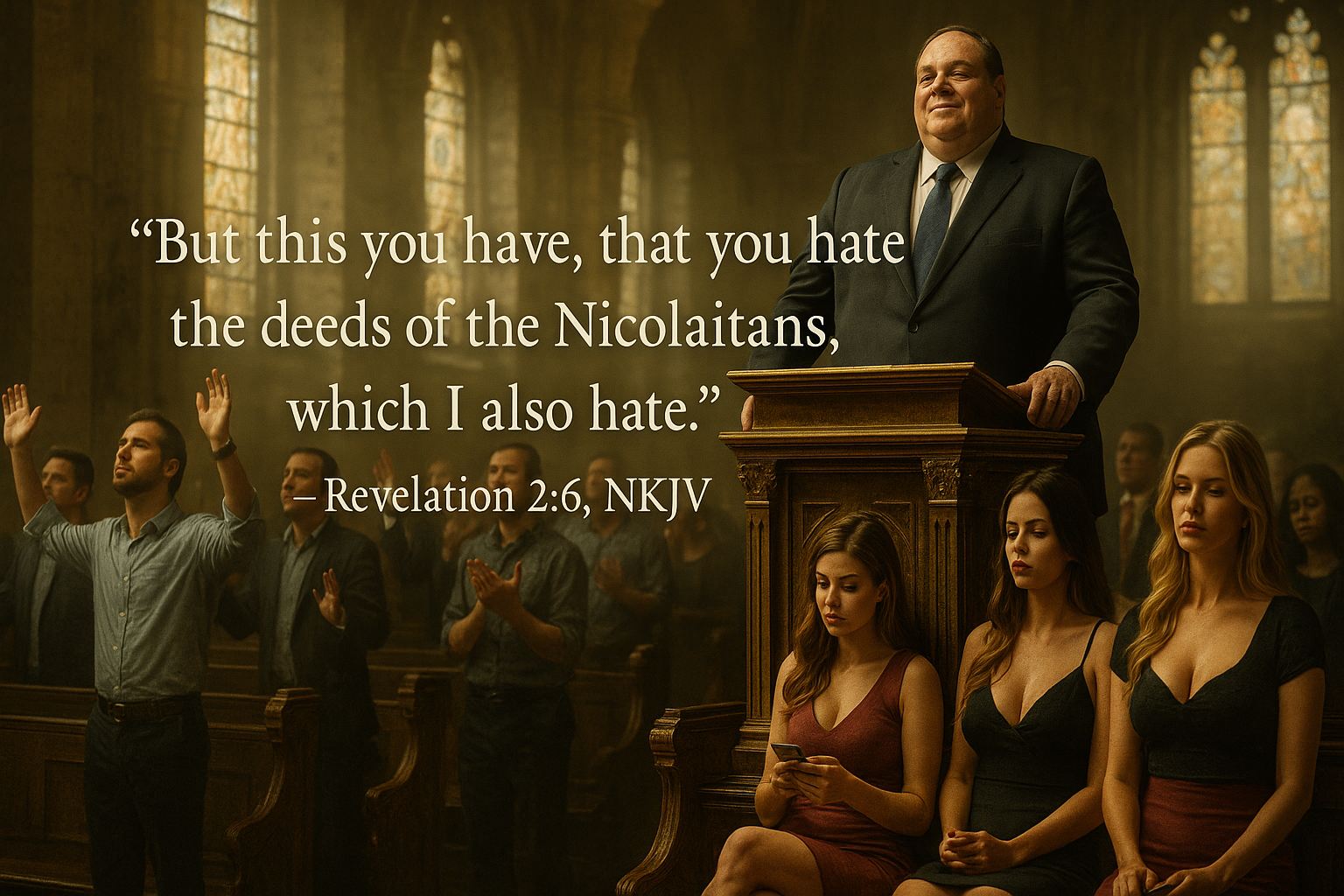
In the opening chapters of Revelation, the risen Christ speaks directly to His Church—piercing words, burning eyes, a two-edged sword proceeding from His mouth. Among the commendations and rebukes, there is one name that echoes with particular disdain: the Nicolaitans.
To the church in Ephesus, He says, “You hate the deeds of the Nicolaitans, which I also hate.” To Pergamos, a more grievous charge: “You have there those who hold the doctrine of the Nicolaitans, which thing I hate.”
Rarely does the Lord speak with such pointed hatred. What was it that provoked such divine revulsion?
Who Were the Nicolaitans?
The Nicolaitans were not outsiders attacking the faith. They were insiders—wolves in sheep’s clothing—sowing seeds of compromise. Rooted in a doctrine that perverted liberty and corrupted grace, they encouraged the early believers to indulge in idolatry and sexual immorality under the guise of Christian freedom. They blurred the line between the sacred and the profane. They whispered, “God is gracious,” while leading souls into darkness.
Many early church fathers—Irenaeus, Hippolytus, Epiphanius—linked them to Nicolas of Antioch, one of the first seven deacons. Whether or not this connection is historically solid, what is certain is the nature of their teaching: a doctrine that offered a crown without a cross, a kingdom without righteousness, and grace without repentance.
The Meaning of Their Name
The very name “Nicolaitan” is telling: Nikao—to conquer, and Laos—the people. The conquerors of the people.
This was a sinister inversion of Christ’s model of leadership, where the greatest is the servant of all. In their wake rose a clerical hierarchy, a division between clergy and laity—a spiritual caste system that stripped power from the Body and vested it in a ruling class.
The Nicolaitan spirit enthroned man-made authority in the place of the Spirit’s leading. It built platforms and pulpits where once there had been tables and towels.
A Doctrine of Compromise
But the sin of the Nicolaitans was not merely institutional—it was deeply immoral. They taught that one could follow Christ and still feast at pagan altars. They sanctified sensuality. They preached a gospel without holiness, a salvation without separation, a Christ without a cross.
In them was the spirit of Balaam, who taught Balak to seduce Israel through compromise. And like Balaam, they prophesied for profit.
Has the Doctrine Returned?
And now, we must ask with trembling hearts: Has the doctrine of the Nicolaitans returned to us in this present age? Or worse, has it never left?
Look around the modern Church. In the pursuit of relevance, we have forsaken reverence. In the name of love, we have lost truth. Preachers boast of grace, yet never speak of sin. Congregations are entertained but never convicted. Holiness is ridiculed. Repentance is optional.
Sexual immorality is tolerated—even celebrated—and leaders who should be shepherds build kingdoms in their own names. The altar has become a stage, and the sanctuary a marketplace. We have fashioned a Jesus who fits into our culture, but not a Christ who calls us out of it.
The Nicolaitan Spirit Today
The Nicolaitan spirit thrives where there is no fear of God. It preaches freedom, but enslaves. It promotes unity, but at the cost of truth. It claims to speak for Christ, yet it is the very doctrine He hates.
Yet not all have bowed the knee. Even in Pergamos, where Satan’s throne was, there were those who held fast to His name. And even now, Christ calls out to His people:
“Repent, or I will come to you quickly and will fight against them with the sword of My mouth.” (Revelation 2:16)
The Call to the Remnant
This is no small matter. The Lord of glory will not share His bride with Baal. He will not allow His house to be defiled with the teachings of those who flatter the flesh and poison the soul. The time has come for judgment to begin at the house of God. The line is being drawn.
Let every remnant heart arise and echo the cry of the saints in Ephesus:
“We hate the deeds of the Nicolaitans, which our Lord also hates.”
Let us cast down the altars of compromise, break the scepters of clerical control, and return to the simplicity and power of the faith once delivered to the saints. Let us be those who love truth more than comfort, holiness more than relevance, and Christ above all.
For the sword of His mouth still speaks. And the One who walks among the lampstands is watching.
This was the prayer that came to my spirit as I walked and prayed this morning.
If a celestial staircase opened before me Lord, I would climb it, step by step, all the way to heaven. If I could lay my burdens down, I would lay them all down now, at Your feet oh Lord.
If the noise of this world could be silenced forever, O what a glorious moment that would be. For nothing surpasses the peace of Your presence, The stillness, the holy rest of our God.
There is no clamoring when we draw near to You, Lord, Only rest, and peace, and stillness. You make me lie down in pastures green, You lead me beside the still waters of life.
Amid the tumult and noise of this age, Fix my mind on the eternal, unseen kingdom. Open my eyes to behold Your way, The kingdom that cannot be shaken.
Open the staircase of heaven before me, Lord, That I might climb into Your presence, Leaving the clamor and the noise behind, And dwelling forever in Your light.
At the turn of the 20th century, we witnessed the birth of two monumental Pentecostal movements. First, in 1904, came the Welsh Revival in Britain, and then, in 1906, the fires of revival swept through Azusa Street in Los Angeles. These were no ordinary stirrings, they were powerful outpourings of the Holy Spirit that would give rise to entire movements, such as the Elim Pentecostal Church in Britain and the Assemblies of God, which would spread globally and impact hundreds of millions.
From these humble beginnings, in every corner of the land, small Pentecostal churches began to emerge. Their message was simple: salvation through Jesus Christ, the power of the Holy Spirit, and the restoration of spiritual gifts. These fellowships sprang up in the shadow of massive denominational institutions, the Church of England, the Church of Scotland, and others, hige edifices steeped in their own traditions. Yet right beside them, in modest, unassuming buildings, were these Spirit-filled gatherings where lives were being radically transformed, adults were getting saved, and the gifts of the Spirit were active and alive.
This was a profound blow to the kingdom of darkness. The enemy, seeing the explosive growth of this movement, would not sit idly by. His question became clear: How can we bring this down? And so, beginning in the 1940s, we saw the emergence of new “theological,” trends, the Word of Faith movement, the Prosperity Gospel, and of course the Charismatic movement in the 60s, which would swallow up the others and become indistinguishable.
It was a cunning strategy: If you can’t beat them, buy them. The philosophy was simple, promise the very things that human beings everywhere fear to lose: health and wealth. Whether you’re in New York City or a remote village in the jungle, the universal concerns remain the same, our bodies and our bank accounts. The enemy offered a counterfeit gospel, one that shifted the focus from the cross of Christ to the desires of the flesh.
The Charismatic Movement became a Trojan horse. It infiltrated Pentecostal churches across the globe, not with persecution, but with promises. And it worked, brilliantly, tragically. The smoke from the fire of true revival has been replaced by the smoke machines of performance and entertainment. The altars were replaced by stages, the message by motivational speaking, and the Spirit by self-help and “self,” seeking
What followed was the tearing down of the very pillars upon which the early Pentecostal movement had stood. The purity of the Gospel was traded for a gospel of gain. Faith, once the precious link to Christ Himself, was twisted into a tool to manipulate blessings. Prosperity or tge lack of it, once counted as rubbish in comparison to knowing Christ, became the goal.Christ had become but a means to a materialistic end.
It was a disaster for the Church, and a stunning success for the enemy. The people rose up and played, just as they did before the golden calf in the wilderness. Think of “holy laughter,” and roaring like animals. And today, we stand in the shadow of that fall, in the ruins of what once was a mighty move of God.
These false ideologies, health and wealth, Name It and Claim It, the separation of faith from Christ Himself, have infected almost every corner of the modern Pentecostal and non-denominational world. Rare is the church untouched. Subtle or blatant, this taint remains, and it must be recognized for what it is.
Now, in this late hour, a remnant is rising, a people who are returning to the simplicity and the power of the cross, who walk not in the counsel of the world but in the fear of the Lord. Let us not be seduced by the glitter of gain or the lure of comfort. Let us remember the foundation laid in tears and prayer and holy fire. It is time to leave the circus behind, with all its many forms of entertainment, and “come out from among her.”
The Herd Mentality and the Call to Swim Against the Current
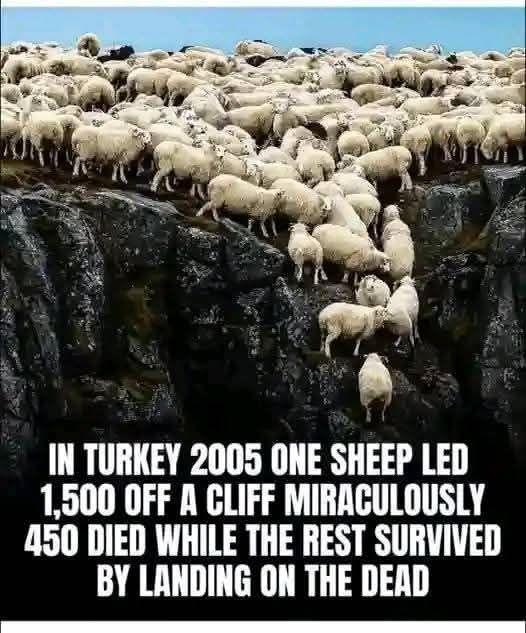
In July 2005, in Eastern Turkey near the village of Gevas in Van province, something astonishing happened. A group of shepherds had left their flock of about 1,500 sheep to have breakfast. During that time, one sheep wandered off a cliff, and every single one of the others followed. It’s a chilling picture of herd mentality , not just among sheep, but a profound metaphor for humanity.
We see this throughout history and even in our own day. People instinctively believe there’s safety in numbers, but the crowd can and mostly are terribly wrong.
One story from 9/11 that has always stayed with me is of two men who were above the impact zone of one of the towers. Very few people survived from above the crash site. These two did, and their story speaks volumes.
As they made their way down a heavily damaged stairwell, they came upon a group of 14 to 20 people heading upward. The men pleaded with them, “Don’t go up, there’s no rescue coming from the roof.”
But some in that group were being swayed by charismatic voices insisting that helicopters would come, that rescue was possible if they just went higher. But they were wrong. Helicopters couldn’t reach the roof because of the intense smoke and heat, and the rooftop doors were locked. Everyone who followed that advice died.
The two men who chose the hard way down , they lived.
That’s the herd mentality again. A subtle, collective pull toward what seems right, especially when others are doing it. But real awareness, real wisdom, often means resisting the flow.
Nazi Germany is another sobering example. A woman in a documentary from the 1960s was asked why she attended Hitler rallies. Her answer has never left me: “There was something in the atmosphere, and we all breathed it in.”
That’s the crowd again. That’s the spirit of the age, the zeitgeist, and it’s often strong enough to sweep entire nations away. Not everyone agreed with the Nazis, but most went along. They gave the salute, kept their heads down, and refused to stand out.
I remember once the Lord said to me, “Frank, if you’re running with the crowd, you’re running in the wrong direction.”
There are two rivers in this life.
The river of God, the river of life, where we are called to be immersed, not just ankle-deep or knee-deep, but swept up and carried by the Spirit of the Lord.
“And he measured one thousand cubits, and brought me through the waters, the water came up to my ankles. Again he measured one thousand and brought me through the waters, the water came up to my knees. Again he measured one thousand and brought me through, the water came up to my waist. Again he measured one thousand, and it was a river that I could not cross, for the water was too deep, water in which one must swim, a river that could not be crossed.” — Ezekiel 47:3–5, NKJV
And then there’s the river of this world, strong, dark, and swift, and we are called to swim upstream, against its flow.
We are not meant to follow the crowd off a cliff. We are called to be a peculiar people, a royal priesthood, a chosen generation. We are pilgrims and strangers in this land, never quite fitting in.
There are two overarching paths that lie before us, as stated by Jesus. One is the broad road that leads to destruction, and many will go in by it — the crowd. The other is the narrow gate and the difficult way that leads to life, and few will find it — the remnant.
“Enter by the narrow gate, for wide is the gate and broad is the way that leads to destruction, and there are many who go in by it. Because narrow is the gate and difficult is the way which leads to life, and there are few who find it.” — Matthew 7:13–14, NKJV
We are those who hear the voice of the Spirit through the Word of God, who see and understand and stand, even if we stand alone.
Let us be voices that warn. And more than that, let our walk be our light and a lamp of direction to others. The word of God is a lamp to our feet, it leads us and guides us in the way that we should go.The Kingdom of God is found along the narrow path that runs counter to the world.
You know, tomorrow is Pentecost (I wrote this a few weeks ago) And like many sacred things in the church, we have made a symbol of it. We have reduced it to a ritual, a religious observance marked by a date on the calendar. Pentecost, like Christmas or Easter, has become a ceremony. But, brothers and sisters, let me tell you plainly, that is not what it was meant to be.
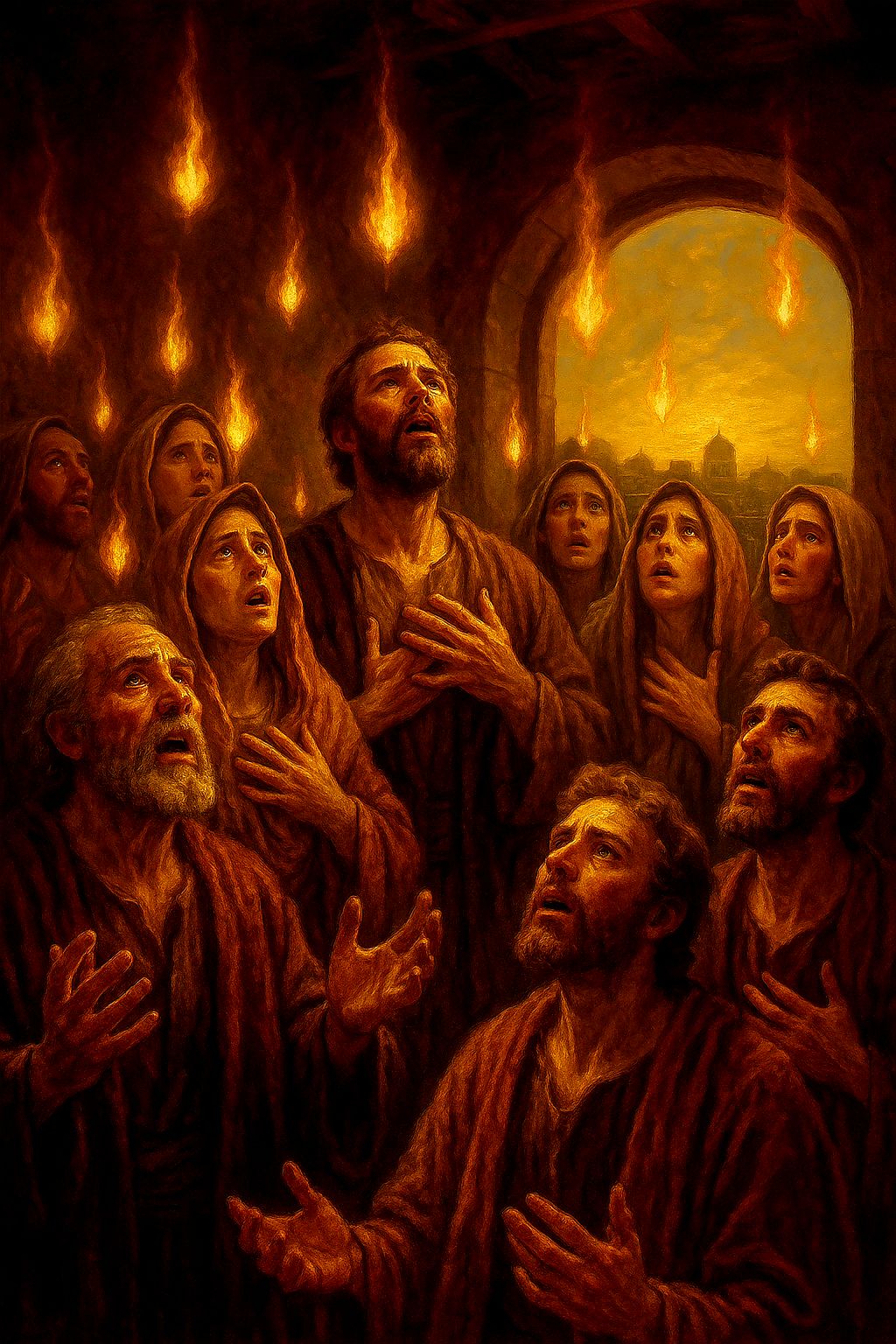
Pentecost was not a celebration of a day. It was the arrival of a Person. The Holy Spirit descended like fire from heaven. As the Word declares, “Then there appeared to them divided tongues, as of fire, and one sat upon each of them. And they were all filled with the Holy Spirit” (Acts 2:3–4, NKJV).
That moment was not meant to be memorialized once a year, it was meant to revolutionize every day. One encounter with the baptism of the Holy Spirit transforms a life utterly. It sets the heart ablaze and loosens the tongue with boldness. It becomes the source of power that causes the devil to flee. It strengthens our feet for the narrow way, “Because narrow is the gate and difficult is the way which leads to life, and there are few who find it” (Matthew 7:14, NKJV).
The Spirit enables us to pass through valleys, to climb spiritual mountains, to face the enemy of our souls. Not with trembling but with power. For “greater is He who is in you than he who is in the world” (1 John 4:4, NKJV). Pentecost is not a date, it is a way of living, it is heaven’s breath within us, propelling us forward in divine strength.
Jesus Himself declared, “I came to send fire on the earth, and how I wish it were already kindled” (Luke 12:49, NKJV). And John the Baptist testified of Christ, saying, “He will baptize you with the Holy Spirit and fire” (Luke 3:16, NKJV). This fire, I believe, was taken from the coals of the heavenly altar, the very presence of God, and placed upon frail men.
And what happened? Those few, filled with that fire, “turned the world upside down” (Acts 17:6, NKJV). They did not wait for a Sunday. They did not look to feast days. They carried Pentecost in their bones, in their breath, and in their speech. They were pierced by power and spoke so that “when they heard this, they were cut to the heart” (Acts 2:37, NKJV).
You must be born again. You must be baptized in the Holy Spirit. You must have the fire of God within. Without Him, Christianity becomes religion, an empty shell. But with Him, it becomes life and that more abundantly (John 10:10, NKJV).
The apostolic revelation given to Paul, as recorded in Colossians 1:26, presents one of the most profound disclosures in redemptive history—a mystery once concealed from ages and generations, now gloriously revealed to the saints. This mystery, long hidden in the counsels of God, was not perceived by the prophets nor comprehended by the wise of this world. It is the astounding truth that in Christ Jesus, Jew and Gentile are no longer divided, but made one—a new humanity, a single body in the Messiah. This is the long-anticipated fulfillment of the promise to Abraham, that in his seed all the nations of the earth would be blessed. No merely ethnic boundary remains, for in Christ there is neither Jew nor Greek. This is a revelation of cosmic consequence and divine ingenuity, wholly unforeseen in its breadth and intimacy.
Yet, astonishingly, the mystery deepens. As Paul continues in Colossians 2:2–3, he reveals that the purpose of this unity is not an end in itself, but a divine conduit by which the saints are brought into the very heart of God. He prays that their hearts might be encouraged, being knit together in love, and that they may attain to all the riches of the full assurance of understanding—to the knowledge of the mystery of God, both of the Father and of Christ.
Herein lies the surpassing dimension of the mystery: not merely reconciliation between former enemies, but an invitation into divine communion. In Christ are hidden all the treasures of wisdom and knowledge. Through union with Him, the veil is lifted and the Father—once unknowable and inscrutable—is made known. The mystery begins with the joining of the divided, but it climaxes in the revelation of the Divine. It is not only that Jew and Gentile are made one in Christ, but that in being made one, they are ushered into the very life of God.
This is the formation of the true Israel of God—a people sanctified, a royal priesthood, whose minds are being renewed and whose hearts are being enlarged by the Spirit. The saints are not left with mere doctrine, but are drawn into the riches of divine intimacy, discovering the boundless wisdom and knowledge hidden in Christ. This is the full arc of the mystery: reconciliation leading to revelation, unity giving way to glory, and the Church—Christ’s body—growing in grace as it beholds the face of God in the person of Jesus Christ.
Our small house church, though modest in number, stands as a precious testimony to a deeper reality, a reality that transcends the glittering edifices and booming stages of modern Christendom.
Over a decade ago I made the conscious, Spirit-led shift, joining countless others across the globe who have heard the still small voice calling them out of spiritual Babylon. For in every generation, God reserves for Himself a remnant, a people who will not bow the knee to Baal, no matter how cunningly he reinvents himself through culture, compromise, or counterfeit religion.
Before our very eyes unfolds the tragic convergence of the harlot church, a synthesis of worldliness and religion, dressed in finery but inwardly defiled. Its heartbeat is not the cross, but the stage; not the Spirit, but spectacle. As it was in Rome, so it is today. The Coliseum, once the epicenter of Roman life, rose from the gold and silver plundered by Titus during the destruction of the Temple in Jerusalem. One temple fell, another was built. Worship of the Holy was replaced by worship of self, veiled in the opiate of entertainment. Bread and circuses—tools of distraction, tools of dominion.
Yet the martyr Stephen, in his final breath, echoed the words of our Lord: “The Most High does not dwell in temples made by human hands.” Jesus, speaking to the Samaritan woman, dismantled the geography of worship and pointed to its essence—Spirit and truth. When asked, “Where should we worship?” Christ responded not with a location, but with a mandate: how we are to worship.
It is vital—indeed, imperative—that the true saints gather not around programs, performances, or personalities, but around the presence of God. In Spirit. In truth. And as the great Day of the Lord draws ever nearer, this calling becomes all the more urgent. For history has shown: men gather to entertain themselves. But few gather to worship God as He has ordained.
Let us, then, be counted among the few—those walking the narrow path that leads to life. Let us not be swept away by the many, whose feet tread the broad road of destruction. Let our assemblies be small, but pure; hidden, but radiant. May our worship rise not from stages, but from sanctified hearts. For the time is short, and the Bride must make herself ready.
A couple of days ago, I found myself praying through the pain. The weight of chronic suffering pressed hard against my body, sleepless nights, relentless aches, and then came the news: my mother, already fragile, had fallen again, twice in three days. Now she lies in a hospital bed back in Scotland, and I feel the ache of distance more deeply than the pain in my bones.
But in the middle of this storm, our little fellowship had just been walking through Colossians 1, and Paul’s words struck deep: “Strengthened with all might, according to His glorious power, for all patience and longsuffering with joy.” Oh, what a mystery! That in our weakness, we are strengthened, not by our own feeble will, not by grit or determination, but by all might, according to His glorious power. It is Christ. It is all Christ. His strength, His might, His glory. He initiates, He enables, and in Him, we become more than conquerors. And as this truth ignited my spirit, a prayer rose from the depths, a cry not of despair but of victory, and it thrilled my soul and lifted me high, far above the valley, to a place where joy and power meet on the mountaintop of faith. Glory to God!
……………………This was my prayer……….
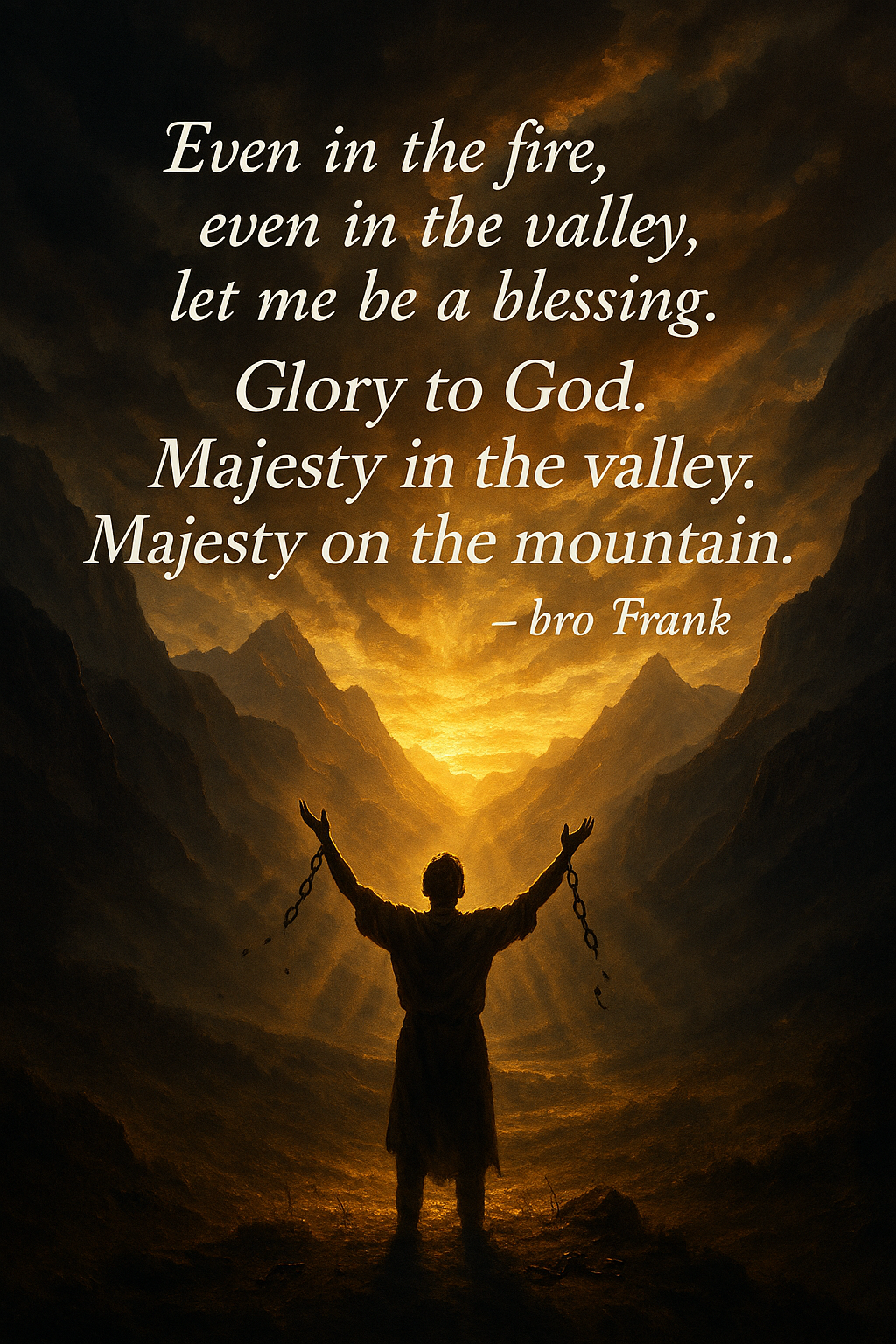
When every last breath is torn from my lungs, still, I will give You the kiss of life. When I have tasted no food for many days, my soul shall yet feed the hungry. When the sun has hidden its face and the heavens remain cloaked in silence, I will lift my face to You, and You, O Radiant One, will shine through me. And when my heart is heavy with sorrow and anguish drowns my soul, I will break the alabaster jar of joy and pour it out upon the weary. O Lord of Heaven and Earth! Even in the testing, even in the fire and the fury, even in the shadow of death and in the long-suffering of my pain, let me be a blessing. Let me bless them from the prison of that pain. Let me lift them from the depths of my own valley. If they are halfway up the mountain and I am still far below, let them hear my song rise from the depths:Glory to God. Glory to God!
And may the valley blaze with the light of that glory. Let the darkness tremble. Let chains be shattered. Let the echo of praise thunder through every cavern, For You, O King, are worthy in fire and flood, in feast and famine. Majesty in the valley. Majesty on the mountain.
If I can rejoice in the midst of suffering, then I stand at the threshold of a sacred mystery, that place where I, in my own frail flesh, “fill up what is lacking in the afflictions of Christ… for the sake of His Body.” Only the soul saturated and drenched in the Spirit of the Living God, can rise in the midst of wreckage of loss and cry out with trembling lips, “The Lord gives, and the Lord takes away, blessed be the name of the Lord!” This is no mere endurance, no stoic stance, it is a sacred participation in the sorrow and the splendor of Christ. It is the fellowship of His suffering. A communion few will dare to enter, too costly for most, and yet it is the very ground where heaven bows down and kisses the wounded earth
When heaven collides with earth, then it enters into sorrow. How could it be otherwise? One is perfect, the other a ruin of its original. And we, we who have been born from above, have been invaded by that very heaven. It fills our bones. It saturates our hearts. And in that collision we begin to drink from the same bitter cup our Lord once drank. We are not spectators. We are not distant. We are His Body, and so we must enter into that same sorrow, that way of suffering, and there we must rejoice in the midst of it all. And the joy we share, as we tarry there, begins to tear down the kingdom of darkness.
Our joy is the indelible, supernatural fingerprint of heavens glory that lies within us. Our brokenness, shattered by a dying world, becomes the sacred fissures through which the glory of God bursts forth. And as that glory pours forth, it kisses the wounded earth, and it becomes a balm of Gilead. It is the fellowship of His suffering. It is the communion of the afflicted. It is the royal priesthood of the scarred and the sanctified. A holy nation, set apart, bearing upon our very bodies the marks of our King. Not in shame, but in triumph. Not in defeat, but in everlasting victory.
I find myself increasingly dismayed by the widespread lack of discernment concerning not only the papacy but the Catholic Church as a whole. Speaking as a former Catholic, one who departed from the Church upon experiencing a genuine conversion, a born-again encounter with Christ. I am particularly troubled by the growing acceptance of Catholicism among Protestant and Evangelical circles that, only a few decades ago, would have maintained a clear separation. The shift over the past 25 to 30 years is both significant and concerning.
Research indicates that there are at least 20 million former Catholics in the United States alone. Of these, studies suggest that approximately 80–90% departed after undergoing a born-again experience. If we extend these figures to South America, the number nearly doubles, approaching 50 million individuals across the Americas who have left Catholicism for similar reasons. When extrapolated globally, the figure could be closer to 100 million. There is, therefore, a profound and deliberate reason why so many now identify as “ex-Catholics,” myself included, and I do not hesitate to affirm that designation.
The widespread failure to recognize these realities, in my view, correlates closely with the phenomenon commonly referred to as the “Great Falling Away” a time marked by diminishing spiritual discernment, widespread biblical illiteracy, and the dilution of Protestant witness, which has become but a shadow of its former vitality. This erosion continues largely unabated.
The idea that the head of the Catholic Church, the Pope, could be regarded as a born-again believer is, in my estimation, theologically untenable and historically absurd. This is to say nothing of the longstanding doctrinal errors promulgated by the Catholic Church, foremost among them the dogma of transubstantiation. The claim that a priest has the authority to transform a piece of bread into the literal body of Christ not only defies plain scriptural teaching but also strains credulity to the utmost. Such a claim, divorced from biblical foundations, highlights the extent of the doctrinal chasm.
Given these concerns, I have deliberately refrained from engagement with recent papal funerals, elections, and public commentary surrounding the pontificate. I am personally persuaded that the figure of the Pope, whether the present or a soon-coming successor, will fulfill the prophetic role of the False Prophet, one who will direct the world to the Antichrist, declaring him to be the true Christ. In a world that increasingly regards the Pope as the de facto figurehead of Christianity, reverently referring to him as the “Holy Father” and the “Vicar of Christ,” such developments seem to me to be falling into place with alarming predictability.
Then Moses stood, trembling before the living God and cried, “If Your Presence does not go with us, do not bring us up from here!” What use is a promised land without the presence of the Lord? What use victory without the Victor? Better to die in the wilderness with His presence than to live in palaces void of His presence. Moses didn’t crave gold or glory—only God. “How will they know we have found grace in Your sight unless You are with us? For it is Your Presence that sets us apart from all the peoples of the earth!”
This plea came after the shame of the golden calf. God had said, “I will not go in your midst, lest I consume you on the way, for you are a stiff-necked people.” Judgment hung heavy. But the people responded with brokenness, they stripped themselves of their ornaments, the very gold they once used to craft an idol. What was once an object of rebellion would now be set apart for worship, given for the building of the tabernacle. Out of ashes, something holy would rise.
God, moved by the bold and broken cry of His servant, said to Moses, “I will do this thing that you have spoken, for you have found grace in My sight, and I know you by name.”
Oh, the wonder of being known by God, not just as a face in the crowd, but as a beloved child. Your name, spoken from His lips. The same voice that formed the stars knows your name.
But Moses was not satisfied. He wanted more. “Show me Your glory!” he cried. The cloud wasn’t enough. The fire wasn’t enough. The voice on Sinai wasn’t enough. He longed to see God Himself. Do we? Do you long for His presence with such desperation? Is this one desire the fire that burns in your bones?
David knew that longing. “I have set the Lord always before me; because He is at my right hand, I shall not be moved… for in Your Presence there is fullness of joy.” Not a taste, not a whisper, not a portion-fullness. The very life of the soul. Like a deer pants for the water, so our souls should pant for Him. We cannot go forward unless He goes with us. We need the cloud by day, the fire by night, and the glory that changes everything.
David cried again in Psalm 27, “One thing I have desired of the Lord, that will I seek: that I may dwell in the house of the Lord all the days of my life, to behold the beauty of the Lord, and to inquire in His temple.” His heart was not set on fame or fortune, but on this one thing—to dwell with God, to see His beauty, to be near Him. In the time of trouble, God would hide him, lift him high upon the Rock.
To Moses, God replied, “I will make all My goodness pass before you… but no one can see My face and live. Still, there is a place by Me. Stand on the rock. I will hide you in the cleft of the rock and cover you with My hand. Then you shall see My back.” What a mercy. What a gift. Moses stood on the Rock, hidden in the cleft, shielded by God’s hand, and he saw the glory of the Lord.
Dear brothers and sisters, do you stand upon the Rock? Are you hidden in the cleft? Has the hand of God covered you, and have you glimpsed His glory? Has it changed you from the inside out? Like Isaiah, who saw the Lord and was undone. Like Jeremiah, who burned with His word. Like Ezekiel, who fell before the wheels of glory. Has His fire touched your lips?
This is no ordinary walk. This is the baptism of fire. For Jesus said, “I have come to cast fire upon the earth, oh, how I wish it were already kindled!” Our God is a consuming fire. He burns away the flesh, the pride, the idols, and reveals His glory in the soul that longs for Him. Let that fire fall.
There is power, brothers and sisters, real power. In Christ. It resides within us and we have been called to exercise it in the name of the Lord Jesus. Just because the Word of Faith movement and the Charismatics have so abused this notion, this should not dissuade us from moving in the power of God,He gives power to the weak, not just comfort, not just words, but power, power from heaven
poured into fragile clay. To those who have no might, He increases strength. This is not human resolve. This is not willpower. This is divine empowerment. Those who wait on the Lord? They don’t just survive, they rise. They mount up with wings like eagles. They run and do not grow weary. They walk, and they do not faint.
Why? Because it is God, yes, God, who commanded light to shine forth from darkness, who said “Let there be!” and there was, who has now shone into our hearts the light of the knowledge of the glory of God in the face of Jesus Christ. There is power in the light, there is power in the “knowledge of glory.” Not the head knowledge, the mental assent to an abstract truth, but the glory itself and your experience of it and in it.
And this treasure, what a treasure! This power lives in earthen vessels, in us, so that the excellence of the power may be of God and not of us. And Jesus said: “You shall receive power when the Holy Spirit has come upon you…” (Acts 1:8). Power to live. Power to stand. Power to speak. Power to shine like lights in a darkened world. Power to be His witnesses in Jerusalem, Judea, Samaria, and to the ends of the earth.
Paul declared, “I can do all things through Christ who strengthens me.” He prayed that we would be strengthened with might through His Spirit in the inner man. And Jesus Himself said, “My grace is sufficient for you, for My strength is made perfect in weakness.” So Paul says, “Therefore I will boast in my infirmities, that the power of Christ may rest upon me.” Do you believe that today, saints? Do you believe there is a power alive in you? Christ in you, the hope of glory? Is there life in you? Is there light in you? Then let it burn. Let it blaze. Let the world see Jesus alive in you.
Let me give you a small example of Gods glory and power. I sat in the vet’s office many years ago as my beloved dog was old and sick and dying. I asked them how long the injection would take and they said a minute, maybe two. But after five minutes passed—she was still breathing. Confusion crossed their faces. The young women looked a little panicked. Something unspoken hung in the air. My hand was resting on her head. And then, in that moment, the Lord whispered to me: “Take your hand off her head.” I obeyed. As I did, her head slowly lowered and she rested on my foot and passed away.
There is power, my friends. Power in the touch. Power in obedience. Power in surrender. Power in the flow of Christ’s Spirit through yielded vessels. Will you let Him flow through you today? The world is starving, starving for an expression of Christ. Not religion. Not performance. But the raw, radiant reality of Jesus alive in us.
Let Him rise in you. Let Him shine through you. Let the power of Christ rest upon you today. The resurrection power of the Holy Spirit, the same power that caused Christ to rise from the dead, dwells with us earthen vessels.
In Ezekiel chater two, Ezekiel is still reeling from the overwhelming vision in chapter 1. The heavens had opened. The glory of the Lord had appeared. And what does a man do when he beholds the living God? He falls, face down, trembling, undone. Just like Isaiah in chapter 6, who cried, “Woe is me!” when he saw the Lord high and lifted up. And Jeremiah, he too had his moment, his calling, his confrontation with divine fire.
Every time, every single time, when a man comes into the presence of the Most High, he cannot stand. It is the only posture that makes sense before such holiness: to fall flat on your face, emptied of pride, silenced by glory.But then, then! The voice of the Lord cuts through with the weight of glory and says, “Son of man, stand on your feet.” Oh, can you hear it? It’s as though He’s speaking life into dust. It’s the same voice that called to the dry bones in the valley, saying, “Live!” And live they did. Bone to bone, sinew to sinew, flesh upon flesh, but it meant nothing without the breath.
And then—the wind! The Spirit! The breath of life rushed through the valley, and what had been dead stood tall, a vast army, alive by the very breath of God.So it is with us, brothers and sisters. We were dead—dead in our sins, dry and lifeless in a dark valley. But God! He breathed into us His Spirit. He raised us up. He caused us to stand—not by our might, not by our will, but by His power, His Spirit, His holy command.
We move, we speak, we rise, in the name and by the power of the Lord Jesus Christ. But it all begins,with an encounter. An encounter that breaks us down before it builds us up. This is the birth place of true obedience. This encounter, this losing of oneself, is the primary motivation for our mission in life, whatever He calls us to do. Ezekiel chapter 2 is not just the next chapter in a prophet’s story, it’s the holy aftermath of a collision with the Divine. It’s the moment where the fallen man hears the voice of God saying, “Rise.” And by His Spirit—we do.
It is a holy thing to know who you are in the Lord. To search the chambers of your own spirit with trembling , for the flesh is relentless, and is our most cunning foe. It creeps in as a whisper, yet departs in a tempest, tearing as it goes. But the Lord, ah, the Lord He speaks not in thunder, nor in the earthquake, but in that still, small voice. It is not the volume that stirs and shakes mountains, but the weight of the Word itself, Spirit-breathed, eternal.
For passion can rage like a sea in a storm, waves rising like giants, smashing all that dares to stand. But gaze upon the Christ before Pilate, Truth wrapped in silence, power clothed in meekness. Love’s boldness stood face to face with earthly might, yet never raised its voice in pride or vanity, the power of knowing.
If the message be truly of God, then it does not waver,it is unchanging, steadfast as His own Word. But the messenger? Oh, he is tested. Ridiculed. Wounded. Laid bare. He is stripped of self until he walks quietly, humbly, unknown to men, yet known to God. His heart beats not for applause but for obedience, to carry the fire he was given.
It is sweet, yes,so sweet,to hear His voice. But to speak it? That is often bitter. Bittersweet, the flavor of the prophetic path. Yet we must be faithful. Come storm or silence, come crowd or solitude,we must speak what He has spoken.
Let the waves crash, let the world rage. But let us walk on. One step in front of the other. One day at a time. Falling down but getting back up again. We can do all of this in Christ alone. In Him all things are possible and only by the power of the Holy Spirit can the message be delivered.
The great falling away has been an intentional wilful act. Millions of “believers,” all over the world have heaped up teachers to themselves. “For the time will come when people will not put up with sound doctrine………they will turn their ears away from the truth and turn aside to myths.” (2 Tim 4:3-4)
They have seized the treasures of this world and their priests have molded them into idols for them. They’ve sought out teachers who preach and justify their ways, teaching them how to thrive and live their best lives now. It’s a pyramid scheme of prosperity with their leaders always show casing their own success as proof. The blind lead the blind, and no one wants it any other way. Think of how the children of Israel did the same in their wilderness days, when leadership (Moses) was absent……….
They handed over the treasures of Egypt—the very spoils of their deliverance—not in thanksgiving to God, but to the priest who forged the idol of their rebellion. The same image of bondage they had just escaped, they now bowed to in ecstasy. And then—they rose up and played, casting off restraint like it was a thing to be mocked.
Eli and his sons? They stole from the brazen altar with grasping hands. They gorged themselves on what was sacred, their bellies fattened by what was never theirs to take. They took the choicest cuts, dripping with the blood of irreverence, showing no fear, no care for the holy things they defiled.
Here’s the truth, plain and terrifying: the people have clamored for exactly this. They didn’t stumble into corruption—they desired it. They built it, fed it, and now lie with it. This is no accidental fall—it’s a deliberate unholy alliance, a willful union where guilt is not only shared, it’s celebrated. The writing is on the wall.
Moses gave the people an ultimatum “whoever is on the Lord’s side come to me.” Three thousand were killed that day. Elijah says “How long will you waver between two opinions? If the Lord is God, follow Him, but if Baal is God, follow Him. But the people said nothing” Four hundred and fifty teachers of Baal were killed after fire fell from heaven. Joshua says “But if serving the Lord seems undesirable to you, then choose for yourselves this day whom you will serve, whether the Gods your ancestors served beyond the Euphrates or the Gods of the Amorites, in whose land you are living. But as for me and my household, we will serve the Lord.”
In every generation the people have to decide who they will serve, who they will follow. The few will follow the Lord and the majority will follow the gods of their own “ancestors,” (dead religion) or the gods of the land in which they dwell. This generation has decided, the great falling away is complete, and now only a remnant, a few, will come out from among them. They and their household will serve the Lord.
The great spiritual decline we are experiencing has many roots.Both leadership and the people share responsibility for spiritual decline. While leaders bear the weight of accountability, the congregation is not without blame. What we witness today, particularly in the rise of large churches and the decline of true faith, mirrors the law of diminishing returns.
To clarify, the law of diminishing returns states that as you increase one factor of production—such as labor or capital—while keeping other inputs constant, the additional benefit from each added unit will eventually decrease. In the context of faith, simply increasing the number of people in a church does not equate to spiritual growth. In fact, it can have the opposite effect.
Consider a family barely surviving on limited resources. If several more families move in without an increase in provisions, everyone suffers. The same principle applies to the church: if discipleship and spiritual nourishment are neglected in favor of entertainment and distraction, then increasing attendance only amplifies the problem. Rather than strengthening the body of Christ, it weakens it.
Jesus transformed the world with just twelve disciples. It was not their numbers but the presence of the Lord in their midst that made the difference. Where two or three gather in His name, His presence is enough to accomplish immeasurable things. A few loaves and fish can feed thousands when blessed by Him. Yet today, multitudes gather, feeding on the abundance of their own works, and still, they starve spiritually.
True power lies not in the size of the gathering but in the reality of His presence, His purpose, and His work in the midst of His people.
The great falling away isn’t about people no longer “going to church,” since the concept of attending “church” is foreign to the Scriptures. Genuine believers are the Church. The true falling away is a departure from truth itself. A building may be packed with people, but who are they spiritually? Are they radical followers of Jesus with deep relationships with Him, or compromisers who embrace Christ but reject the cross?
Those of us who have left religious traditions—I myself am a former Catholic—are well-acquainted with the Sunday-only Christian who checks a box by attending a service, perhaps even midweek gatherings, men’s BBQ nights, or women’s retreats. I call this the processed church. Just as processed food is altered from its original state for convenience—loaded with sugars, unhealthy fats, preservatives, and lacking nutrients—the spiritually processed church has also been altered for convenience.
What are the spiritual effects of this processed church? Consider the “added sugar”: elaborate stages, entertainment-driven worship bands, and smoke machines designed to hype people up, compensating for the absence of God’s genuine presence. Many nominal believers have never truly encountered God’s authentic presence and therefore cannot discern the difference.
Think of “unhealthy fats and low nutrients”: the Word of God diluted, compromised, and stripped of its true nutritional value. These “fats” are sermons focused solely on worldly success, prosperity teachings, and self-enrichment schemes, creating spiritually unhealthy Christians who must continually rely on shallow injections of emotional hype to stay spiritually “alive.” The church system has taught its followers dependency on itself rather than complete reliance on Jesus.
What’s the solution? Revolution—a total abandonment of this processed religious system in favor of something pure, raw, organic, and unaltered by worldly additives. Without such radical change, the current system will collapse under the weight of worldliness and self-centered doctrines disguised as salvation.
There is a growing hunger, especially among younger generations raised within spiritually unhealthy environments, for authenticity, radical commitment, and an uncompromising devotion to Christ Himself. They desire a church wholly devoted to Jesus, characterized by quiet reverence and genuine holiness. A community where believers edify one another according to Scripture, where prophecy, exhortation, wisdom, tongues, and interpretations are practiced. A fellowship without hierarchical leadership, led instead by humble elders and deacons who serve selflessly, desiring no recognition or financial reward. A place that equips believers to live radically, to embrace suffering for Christ, proudly bearing the cross and the scars upon their backs as marks of their love, devotion and authenticity.
This is the organic Church—unprocessed by the world, radically committed to Jesus Christ and His Kingdom.
There remains a remnant—a people set apart, standing in the wilderness to proclaim God’s truth. They are anchored in His Word, separate from the systems of religion, for they understand that Christ did not come to establish another religion but to restore relationship.
To be outside the camp carries risk. When Israel fell into idolatry with the golden calf, a separation was established between the people and God. The Tent of Meeting, set outside the camp, became a place where Moses, Joshua, and the priests entered into His presence, while the people could only watch from their tents. This same idolatry persists today, creating a divide between God and those entangled in religious systems.
The camp represents the churches and religious institutions of our time, while the priests—God’s remnant—have left the camp in pursuit of the true dwelling place of His presence. To enter the Tent of Meeting, one must first “come out from among her.” When Israel entered the Promised Land, the Tent was replaced by the temple, but in time, the temple itself became a stronghold of religion, ultimately torn down stone by stone. And yet, the Tent returns, a place of worship in the wilderness—a place called Spirit and Truth.
As Jesus told the Samaritan woman at the well:
“Our fathers worshiped on this mountain, and you Jews say that in Jerusalem is the place where one ought to worship.”
Jesus said to her, “Woman, believe Me, the hour is coming when you will neither on this mountain nor in Jerusalem worship the Father. You worship what you do not know; we worship what we do know, for salvation is of the Jews. But the hour is coming, and now is, when the true worshipers will worship the Father in spirit and truth, for the Father is seeking such to worship Him. God is Spirit, and those who worship Him must worship in spirit and truth.“(John 4:20-24)
True worship is not bound to temples built by human hands but is found where God dwells—outside the camp, beyond the gate. The Lord, who was crucified at Calvary, stands in contrast to the Holy of Holies within the temple. While religious men seek their refuge in structures and traditions, the Lord calls His people to meet Him in Spirit and truth.
The call goes forth: Come out of the camp. Come to the Tent of Meeting. Come and tabernacle with the Lord.






 A Call To The Remnant