


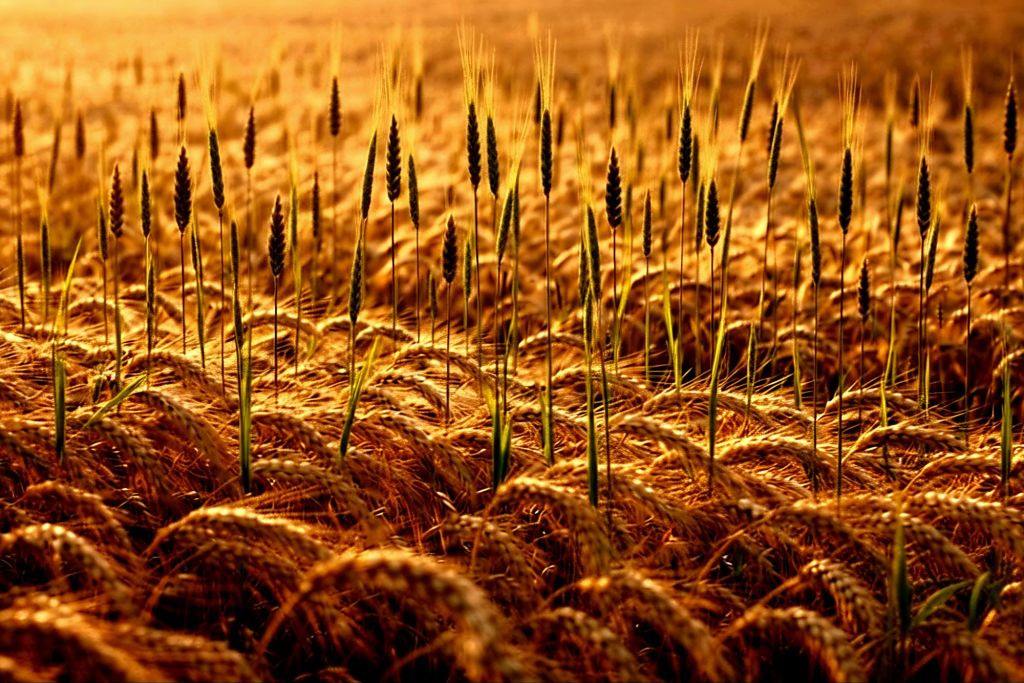
We stand in a time when the Lord’s description of the harvest is no longer theoretical, but increasingly observable, to the point that what once lay hidden within the field can now be discerned as the age moves toward its consummation.
The Lord did not frame the close of the age as a single moment, but as a harvest season, as He Himself declared when opening the parable of the field [Matthew 13:24].
A closing span in which what has long grown together can no longer conceal its nature, for the harvest, He said, is the end of the age [Matthew 13:39].
When the grain reaches fullness, weight comes upon the head of the true wheat. It bows, heavy with formed life, while the tare, light and fruitless, remains upright, exposed by its own barrenness.
This is why there must be a period of unveiling. The distinction, once hidden in the green blade, becomes undeniable in the ripened field, just as He taught that both must grow together until the harvest [Matthew 13:30].
What could not safely be touched in the early growth can now be handled without harm to the wheat, because maturity has made separation just, visible, and irreversible.
So within the synteleia tou aiōnos (Matthew 13:39), the consummation of the age, there unfolds a measured work of exposure and removal.
It is not haste, but precision. Not impulse, but ripeness that governs the reaping.
The tares are taken from among the wheat because their habitation was never separate, reflecting His own words that the enemy sowed them among the wheat while men slept [Matthew 13:25].
They shared the same soil, the same rain, the same sun, yet bore no grain.
And when the reapers move, they do so in a window of divine timing, for He said the reapers are the angels sent forth at the close of the age [Matthew 13:39–41].
In that solemn interval, the uprightness of the tare becomes its own testimony, and the harvest, long foretold, proceeds without injury to the wheat, fulfilling His declaration that all things that offend would be gathered out of His kingdom [Matthew 13:41].
And in an actual field, as the season turns and the wind moves across the ripened grain, another distinction appears.
The wheat does not only bow from weight, it moves differently.
When the gusts come, the true wheat sways in unified rhythm, heavy heads yielding, bending without breaking, the whole field rolling like waves of gold.
But the tares, stiffer and lighter, resist the movement. They jut upward, visually discordant, unable to flow with the humbled harvest around them, a living contrast between fruitfulness and barrenness.
Farmers have long known that near reaping time, the mixed field reveals itself not merely by fruit, but by motion, posture, and response to pressure.
And so too in the closing span of this age, when the winds of testing, exposure, and judgment begin to blow across the house of God, ministries once indistinguishable from the surrounding wheat find themselves revealed by how they stand, echoing the apostolic warning that judgment must begin at the house of God [1 Peter 4:17].
The recent unravelings surrounding International House of Prayer Kansas City and controversies touching streams connected to Bethel Church have, for many, felt like that late season wind moving across the field.
Not creating what was hidden, but revealing what maturity and pressure made visible.
For the first labor of the harvest is not the gentle gathering of the wheat, but the careful and deliberate removal of the tares from among it.
Separation is the primary work.
For they did not grow in distant fields, but intertwined in the same soil, their roots wrapped together beneath the surface, their blades indistinguishable in the early season.
And so when the harvest begins, the more exacting task comes first, just as the Lord instructed, gather the tares first and bind them [Matthew 13:30].
The tares must be identified, drawn out, and gathered away with precision, lest the wheat be harmed in the process.
It is a judicial work before it is a restorative one, a clearing of the field before the securing of the grain.
Only when that difficult labor has been sufficiently accomplished does the harvest of the wheat proceed with swiftness and clarity.
For once the choking growth has been removed, the bowed heads stand unobstructed, ready for the reaper’s hand.
Then the work becomes one of gathering rather than separating, of bringing in rather than casting out, fulfilling His promise that the righteous would be gathered into His barn [Matthew 13:30].
The barn awaits what the field has produced, and the weight of the wheat, once hidden among the tares, is now brought safely home.
The paradigm shift has taken place in the world.
Thus the parable and the apostolic warning converge, revealing that the exposure of the tares is not reserved for a distant day, but is taking place even now.
What was planted in secrecy is being uncovered in the present hour.
The likeness that once concealed is breaking down, and the field itself is bearing witness to the difference.
For the harvest is advancing, the separation is underway, and the righteous stand on the threshold of that moment when they will shine forth as the sun in the kingdom of their Father [Matthew 13:43].

 A Call To The Remnant