A Call To The Remnant

Scottish Warriors for Christ- http://www.facebook.com/acalltotheremnant

Archive for August, 2025

The rise and resurgence of the Nicolatians

Posted by appolus on August 30, 2025

The Doctrine That Christ Hates: The Rise and Return of the Nicolaitans (Did They Ever Leave?)

Christ’s Piercing Words

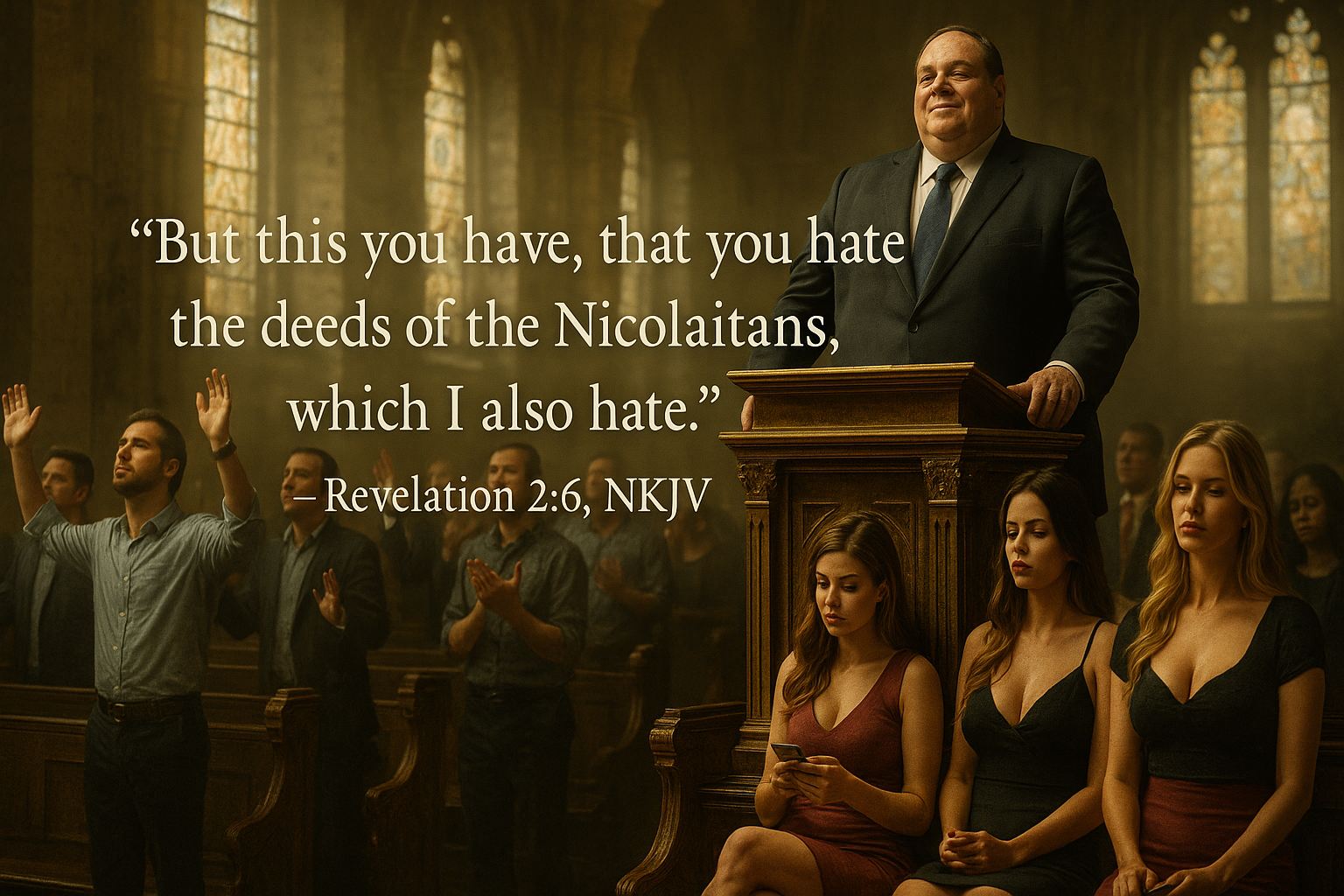
In the opening chapters of Revelation, the risen Christ speaks directly to His Church—piercing words, burning eyes, a two-edged sword proceeding from His mouth. Among the commendations and rebukes, there is one name that echoes with particular disdain: the Nicolaitans.

To the church in Ephesus, He says, “You hate the deeds of the Nicolaitans, which I also hate.” To Pergamos, a more grievous charge: “You have there those who hold the doctrine of the Nicolaitans, which thing I hate.”

Rarely does the Lord speak with such pointed hatred. What was it that provoked such divine revulsion?

Who Were the Nicolaitans?

The Nicolaitans were not outsiders attacking the faith. They were insiders—wolves in sheep’s clothing—sowing seeds of compromise. Rooted in a doctrine that perverted liberty and corrupted grace, they encouraged the early believers to indulge in idolatry and sexual immorality under the guise of Christian freedom. They blurred the line between the sacred and the profane. They whispered, “God is gracious,” while leading souls into darkness.

Many early church fathers—Irenaeus, Hippolytus, Epiphanius—linked them to Nicolas of Antioch, one of the first seven deacons. Whether or not this connection is historically solid, what is certain is the nature of their teaching: a doctrine that offered a crown without a cross, a kingdom without righteousness, and grace without repentance.

The Meaning of Their Name

The very name “Nicolaitan” is telling: Nikao—to conquer, and Laos—the people. The conquerors of the people.

This was a sinister inversion of Christ’s model of leadership, where the greatest is the servant of all. In their wake rose a clerical hierarchy, a division between clergy and laity—a spiritual caste system that stripped power from the Body and vested it in a ruling class.

The Nicolaitan spirit enthroned man-made authority in the place of the Spirit’s leading. It built platforms and pulpits where once there had been tables and towels.

A Doctrine of Compromise

But the sin of the Nicolaitans was not merely institutional—it was deeply immoral. They taught that one could follow Christ and still feast at pagan altars. They sanctified sensuality. They preached a gospel without holiness, a salvation without separation, a Christ without a cross.

In them was the spirit of Balaam, who taught Balak to seduce Israel through compromise. And like Balaam, they prophesied for profit.

Has the Doctrine Returned?

And now, we must ask with trembling hearts: Has the doctrine of the Nicolaitans returned to us in this present age? Or worse, has it never left?

Look around the modern Church. In the pursuit of relevance, we have forsaken reverence. In the name of love, we have lost truth. Preachers boast of grace, yet never speak of sin. Congregations are entertained but never convicted. Holiness is ridiculed. Repentance is optional.

Sexual immorality is tolerated—even celebrated—and leaders who should be shepherds build kingdoms in their own names. The altar has become a stage, and the sanctuary a marketplace. We have fashioned a Jesus who fits into our culture, but not a Christ who calls us out of it.

The Nicolaitan Spirit Today

The Nicolaitan spirit thrives where there is no fear of God. It preaches freedom, but enslaves. It promotes unity, but at the cost of truth. It claims to speak for Christ, yet it is the very doctrine He hates.

Yet not all have bowed the knee. Even in Pergamos, where Satan’s throne was, there were those who held fast to His name. And even now, Christ calls out to His people:

“Repent, or I will come to you quickly and will fight against them with the sword of My mouth.” (Revelation 2:16)

The Call to the Remnant

This is no small matter. The Lord of glory will not share His bride with Baal. He will not allow His house to be defiled with the teachings of those who flatter the flesh and poison the soul. The time has come for judgment to begin at the house of God. The line is being drawn.

Let every remnant heart arise and echo the cry of the saints in Ephesus:

“We hate the deeds of the Nicolaitans, which our Lord also hates.”

Let us cast down the altars of compromise, break the scepters of clerical control, and return to the simplicity and power of the faith once delivered to the saints. Let us be those who love truth more than comfort, holiness more than relevance, and Christ above all.

For the sword of His mouth still speaks. And the One who walks among the lampstands is watching.


Posted in Babylon, Christian, christian blog, christian living, Christianity, Church history, consequences of sin, Counterfeit Jesus, Daily devotional, Devotions, end times, End Times Eschatology, Eschatology - Study of the 'End Times', heresy, Jesus, revival, Spiritual warfare, the crucified life, the deeper life, the gospel, the persectuted church, The presence of God, the remnant, The State of the Chuch and Manifest presence, the state of the church, Uncategorized | Tagged: , , , , | 1 Comment »

The Fall of Christendom—And the Separation of the Remnant

Posted by appolus on August 22, 2025

More than a decade ago, I wrote The Fall of Christendom—And the Separation of the Remnant. Since its publication, I have been humbled by the many messages from readers who shared how it opened their eyes to the larger story, the sweeping overview of how Christendom arrived at its present state. That “big picture” view has always been the burden of my spirit.

Today, I return to those themes, not to rehash old arguments, but to press them further—deeper, into the marrow of our collective conscience. The question remains as urgent as ever, perhaps even more so in our time of great religious confusion:

How did we get here?


Apostolic Warnings

The New Testament contains not only proclamations of grace but also sobering warnings. Three texts stand out as particularly vital:

  • Hebrews warns against retreating into Judaism.

  • Galatians cautions against beginning in the Spirit but seeking perfection through the law.

  • Revelation presents Christ’s own admonitions to the churches, declaring that their lampstand would be removed if they refused to repent.

And here lies the burning question: What would it look like if they did not repent?

  • What if the Galatians persisted in finishing in the flesh what began in the Spirit?

  • What if the Hebrews clung to the forms and ceremonies of a passing covenant?

  • What if the churches ignored Christ’s rebuke and carried on with cold orthodoxy, lukewarm faith, or lifeless ritual?

History itself gives us the answer: Christianity, once ablaze with apostolic fire, slowly morphed into a religion of priests, altars, incense, and empire. A living faith became an institution. The Spirit was quenched. The lampstand removed.

And yet—even in the darkest chapters—God preserved a remnant. A people who chose Spirit over ceremony, truth over tradition, Christ Himself over the systems that claimed His name.


A Prophetic Call

This post is not merely history, nor is it theory. It is a call. A prophetic summons to look unflinchingly at where we are, to trace how we got here, and to reckon with what it means that the lampstand has already been removed from much of Christendom.

The only hope lies where it always has:

  • In returning to the Word of God and the Spirit of Truth.

  • In joining the remnant outside the gates.

  • In embracing Christ as the living Head of His people.


1. Hebrews: Warning Against Returning to Judaism

The Epistle to the Hebrews insists the old covenant is obsolete:

“Now what is becoming obsolete and growing old is ready to vanish away.” (Heb. 8:13 NKJV)

To return to temple and priesthood was to crucify Christ afresh (Heb. 6:6).

History confirms the warning was ignored. By the late 2nd century, the Eucharist was increasingly described as a sacrifice, bishops as priests. Cyprian of Carthage argued the bishop stood in the place of Christ in offering the Eucharist. Thus, shadows of Judaism crept back under Christian names.


2. Galatians: Warning Against Finishing in the Flesh

Paul’s rebuke was stark:

“Having begun in the Spirit, are you now being made perfect by the flesh?” (Gal. 3:3 NKJV)

By the 3rd century, salvation was widely understood as mediated through sacraments. Baptism, Eucharist, and penance became a system where grace was dispensed mechanically. The life of the Spirit was overshadowed by ritual performance.


3. Revelation: Warning to the Churches

Christ warned the churches: Ephesus had lost first love, Sardis had a name but was dead, Laodicea was lukewarm.

By the 4th century, Christianity outwardly triumphed with basilicas and liturgies, but inwardly the flame dimmed. Nominal Christianity flourished while true discipleship waned.


4. Historical Development: From Apostles to Constantine

a. Second and Third Centuries

  • The monarchical bishop system arose. Ignatius urged obedience to bishops as if to Christ.

  • The Montanists resisted, emphasizing the Spirit, prophecy, and holiness. Tertullian joined them. They were condemned as heretics, proof that institutional Christianity preferred order over Spirit.

b. Constantine and Imperial Christianity

The 4th century marked a dramatic shift. Constantine favored Christianity, making it the religion of empire. Bishops gained power, councils met under imperial patronage.

Christianity outwardly triumphed but inwardly conformed to worldly structures.


5. The Hollowing of Christianity

By the medieval period, the warnings were ignored:

  • Hebrews ignored: a priesthood and continual sacrifices (the Mass).

  • Galatians ignored: salvation by works and sacraments.

  • Revelation ignored: churches wealthy, powerful, yet spiritually impoverished.

The church became a form of godliness without power (2 Tim. 3:5).


6. Case Studies of the Remnant

  • Montanists (2nd–3rd c.) – Spirit, prophecy, holiness, condemned as heretics.

  • Waldensians (12th–13th c.) – Apostolic poverty, vernacular preaching, rejected clerical mediation. Persecuted.

  • Anabaptists (16th c.) – Radical discipleship, voluntary faith, often martyred by both Catholics and Protestants.


7. The Reformers: A Partial Recovery

The Reformers restored key truths—justification by faith, authority of Scripture, priesthood of believers.

But much of the medieval framework remained:

  • Luther retained infant baptism and the state church.

  • Calvin enforced conformity and sanctioned persecution.

The Reformation was real, but incomplete.


8. Theological Reflections

  1. Warnings are Perennial – Drift to ritual, reliance on flesh, loss of first love appear in every age.

  2. Apostasy as Substitution – Replacing Christ with religion, law, or cultural Christianity.

  3. The Remnant Principle – God preserves a faithful witness in every generation.


Conclusion: A Prophetic Word for Today

History demonstrates the accuracy of the apostolic warnings. Christendom became ritual without reality, tradition without truth, form without fire.

The prophetic word today is urgent:

  • The lampstand has already been extinguished in much of what calls itself church.

  • God’s people must leave man-made religion and come into the light of Christ.

  • They must go outside the camp, bearing His reproach but gaining His glory (Heb. 13:13).

The hope does not lie in the institutions of Christendom, but in Christ Himself, the same yesterday, today, and forever.

The choice is clear: remain in the darkness of religion where the lampstand has been removed, or come into His marvelous light where His Spirit gives life.

Posted in Babylon, christian blog, christian living, Christianity, Church history, Constantine, controlling churches, prophecy, remnant church, revival, testimony, the crucified life, the deeper life, the gospel, the persectuted church, The presence of God, the remnant, The State of the Chuch and Manifest presence, the state of the church, theology | Tagged: , , , , | 3 Comments »

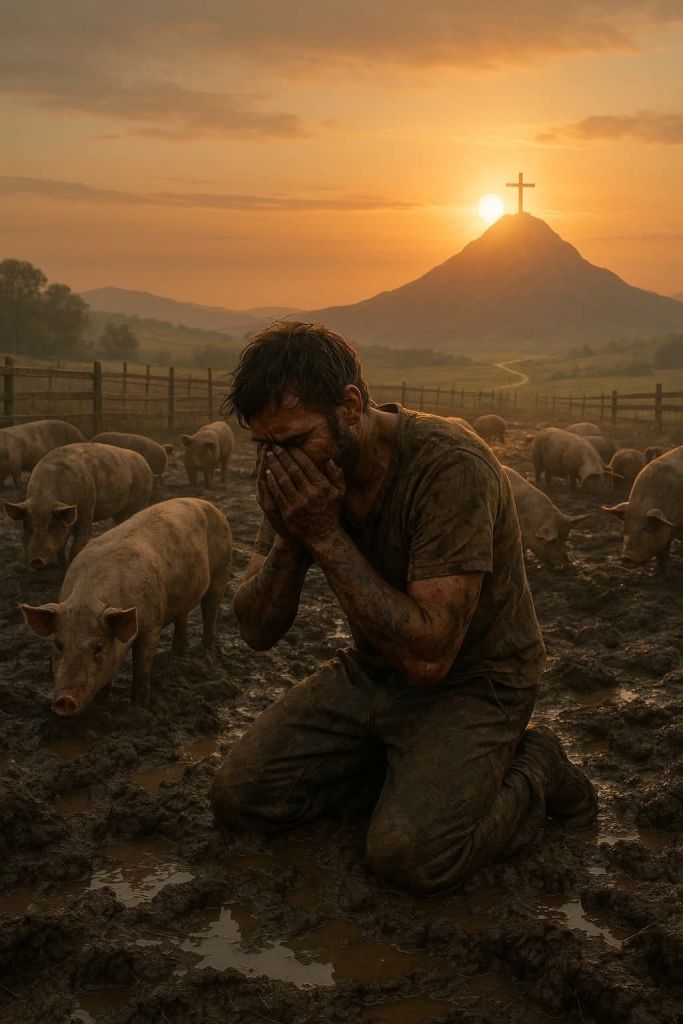
O CHURCH, RETURN FROM THE PIGSTY – A PROPHETIC LAMENT AND CALL

Posted by appolus on August 14, 2025

In the parable of the prodigal son (Luke 15:11–32), Jesus gives us a picture we dare not turn away from. A son goes to his father and demands what he believes is his right. The father, with sorrow in his eyes, grants it. The son leaves for a far country, intoxicated by the noise of sin and the wine of the world. For a time the music is loud and the cups are full, yet the sweetness turns bitter and the music fades into the groan of hunger. All is gone, and he is left with nothing. He takes work feeding swine, longing even for their food, and no one gives him anything (v.15–16). The father does not chase him into the darkness. He waits. He longs. But the son must first come to himself before he can come home (v.17).

In the stench of the pigsty the young man finally sees the truth. His condition pierces his heart like an arrow (Lamentations 3:40). His pride is broken and his hope rests only in mercy. He says, I am no longer worthy to be called your son, make me like one of your hired servants (Luke 15:19). He rises, not in strength but in weakness, not in triumph but in repentance (James 4:10). Step by step, through dust and shame, he walks the long road home (Micah 6:8). The father sees him while he is still far off, runs to him, embraces him, and restores him fully (Luke 15:20).

Church, do you not see? We are that son. We have taken the treasures of heaven, the sharp and living Word of God (Hebrews 4:12), the glory of His presence, the power of His Spirit (Acts 1:8), the holy calling to be a set apart people (1 Peter 2:9), and we have squandered them. We have gone into the far country, embraced its ways (Romans 12:2), and lived as it lives. We have traded holiness for popularity (Hebrews 12:14), truth for comfort (2 Timothy 4:3–4), and the fear of God for the applause of men (John 12:43).

Now the banquet is over and the gold has turned to dust in our hands. Our garments are stained and our lamps are dim (Matthew 25:8). This is the state of the modern church. We are in the pigsty (Isaiah 1:4–6), trying to call it blessing while the stench rises to heaven. And yet, even now, the voice of the Lord is heard, saying, Come to Me, all you who labor and are heavy laden, and I will give you rest (Matthew 11:28). Return to Me, and I will return to you (Malachi 3:7). Be zealous and repent (Revelation 3:19).

Leaders, shepherds of the flock (Jeremiah 23:1–2), you will give an account before God. Tear your hearts and not your garments (Joel 2:13). Weep between the porch and the altar (Joel 2:17). Let your tears be rivers upon your cheeks (Psalm 126:5). Let cries of repentance rise like incense before the throne (Psalm 141:2). The hour is late and the call is urgent.

We must come to ourselves. We must take the road of humiliation back to the Father’s house, for His thoughts are not our thoughts, nor are His ways our ways (Isaiah 55:8). If we will humble ourselves under His mighty hand (1 Peter 5:6), He will lift us up. He will heal our wounds (Hosea 6:1–2) and restore the joy of His salvation (Psalm 51:12). But if we refuse, the pigsty will be our dwelling still and the stench will only deepen.

The question is not whether the Father is willing to receive us. The question is whether we will rise from the filth, bow low before Him, and begin the journey home. The door stands open. The Father waits. The time to move is now.

Posted in christian blog, christian living, Christianity, Daily devotional, Devotions | Tagged: , , , , , , , , , , , , , | 4 Comments »

Psalm 100 and 103

Posted by appolus on August 14, 2025

This was the prayer that came to my spirit as I walked and prayed this morning.

If a celestial staircase opened before me Lord,
I would climb it, step by step, all the way to heaven.
If I could lay my burdens down,
I would lay them all down now, at Your feet oh Lord.

If the noise of this world could be silenced forever,
O what a glorious moment that would be.
For nothing surpasses the peace of Your presence,
The stillness, the holy rest of our God.

There is no clamoring when we draw near to You, Lord,
Only rest, and peace, and stillness.
You make me lie down in pastures green,
You lead me beside the still waters of life.

Amid the tumult and noise of this age,
Fix my mind on the eternal, unseen kingdom.
Open my eyes to behold Your way,
The kingdom that cannot be shaken.

Open the staircase of heaven before me, Lord,
That I might climb into Your presence,
Leaving the clamor and the noise behind,
And dwelling forever in Your light.

I turned this prayer into a song…….bro Frank

Posted in Christian, Daily devotional, Devotions, worship, Worship in Spirit and in Truth, worship music | Tagged: , , , , , , , , , | 4 Comments »

Sowing the Wind, Reaping the Whirlwind: A Reflection on Collective Consequences

Posted by appolus on August 4, 2025

History is filled with examples of national or collective consequence, when entire populations suffer the results of ideologies or movements they have supported. After World War II, the German people endured immense suffering. Over 600,000 children were killed. Cities were flattened. Women were raped by the invading Soviets. Hunger and displacement were widespread. While not every German was guilty of Nazism, Hitler and his regime had broad popular support. That support had consequences, natural, inevitable, and devastating.

This was not divine retribution, it was the harsh outcome of cause and effect. When a society builds its identity around hatred, violence, or conquest, it will eventually face the very storm it helped create. This same pattern is unfolding in Gaza. Hamas is not simply a fringe extremist group acting independently. Repeated polling over the years has shown that a strong majority of the Palestinian population, at times over 80 percent, has expressed support for Hamas and its methods. This includes the targeting of civilians and the use of human shields. The suffering that has followed, while tragic, is not inexplicable. It is the bitter fruit of seeds long sown.

That said, two wrongs do not make a right. But when someone has a 100 percent record of only criticizing one side, when outrage is selective and never balanced, that outrage loses moral authority. It becomes ideology rather than truth. And ideology, not principle, is the root of most of the world’s injustices. We must speak differently as followers of Jesus. Our voice must not echo the rage or loyalties of the world. When we become partisan, we compromise our witness. That is how crowds are stirred to cry out, “Give us Barabbas,” choosing political allegiance over righteousness.

The law of sowing and reaping is real and impartial. Everyone is accountable. But in any violent conflict, especially one where survival is at stake, the party that initiates the aggression bears the greater weight of responsibility. The suffering of civilians is always a tragedy, but it does not occur in a moral vacuum. When a people support a movement that glorifies destruction, they must also face the consequences that naturally follow. That does not mean every individual is guilty, but it does mean that actions have repercussions, and movements supported by the many will inevitably shape the fate of the whole.

Yet as Christians, our place is not to take sides in the quarrels of men. Our loyalty is not to any earthly cause but to the Kingdom of God. When Joshua encountered the angel of the Lord and asked, “Are You for us or for our adversaries?” the angel replied, “No, but as Commander of the army of the Lord I have now come” (Joshua 5:13–14, NKJV). This response reveals the true nature of heavenly alignment. It is not about whose side God is on, but whether we are on His.

We are not called to be partisan in the affairs of man. We are ambassadors from another Kingdom, the Kingdom of God. Our response is not to mirror the anger of the world but to weep over its hatred, to mourn the vengeance that devours the children of men, and to speak with clarity, compassion, and conviction from a place that transcends politics, borders, and ideologies.

Posted in end times, End Times Eschatology, Gaza | Tagged: , , , , , , | 3 Comments »

The Rise and Fall of a Movement: From Pentecost to Prosperity

Posted by appolus on August 3, 2025

At the turn of the 20th century, we witnessed the birth of two monumental Pentecostal movements. First, in 1904, came the Welsh Revival in Britain, and then, in 1906, the fires of revival swept through Azusa Street in Los Angeles. These were no ordinary stirrings, they were powerful outpourings of the Holy Spirit that would give rise to entire movements, such as the Elim Pentecostal Church in Britain and the Assemblies of God, which would spread globally and impact hundreds of millions.

From these humble beginnings, in every corner of the land, small Pentecostal churches began to emerge. Their message was simple: salvation through Jesus Christ, the power of the Holy Spirit, and the restoration of spiritual gifts. These fellowships sprang up in the shadow of massive denominational institutions, the Church of England, the Church of Scotland, and others, hige edifices steeped in their own traditions. Yet right beside them, in modest, unassuming buildings, were these Spirit-filled gatherings where lives were being radically transformed, adults were getting saved, and the gifts of the Spirit were active and alive.

This was a profound blow to the kingdom of darkness. The enemy, seeing the explosive growth of this movement, would not sit idly by. His question became clear: How can we bring this down? And so, beginning in the 1940s, we saw the emergence of new “theological,” trends, the Word of Faith movement, the Prosperity Gospel, and of course the Charismatic movement in the 60s, which would swallow up the others and become indistinguishable.

It was a cunning strategy: If you can’t beat them, buy them. The philosophy was simple, promise the very things that human beings everywhere fear to lose: health and wealth. Whether you’re in New York City or a remote village in the jungle, the universal concerns remain the same, our bodies and our bank accounts. The enemy offered a counterfeit gospel, one that shifted the focus from the cross of Christ to the desires of the flesh.

The Charismatic Movement became a Trojan horse. It infiltrated Pentecostal churches across the globe, not with persecution, but with promises. And it worked, brilliantly, tragically. The smoke from the fire of true revival has been replaced by the smoke machines of performance and entertainment. The altars were replaced by stages, the message by motivational speaking, and the Spirit by self-help and “self,” seeking

What followed was the tearing down of the very pillars upon which the early Pentecostal movement had stood. The purity of the Gospel was traded for a gospel of gain. Faith, once the precious link to Christ Himself, was twisted into a tool to manipulate blessings. Prosperity or tge lack of it, once counted as rubbish in comparison to knowing Christ, became the goal.Christ had become but a means to a materialistic end.

It was a disaster for the Church, and a stunning success for the enemy. The people rose up and played, just as they did before the golden calf in the wilderness. Think of “holy laughter,” and roaring like animals. And today, we stand in the shadow of that fall, in the ruins of what once was a mighty move of God.

These false ideologies, health and wealth, Name It and Claim It, the separation of faith from Christ Himself, have infected almost every corner of the modern Pentecostal and non-denominational world. Rare is the church untouched. Subtle or blatant, this taint remains, and it must be recognized for what it is.

Now, in this late hour, a remnant is rising, a people who are returning to the simplicity and the power of the cross, who walk not in the counsel of the world but in the fear of the Lord. Let us not be seduced by the glitter of gain or the lure of comfort. Let us remember the foundation laid in tears and prayer and holy fire. It is time to leave the circus behind, with all its many forms of entertainment, and “come out from among her.”

Posted in Babylon, bible, Charisma Magazine, Charismatic, Christian, christian blog, christian living, Christianity, Church history, church mafia, churches, consequences of sin, Counterfeit Jesus, Daily devotional, Devotions, end times, End Times Eschatology, False Prophets and Teachers, false teachers, Greedy Shepherds, Jesus, remnant church, revival, the crucified life, the deeper life, the gospel, the persectuted church, The presence of God, the remnant, The State of the Chuch and Manifest presence, the state of the church | Tagged: , , , , , , , , | 4 Comments »