Many years ago I was asked to write a piece for the ministry “Persecution Watch,” founded in part by my dear brother Blaine, now gone on into glory. I believe that every genuine saint will soon enough face bars and chains. This is to encourage the saints. Please share if you are led by the Spirit.
There is a holy pattern woven through every life the Lord redeems: our brokenness, or the lack of it, always reveals how much of our nature we have allowed Him to transform. Wherever the self remains unyielded, untouched, unbroken, pain gathers there like a storm waiting to burst forth. For the measure of our troubles is so often the measure of the self we have held on to. We hold onto much of the the old nature, and the pieces of our old self becomes the sharp edges that wound us. The keeping of self becomes the birthplace of our sorrow, and the refusal to be broken becomes the soil where so much of our pain takes root.
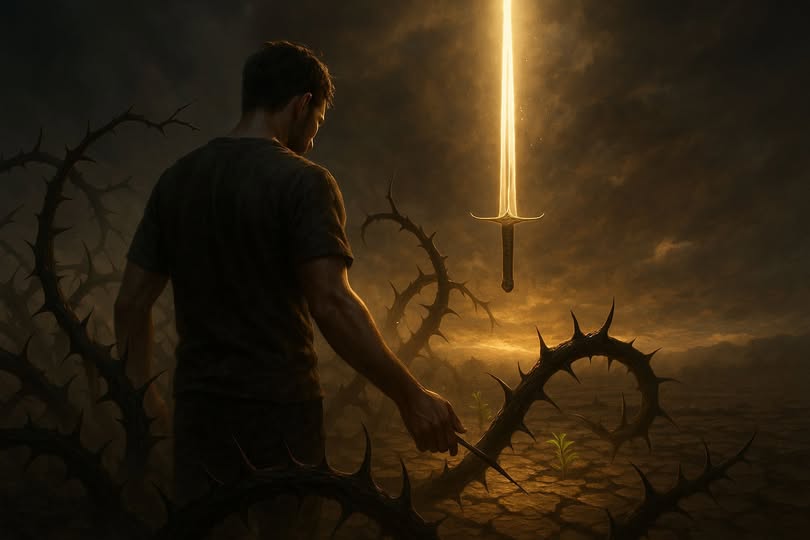
There is a mystery here, one the Spirit teaches slowly: wherever the self is protected, trouble multiplies. Wherever the flesh remains alive, unmortified, unchallenged, it rises with its old strength and lays claim to the inner life. And from that unyielded ground springs turmoil, not random, not surprising, but the predictable fruit of a nature not yet surrendered. Look closely at the landscape of any life, and you will see it: the unbroken places are the breeding ground of unrest and much pain.
But where the Spirit is welcomed, where the self bends low, where the inner man yields to the hand of God, there the breaking becomes a kindness. In the surrendered places, the Lord breathes His life. What once was hard ground cracks open beneath His touch, and from those very fractures new life emerges. For the Spirit does not revive what is meant to die; He resurrects only what has been laid down.
And so the breaking is not destruction, it is invitation. It is the mercy of God pulling us away from the life we keep trying to preserve. In every part of us surrendered, transformation takes root. And the soul learns, slowly and deeply, that what we lose in yielding becomes the very ground where His life begins to grow.
To breathe in the beauty of God’s creation, while walking with the Creator, is to inhale something of the rarified air of heaven. To listen to the quietness is to set our spirit at ease. Noise is the great distraction of this world, the noise of current events, the noise of the TV and the radio, the never-ending noise of the device in our hand, now intimately connected to our ears in a constant stream of stimulation. It dulls the soul and renders the spirit deaf to the still, small voice of the Master.
It is the great tragedy of our age. In such a place it becomes impossible to “seek ye first the Kingdom of God,” for the Kingdom of God is fundamentally still. Who, in our age, has ears to hear what the Spirit would whisper to our souls?
Tell me… can you hear the willows whisper on the wisp?
Can you hear the wings of the swallow as it sweeps through the soft-dying light of dusk?
Can you hear the river murmur as it winds its ancient path beneath the gathering dusk?
Can you hear the sigh of the pines as the evening wind passes through their crowns?
If you can hear these things, then perhaps you can hear the beating heart of God
and find His rhythm.
Many years ago, I walked with a very heavy burden of a particular situation, the constant noise of it filling every step. I did not even notice when the Lord was no longer in the midst of my thoughts, so completely had the season overtaken me. Then, breaking through that long silence of my spirit amidst the great noise of my flesh, came a still, small whisper: “I miss you.” Its simplicity undid me. Only then did I see how long the noise had carried me away. Through tears I answered, “I miss You too.” And in that sacred moment, after a season of distance, we were together again.



 A Call To The Remnant